 CUBE Chatshaala - Discussion Summary
The CUBE ChatShaala session was held on 1 November 2026. The shared participants list included Sailekshmi, Niharika Baghari, Manali Bhujade, Aarya Takke, Kiran, Khushbu Gupta (Chaitanya Science and Arts College, Pamgarh), Om Gupta (Saraswati Shishu Mandir High School, Rahod, Chhattisgarh), Kiran Varma, Chitralekha, Prithviraj, and Rechel Tirkey (Ranchi). Arunan MC moderated alongside the others. The session was titled “Phyllanthus story by Manali”, and the presenter role moved between Sailekshmi, Manali, Aarya and Khushbu as the evening went on.
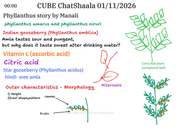
The discussion began with a sensory puzzle written on the whiteboard: Amla (Indian gooseberry, Phyllanthus emblica) tastes sour and pungent, yet water tastes sweet after eating it. Arunan opened the chat by asking whether anyone had actually tried drinking water after eating a gooseberry, which made it a question to test and not only to explain. For the chemistry of the sourness, the whiteboard listed vitamin C (ascorbic acid) and citric acid. Aarya added a reference showing that the fruit is rich in ascorbic acid and that its bitterness probably comes from a high density of ellagitannins such as emblicanin A and B, punigluconin and pedunculagin, along with other polyphenols such as gallic acid, ellagic acid and kaempferol. The sweet aftertaste was discussed but was not settled during the session.
The conversation then moved to the wider genus. Manali shared a PMC article on the medicinal properties of Phyllanthus amarus by Indian authors. Sailekshmi pointed out that both Phyllanthus amarus and Phyllanthus niruri are bitter, and that they share traditional names such as “stone breaker” and chanca piedra, so bitterness alone cannot separate them. Niharika and Aarya both posted the Metastudio thread “Phyllanthus niruri controversy in India”, which holds the central argument of the evening. According to the studies annotated there, true P. niruri is native to the Americas and does not occur in India. Much of the Indian work labelled as P. niruri has probably been done on a “niruri complex” of look-alike species, which includes P. amarus, P. fraternus and P. debilis. The thread lists leaf apex, the arrangement of male and female flowers, and the shape of the glands as characters that help tell P. amarus and P. niruri apart.
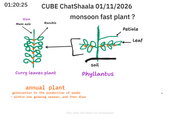
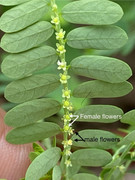
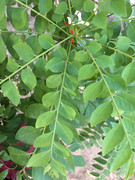
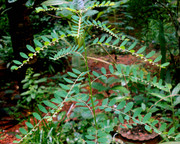
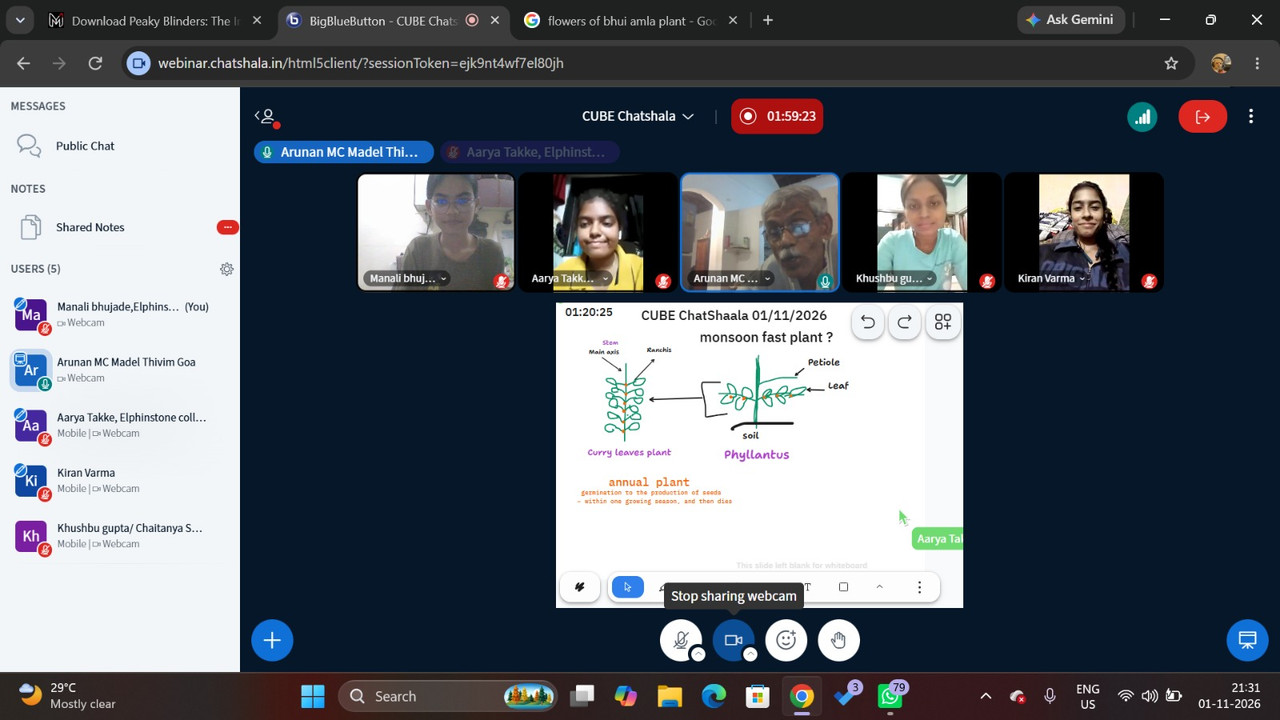
The second half of the session turned to morphology. The whiteboard listed height and leaf shape and pattern as the first things to record, with a sketch of a branch showing leaves and fruits, and a drawing of alternate leaf arrangement. A curry leaf plant was drawn as the example of a compound leaf. Later in the recording, at about 1 hour 20 minutes, the board carried the question “monsoon fast plant?” and a side-by-side comparison. On one side was a curry leaf, with the main axis (stem) and the rachis labelled. On the other was Phyllanthus, with soil, stem, petiole, and leaf labelled,d and small orange dots at the leaf axils. This pair of drawings made one point clear. A Phyllanthus branchlet looks like a pinnately compound leaf, but it is a branch bearing many small simple leaves, and its flowers and fruits sit in the axils of those leaves. In the curry leaf, the whole structure is a true compound leaf, and the buds or flowers arise at the base of the leaf stalk, not at each leaflet. The photographs shared during the session supported this: one showed male and female flowers on the same Phyllanthus branchlet, another marked the bud at the axil of a curry leaf, and a third showed the whole Phyllanthus plant growing in the garden. The board also defined an annual plant as one that goes from germination to seed production within a single growing season and then dies, which fits the rapid appearance of Phyllanthus in the rains.
Language and regional names also came up. Arunan shared the Hindi Wikipedia page for Bhumi Amla along with an image titled “Keezharnelli” (the Malayalam name), and Manali shared an image of curry leaf flowers. The whiteboard also recorded Star gooseberry (Phyllanthus acidus) as a relative of Amla.
 Provocative Questions
-
If water tastes sweet after Amla, is the sweetness in the fruit, in the water, or in the way the tongue and brain compare the two? How would we design a simple home experiment to separate these possibilities, using other sour or astringent foods as controls?
-
Amla gets its sourness from acids and its bitter, puckering quality from tannins. Which of the two do you think is more responsible for the sweet aftertaste, and what observation would prove you wrong?
-
If P. niruri does not grow in India, what exactly have thousands of Indian studies been testing? Does a wrong name make the medicinal findings useless, or only harder to trust?
-
Both P. amarus and P. niruri taste bitter. Can taste ever be used to identify a plant safely, and why is it risky to depend on it?
-
A Phyllanthus branchlet looks like a compound leaf. What simple rule can a beginner use to decide whether a structure is a leaf or a branch? (Hint: look at where the buds and flowers sit.)
-
Phyllanthus appears rapidly in the monsoon and finishes its life within one season. What advantages does this annual strategy give a plant, and what must it get right in order to survive until the next rains?
-
The same genus includes the tree-like Indian gooseberry, the star gooseberry and the tiny herb called Bhumi Amla. What do these have in common that justifies a single genus name?
-
Common names such as Keezharnelli, Bhumi Amla and “stone breaker” travel across languages. How can a community like CUBE record local names responsibly so that they help identification and do not add to the confusion?
 What I Have Learned
The most valuable lesson of the evening was that a question as small as “why does water taste sweet after Amla?” can open up chemistry, physiology,gy and taxonomy at once. I learned that Amla’s sourness can be tied to vitamin C and citric acid, while its bitterness and astringency are tied to a group of tannins and polyphenols. That told me a single fruit offers several tastes for different reasons.
I also learned how fragile a plant name can be. The Phyllanthus niruri discussion showed me that a species name in a research paper is a claim that someone must be able to check. If the plant studied was not properly identified, the medicinal conclusions rest on uncertain ground, however carefully the laboratory work was done.
On the botany side, the comparison of the curry leaf and Phyllanthus taught me to look at where buds and flowers arise before deciding what a structure is. A feathery arrangement that resembles a compound leaf can in fact be a whole branch. Finally, I was reminded that habit and life cycle matter. Calling Phyllanthus a fast monsoon annual explains why it appears in gardens almost overnight and disappears again.
 TINKE Moments (This I Never Knew Earlier)
TINKE moment 1: A branch can pass for a leaf. Before this session, I would have taken the Phyllanthus branchlet, with its neat row of small leaves, for one compound leaf like that of the curry plant. The side-by-side drawings made it clear that the Phyllanthus structure is a branchlet with simple leaves, with flowers and fruits at the leaf axils, while the curry leaf is a true compound leaf with a rachis. This is a useful test for identifying plants in the field.
TINKE moment 2: India may not have the plant it names. I had assumed that Phyllanthus niruri was a common Indian medicinal herb. The Metastudio thread explained that the true P. niruri is native to the Americas, and that the plant sold and studied in India under that name is mostly P. amarus or a related species. This changed how I read the phrase “scientifically proven” on herbal products.
TINKE moment 3: Sour and sweet can share a mouthful. I had thought a sour fruit tastes sour, and that is the end of the matter. The Amla question showed me that taste can change with time and with what follows it, and that the fruit’s acids and tannins may both play a role in the experience.
TINKE moment 4: One genus, many forms. Amla (a tree), the star gooseberry (a small tree), and Bhumi Amla (a small herb) all belong to Phyllanthus. The genus name connects them even though their sizes and habits look nothing alike.
 Gaps and Misconceptions
Gaps
The sweet aftertaste question was raised and discussed, but no explanation was reached. The session did not measure or test anything, such as comparing Amla with other acidic or astringent foods, so the answer is still open. A working explanation would need to be written as a hypothesis and tested at home.
The whiteboard listed height and leaf shape as characters to record, but the session did not go through the specific differences between P. amarus and P. niruri (leaf apex, flower arrangement, glands) on the board itself. These appear only in the Metastudio thread, and they should be checked against a proper flora before anyone relies on them, because the thread’s own wording on flower arrangement is unclear.
The role of tannins was only touched on. A question about whether tannin is a protein-related compound and how it causes astringency would be a good topic for a follow-up session. The PMC article shared by Manali could not be opened for this write-up because of a browser check, so its findings are not described here.
The label “hindi - sree amla” beside the star gooseberry on the board should be verified against a reliable source, since common names for Phyllanthus acidus vary between regions and languages.
Misconceptions
Misconception 1: “Bitter taste identifies the species.” Both P. amarus and P. niruri are bitter, so taste cannot tell them apart. Identification depends on morphological characters, and ideally on expert confirmation.
Misconception 2: “P. niruri is an Indian herb.” According to the studies annotated in the Metastudio thread, true P. niruri is American, and Indian material under that name is generally a complex of related species. Some members of the thread dispute how strongly this should be put, so it is best presented as an unresolved identification problem and not as a scandal.
Misconception 3: “A row of leaflets means a compound leaf.” In Phyllanthus, the row is a leafy branchlet. A reliable clue is whether the buds and flowers arise at the base of each small leaf, which indicates a branch, or only at the base of the whole structure, which indicates a leaf.
Misconception 4: “Sour fruits only taste sour.” Taste is affected by the order of tasting, by the compounds present,nt and by how the tongue responds afterwards, so the same fruit can seem different at different moments.
 Photographs during ChatShaala
 Reference


