# All about cell wall of bacteria and structure of peptidoglycan layer
**URL:** https://metastudio.org/t/all-about-cell-wall-of-bacteria-and-structure-of-peptidoglycan-layer/13971
**Category:** CUBE chat
**Tags:** project, english
**Created:** [October 9, 2022, 7:12pm UTC](https://metastudio.org/t/all-about-cell-wall-of-bacteria-and-structure-of-peptidoglycan-layer/13971 "2022-10-09T19:12:10Z")
**Posts on this page:** 2
**Page:** 1
### Author:  [@Smiti](https://metastudio.org/u/Smiti)
#### Post date: [October 9, 2022, 7:12pm UTC](https://metastudio.org/t/all-about-cell-wall-of-bacteria-and-structure-of-peptidoglycan-layer/13971/1 "2022-10-09T19:12:11Z")

Today we discussed about **Shalini’s project** that she performed with **gram positive bacteria by using SDS gel technique**
Here we discussed about
• What is **cell wall** of bacteria made up of?
- It’s **peptidoglycan layer,** this layer will be **think in gram positive** bacteria and _thin in gram negative_\* bacteria
• In gram positive bacteria there are **many layers of peptidoglycan** so what is peptidoglycan **made up of?**
- Peptidoglycan is made from _long chain of 2 sugars i.e., NAG (N-Acetyl glucosamine) & NAM (N-acetylmuramic acid)_
• How are NAG and NAM **bonded together?**
- They are bonded by **glycosidic bond** as they are sugars to be more specific.. **Beta 1,4- glycosidic bond**
• What is _alpha and beta bond?_

• What is **alpha and beta bond?**
- For this we look at **OH group on 1st carbon** atom of any sugar so **if OH is below the plane then we call it alpha molecule** and if OH is **above** then we call it as **beta molecule**

• Why we **call them peptidoglycan?**
- Here NAG & NAM are \*sugars bonded with glycosidic bond so **glycan** is used but 2 NAM of **2 different chains are bonded together by pentapeptides** so use **peptido** here, together it becomes **peptidoglycan**
• Also, what would happen in we **break cell wall & how do we break it?**
- For breaking cell wall 1st, we will break the _link between m-DAP & D-Ala,_ we can break this bond by using an **endopeptidase**
So, this was about cell wall _inside cell wall we have cell membrane_ made up of **phospholipid bilayer and some protein** so at the end Shalini was trying to say something about this but her voice wasn’t clear
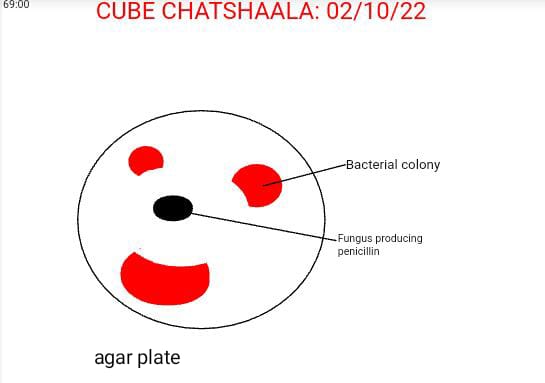
• How does **penicillin breaks cell wall** of bacteria?..
So, if we are culturing any bacteria on _agar plate_ and by any chance _spore of fungus_ enters the agar plate and grows into _fungus that produces penicillin_ then what would happen?
- Penicillin _ **might act like an endopeptidase** _ here and will break the bond between m-DAP & D-Ala
• How will penicillin **break cell wall of bacteria and kill them?**
- By breaking that bond, it will _loosen the cell wall_ and _eventually break it…_ I’m _not sure_ about if penicillin is an endopeptidase and how it breaks the bond here, _can we look for some reference here_ @Misbah @Theertha @Abhi0703 @dhanraj.tribhuvan @2020ugchsncnseethala @sakshiconsultant2002 @SachinPradhan @magpie @Himanshu @KiranKalakotiR and others
---
### Author:  [@jaikishan](https://metastudio.org/u/jaikishan)
#### Post date: [October 13, 2022, 4:23pm UTC](https://metastudio.org/t/all-about-cell-wall-of-bacteria-and-structure-of-peptidoglycan-layer/13971/2 "2022-10-13T16:23:58Z")
Fantastic so much content being discussed in a Hands-on context.