 CUBE Chatshaala - Discussion Summary
The CUBE Chatshaala session of 23 October 2026 brought together twelve participants from different centres, including Sailekshmi, Manali Bhujade, Niharika Baghari, Aarya Takke, Kiran Kalakoti, Khushbu Gupta, Arunan MC (Madel Thivim, Goa), Susanta Tanti, Prithviraj, Himanshu Joshi, Rechel Tirkey (Ranchi), and Rahul. The session ran for a little over two hours. The whiteboard was titled “Reflex action concept - everyday activity part”, with two side notes: “learning and memory” and “behavioral adaptation”.
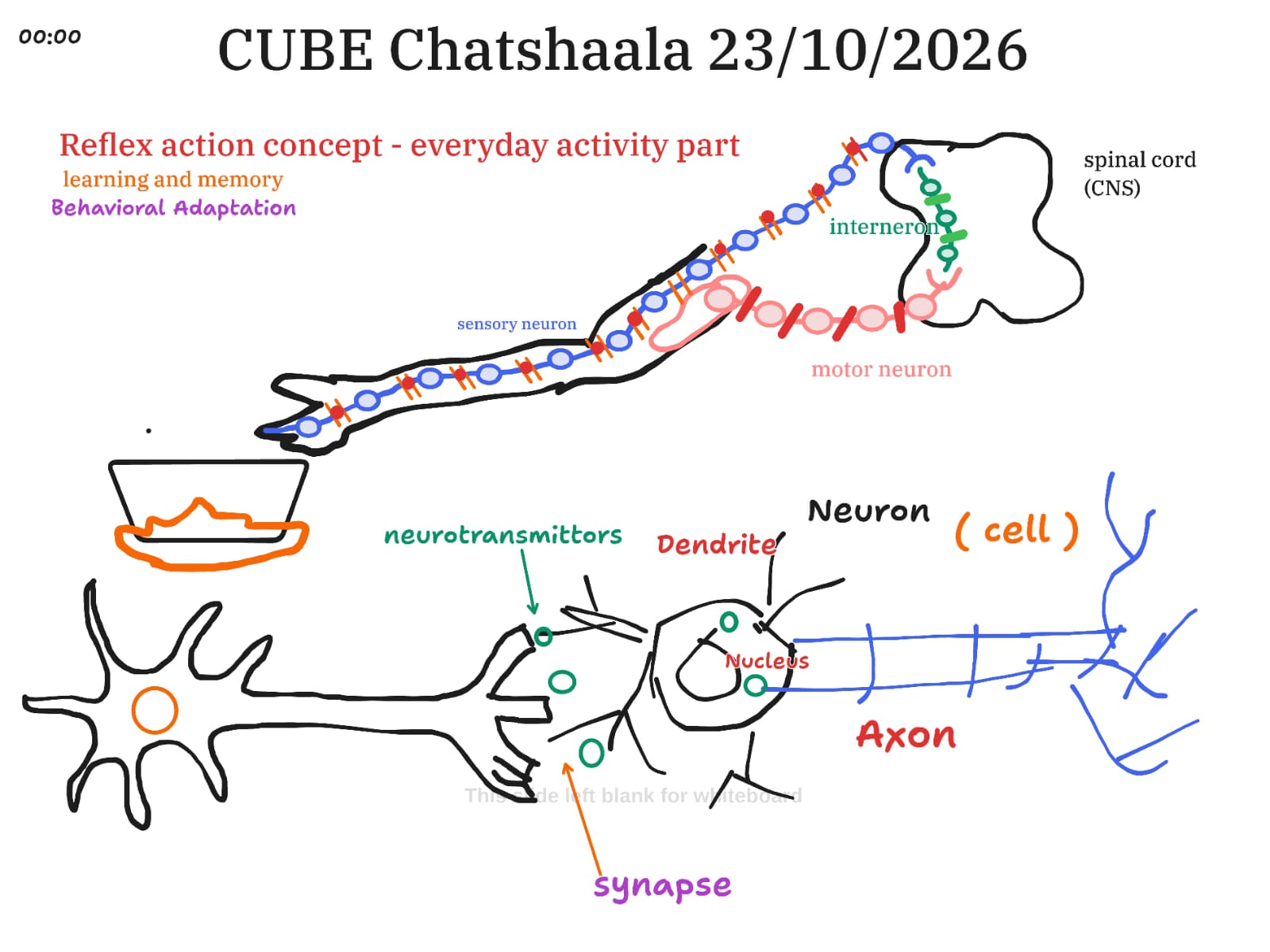
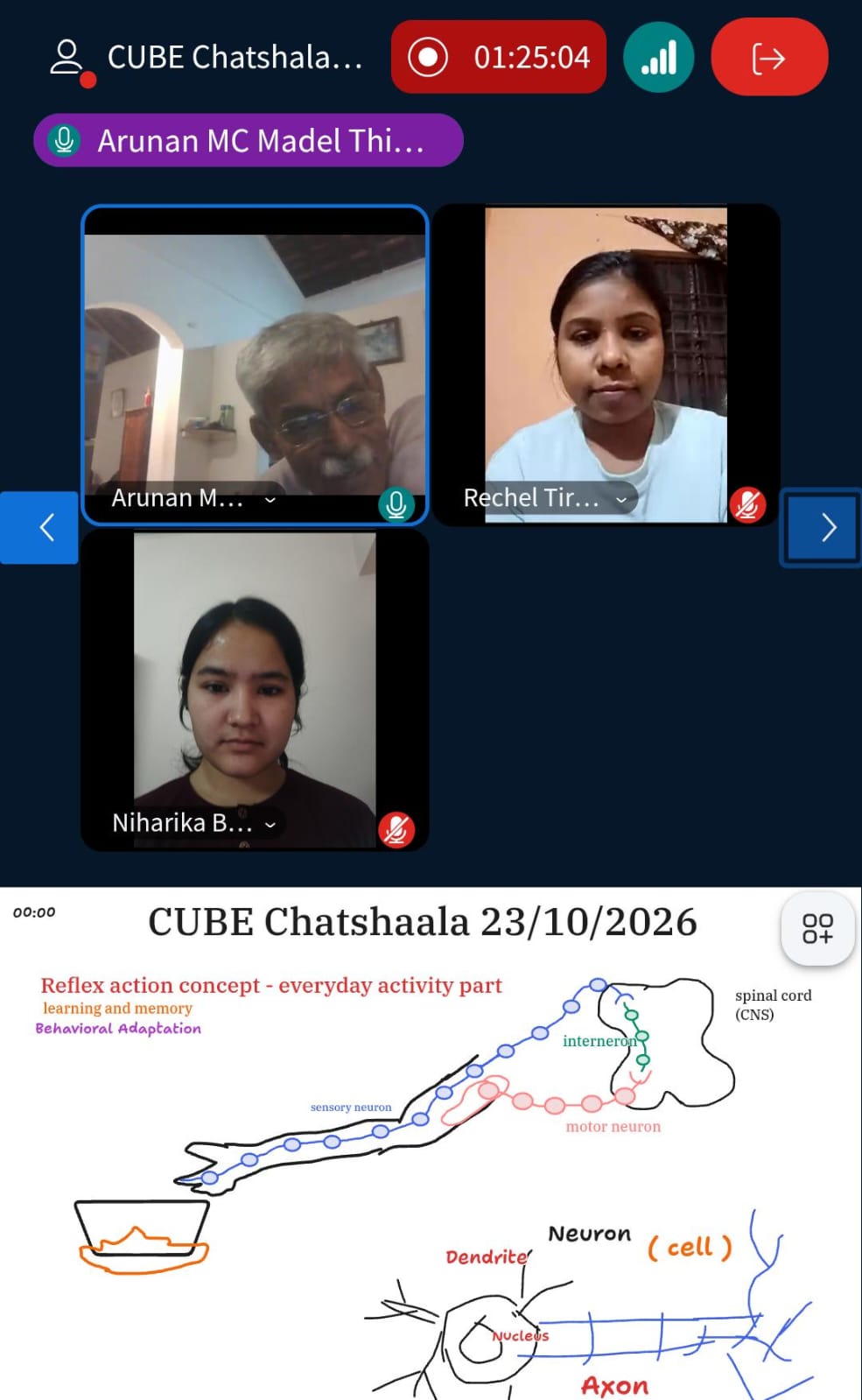
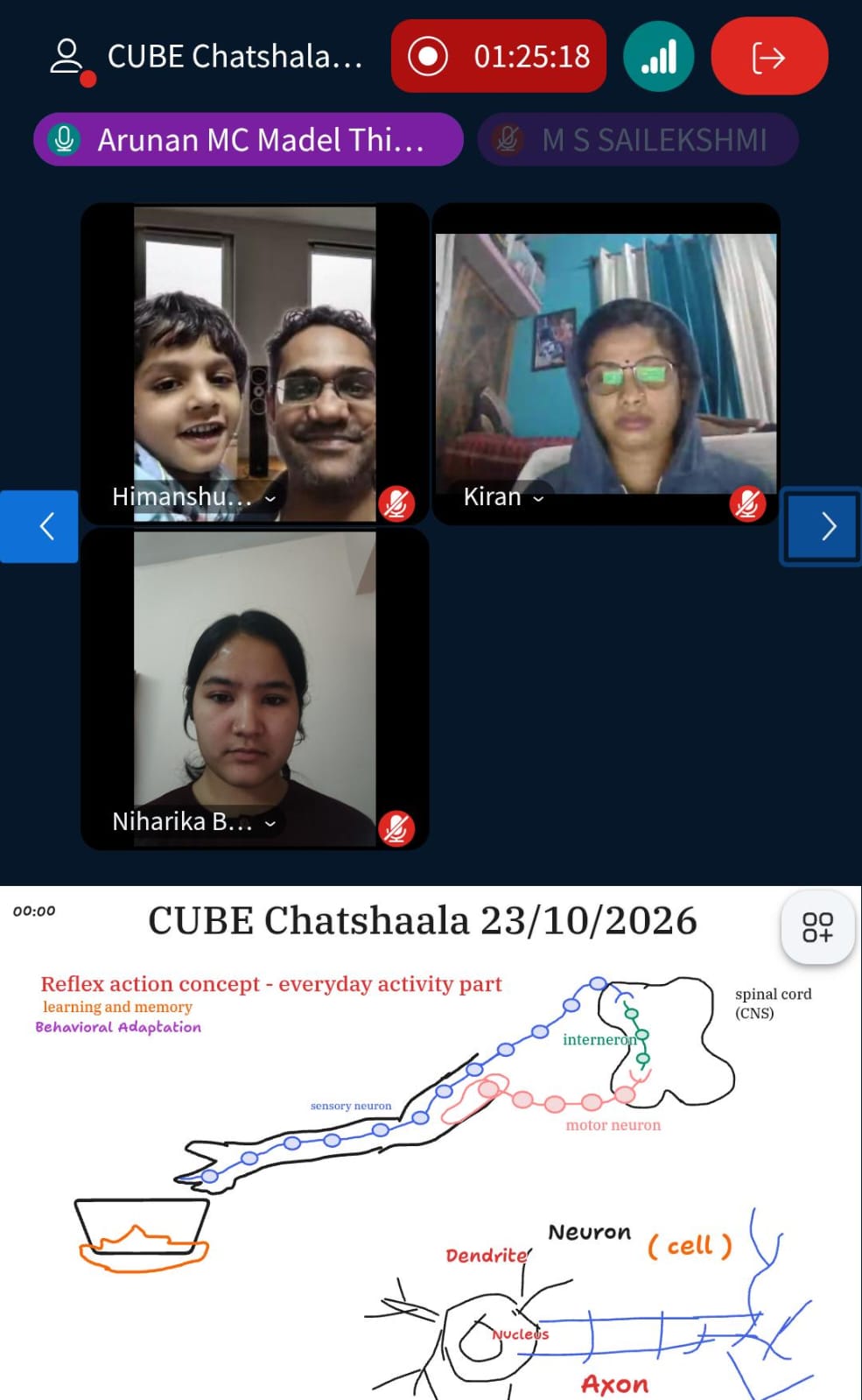
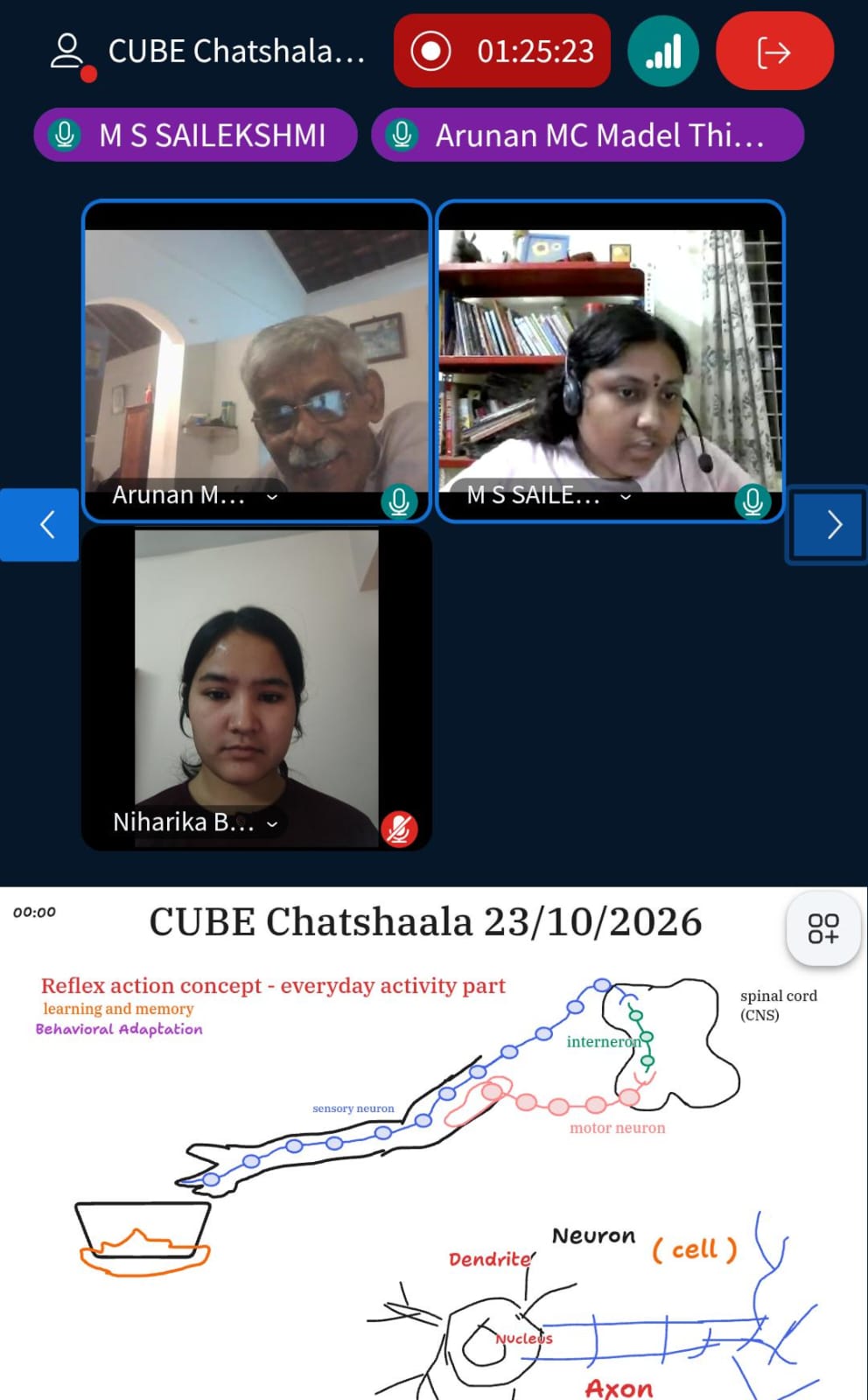
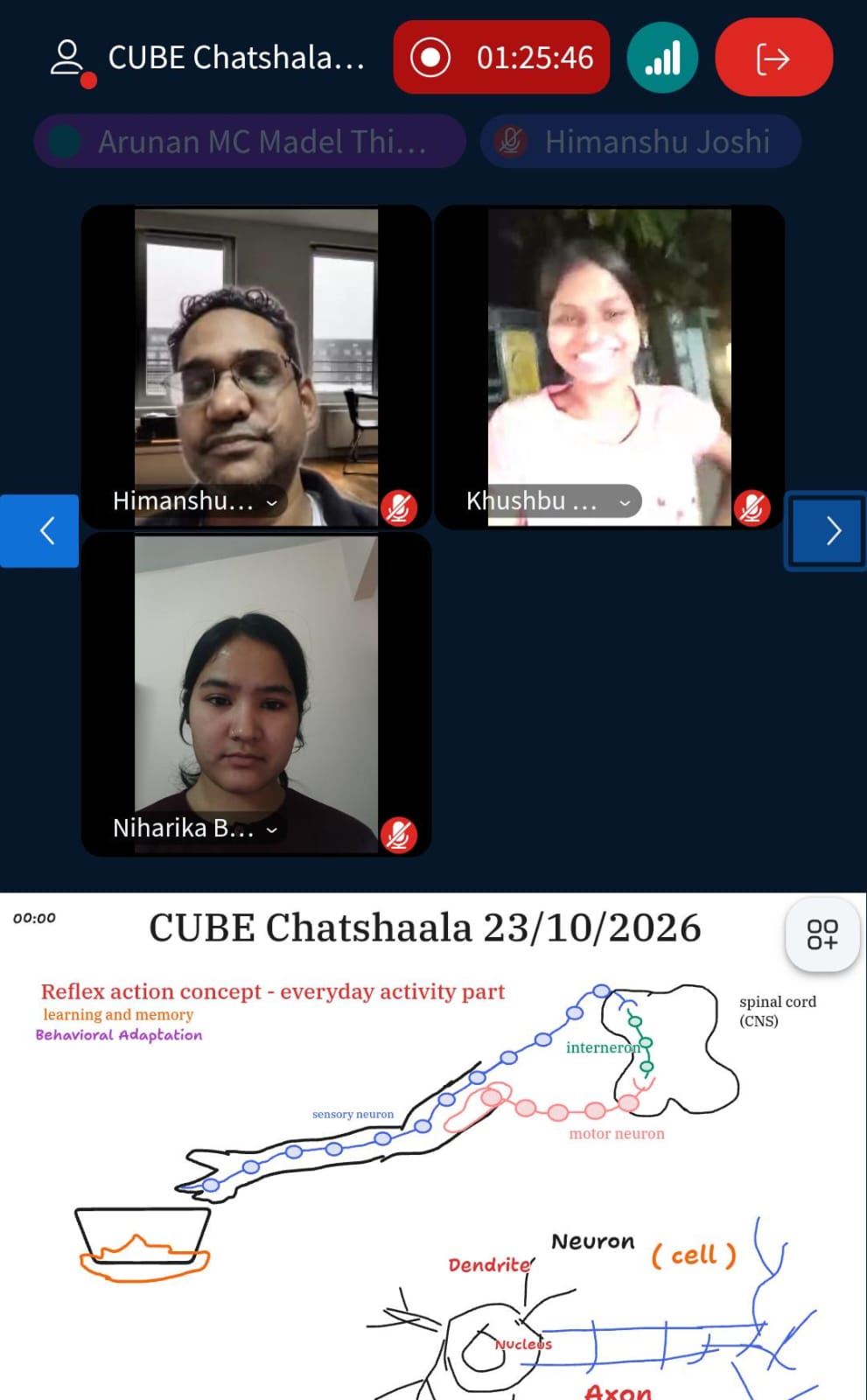
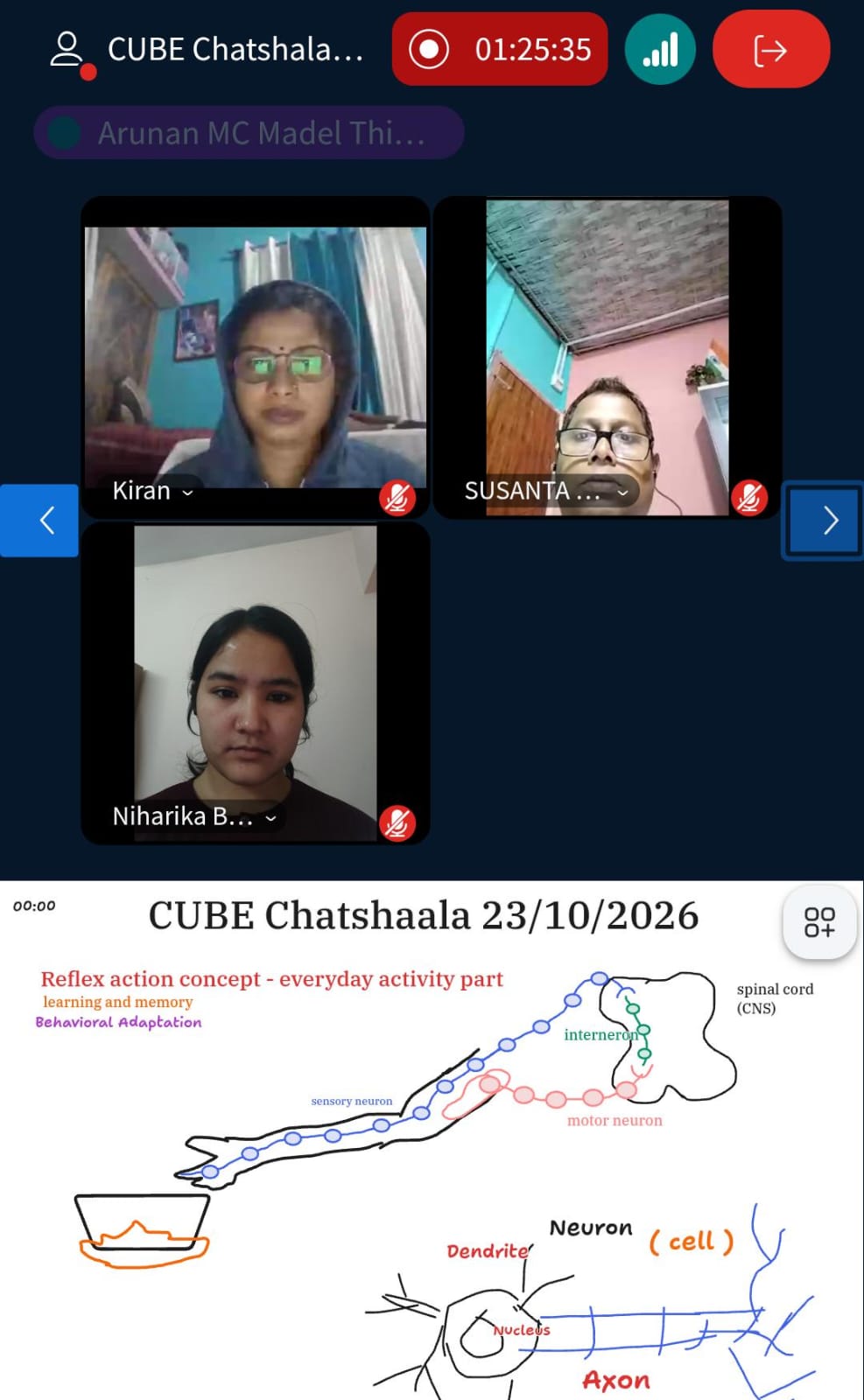
The discussion began with the idea that a reflex is something we use every day without thinking about it. The whiteboard showed a hand touching a hot bowl, with the pathway of the response drawn from the fingertips to the spinal cord and back to the muscle. The sensory neuron (blue) carried the signal from the skin towards the spinal cord, which was labelled as part of the central nervous system. Inside the cord, an interneuron (green) passed the message on. The motor neuron (pink) then carried the instruction back to the muscle of the arm, so the hand could be pulled away before the brain was consciously involved.
Below the reflex arc, a large labelled sketch of a single neuron, described as a cell, supported the explanation. It marked the dendrites, the nucleus, the axon, the synapse, and the neurotransmitters. The synapse was drawn as the small gap where chemical messengers cross from one neuron to the next.
Niharika opened the reference material by sharing links on Eric R. Kandel, the Nobel laureate whose work on learning and memory connects directly to the side notes on the board. Manali added her Wikipedia page. Arunan appreciated that the session was linking the school curriculum with the wider context of learning. Sailekshmi then clarified a basic point of vocabulary: a neuron is a single microscopic cell, while a nerve is a visible, cable-like bundle containing the axons of many neurons.
The most active part of the discussion came through questions in the chat. Aarya asked whether the reflex arc has only one interneuron, since multiple interneurons had not been discussed earlier. She also asked whether the circles on the sensory and motor pathways were cell bodies or a way of showing the signal travelling. Sailekshmi confirmed that the circles represent cell bodies, in line with Niharika’s neuron diagram. Rechel then asked what the “signal” really is and whether some chemical travels from neuron to neuron. Sailekshmi explained that the signal is electrochemical. Inside a neuron, it moves as an electrical wave called an action potential, caused by ions crossing the cell membrane. At the synapse, it cannot jump the gap, so the electrical signal triggers the release of neurotransmitters. These cross the cleft, bind to receptors on the next neuron, and start a fresh electrical impulse there.
Towards the end, Niharika shared a Queensland Brain Institute resource on types of neurons. It described sensory neurons as the cells activated by physical or chemical input from the environment, such as touch, heat, sound, light, taste, and smell. It also noted that most sensory neurons are pseudounipolar, meaning a single axon splits into two branches. This tied the abstract diagram back to the everyday example of touching something hot.
 Provocative Questions
-
A reflex lets the hand move away before we consciously feel the heat. If the brain is not in charge in that moment, when and how does it find out what happened?
-
The board linked reflexes with learning and memory and with behavioral adaptation. Can a reflex change with experience, or is it fixed for life?
-
The reflex arc on the board used one interneuron, while the chat raised the possibility of many. What would be lost or gained if there were none, as in the knee-jerk reflex, or dozens?
-
The signal is electrical inside the neuron and chemical at the synapse. Why would nature choose a hybrid system instead of one continuous electrical wire?
-
If neurotransmitters take time to cross the synaptic gap, why is the whole reflex still so fast? What features of the neuron might be speeding it up?
-
A neuron is a cell and a nerve is a bundle. When someone says “I have a pinched nerve”, which one is actually affected, and what does the person feel?
-
Sensory neurons respond to heat, touch, sound, light, taste, and smell. Do all of them use the same kind of signal once the message is on its way, and if so, how does the brain tell them apart?
-
Why would Eric Kandel, a Nobel laureate in neuroscience, be central to a discussion that began with a simple hand-and-hot-bowl drawing?
 What I Have Learned
The first thing I took from this session is that a reflex is a complete, repeatable circuit with a sensory neuron, an interneuron,n and a motor neuron, and the whole loop can finish without the brain deciding anything. That is why it protects us so effectively in everyday situations.
Second, I now see the difference between a neuron and a nerve much more clearly. A neuron is one cell, while a nerve is a bundle of many axons, much like a cable made of many wires. I had used the two words loosely before.
Third, the signal is not one thing. It is electrical along the axon and chemical across the synapse, and the neurotransmitters are what carry the message over the gap. Rechel’s simple question about the nature of the signal helped me understand this far better than a textbook line would have.
Fourth, a diagram deserves careful reading. Aarya’s question about what the circles meant showed me that a drawing can be interpreted in more than one way. A label or a short note makes a big difference.
Finally, I learned that everyday experiences, learning and memory, and behavioral adaptation are all connected to the same cells and synapses. Starting from a hot bowl and ending at Kandel’s work showed how a small example can lead to very large ideas.
# TINKE Moments (This I Never Knew Earlier)
-
Neuron versus nerve. For many of us, the two terms were interchangeable. It became explicit that a neuron is a single microscopic cell, whereas a nerve is a macroscopic bundle of axons from many neurons. This is a good example of a familiar word hiding a precise meaning.
-
The signal is electrochemical. Rechel’s question exposed an assumption that the signal is either purely electrical or purely chemical, travelling from cell to cell. The clarification was that the action potential travels inside the cell, and neurotransmitters carry the message between cells. This turned a vague idea into a clear two-step picture.
-
Reading the circles on the diagram. Aarya’s question led to a useful realisation that a drawing needs to state what its symbols represent. Once the circles were confirmed as cell bodies, the pathway made more sense, and it also raised a deeper question about how many neurons are really involved.
-
Interneurons in the plural. The doubt about whether there is only one interneuron revealed that a simplified classroom diagram may hide complexity. A single labelled interneuron is a teaching convenience, and real circuits can be more elaborate.
-
Shape of sensory neurons. The point that most sensory neurons are pseudounipolar, with one axon that splits into two branches, was new to many of us. It shows that neurons do not all look like the textbook picture with many dendrites and one axon.
 Gaps and Misconceptions
Gap: the number of interneurons. The board showed one interneuron, and the chat raised the question of whether there could be more. This was not fully settled during the session. It would help to discuss the difference between a simple reflex pathway and the more complex circuits found in the spinal cord, and to note that some reflexes do not need an interneuron at all.
Gap: what the circles on the sensory and motor pathways mean. They were confirmed as cell bodies, but a single neuron has only one cell body. A row of circles along one path therefore suggests several neurons in a chain, or a schematic that is not literal. The distinction between one long neuron and many connected neurons deserves a clear explanation next time.
Gap: the role of the brain in a reflex. The session focused on the spinal cord and the reflex arc, but did not discuss when the brain becomes aware of what has happened. This would complete the picture of why we feel pain a moment after we have already moved our hand.
Gap: the link to learning and memory. The notes on learning, memory, and behavioral adaptation, along with the Kandel references, were introduced but not developed in depth. A short follow-up on how repeated experience can change synapses would connect these ideas to the reflex.
Misconception: the signal as a single chemical travelling along the neuron. As Rechel’s question suggested, it is easy to imagine a substance moving physically from one neuron to the next. In reality, the electrical impulse travels within a neuron, and the chemical step happens only at the synapse.
Misconception: the neuron and the nerve as the same structure. They are related but different. One is a cell, the other a bundle of many cells’ axons.
Misconception: the diagram as a literal picture. The board was a simplified model. Real neurons are microscopic, far more numerous, and arranged in much more intricate circuits than a hand-drawn sketch can show.
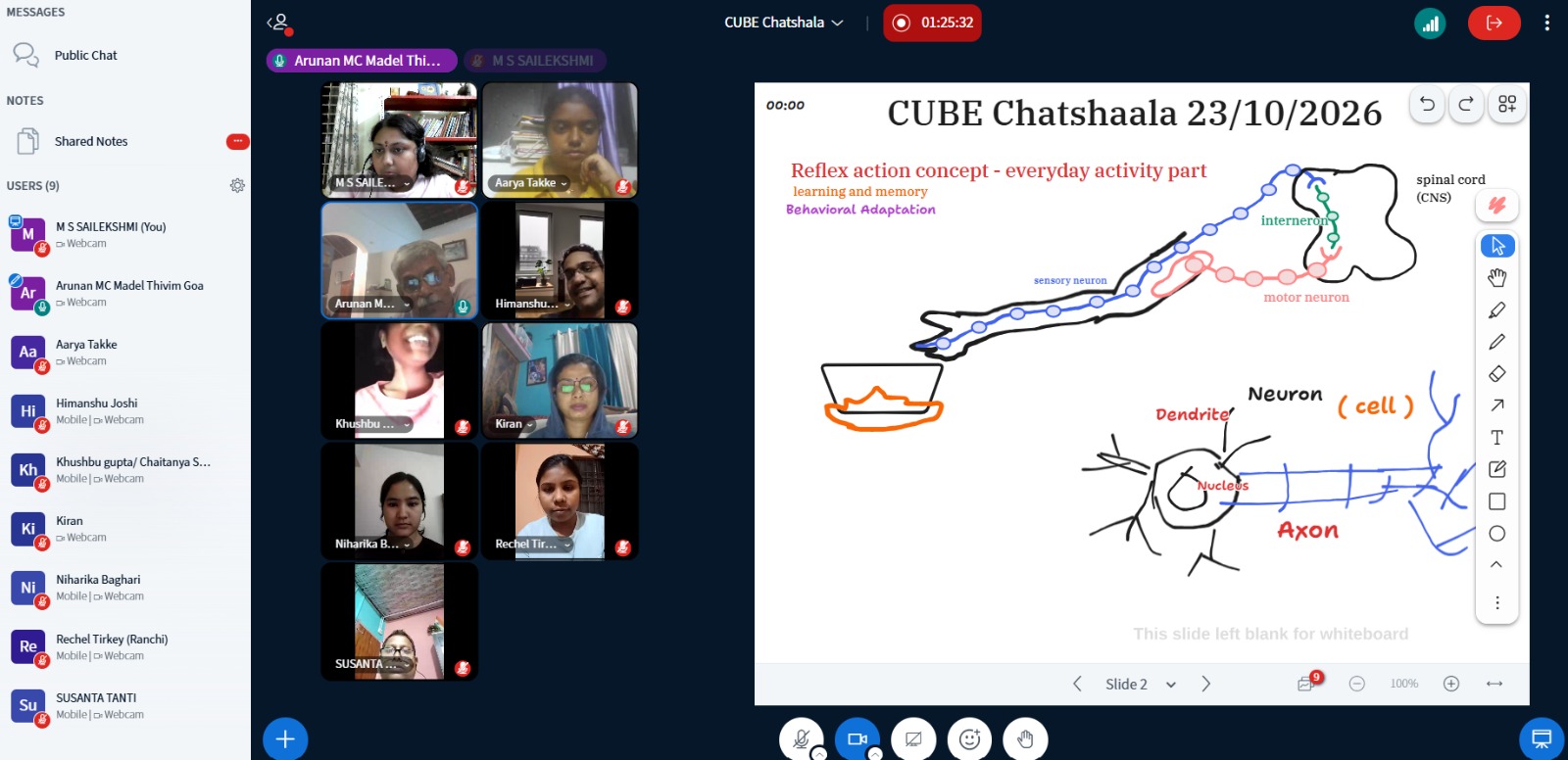
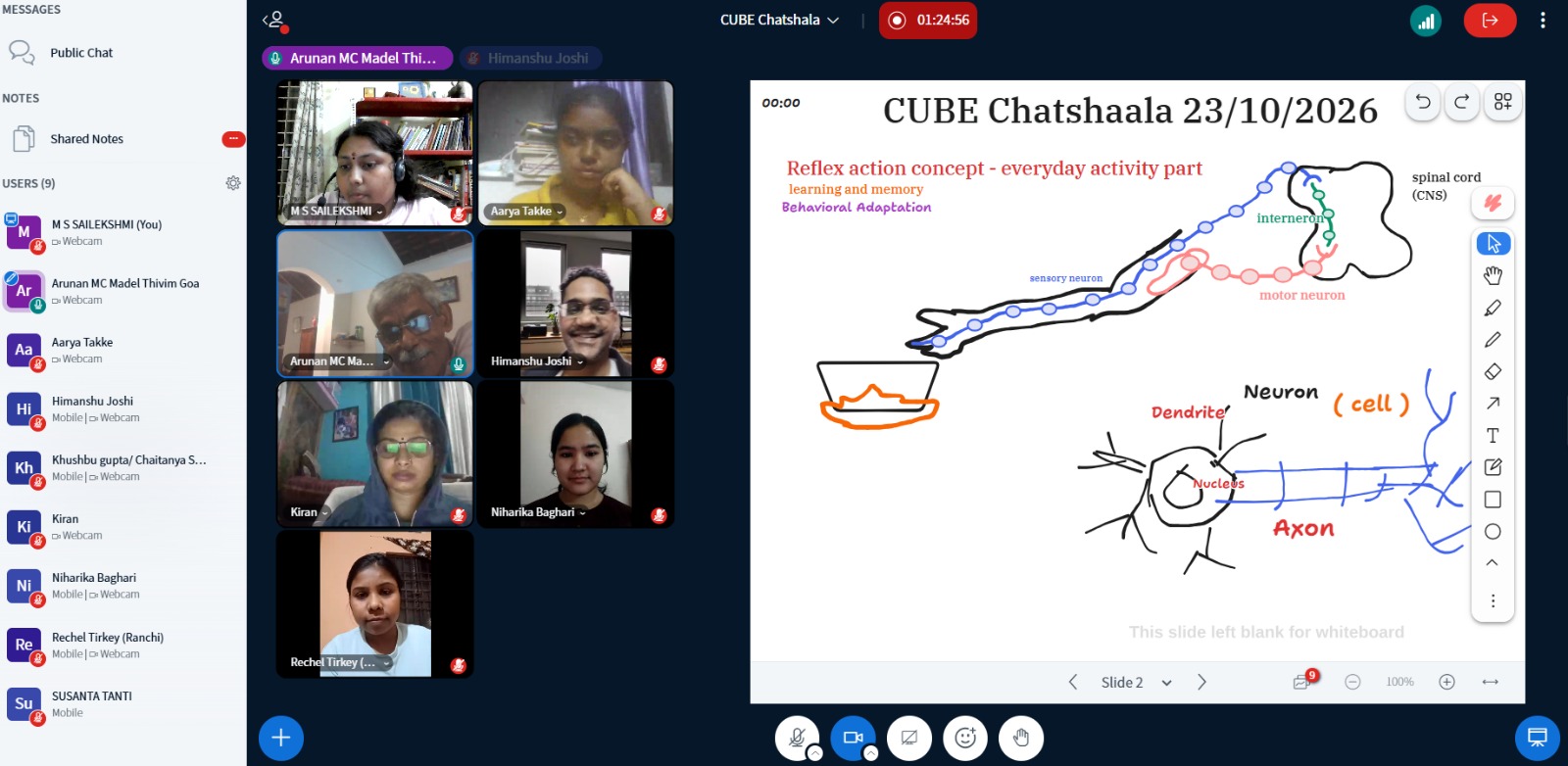
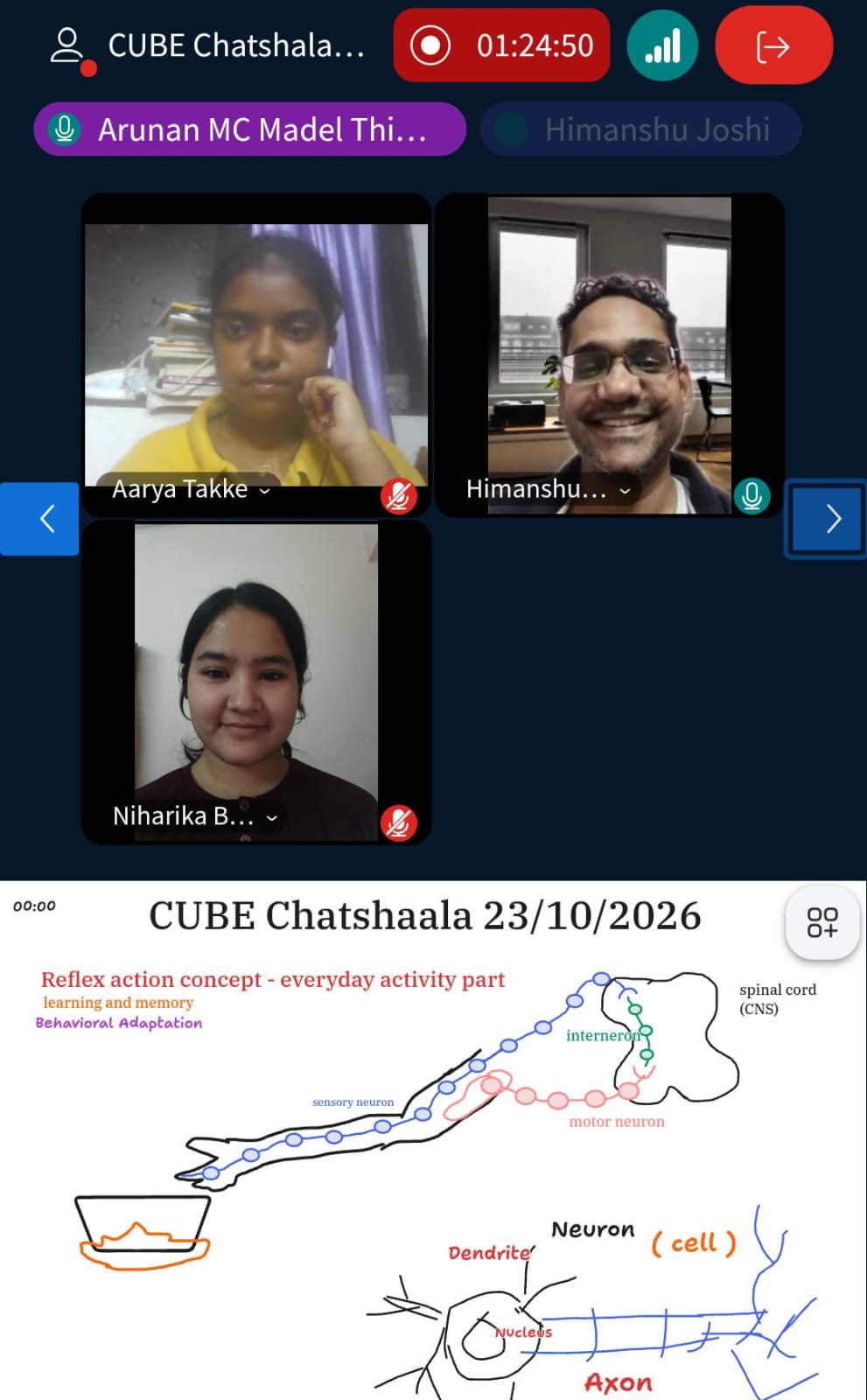
 Photographs during Chatshaala
 Referance