# Cardamine: the table top farm
**URL:** https://metastudio.org/t/cardamine-the-table-top-farm/1867
**Category:** CUBE chat
**Created:** [August 22, 2019, 6:48pm UTC](https://metastudio.org/t/cardamine-the-table-top-farm/1867 "2019-08-22T18:48:30Z")
**Posts on this page:** 20
**Page:** 1
### Author:  [@Priti\_Kanade](https://metastudio.org/u/Priti_Kanade)
#### Post date: [August 22, 2019, 6:48pm UTC](https://metastudio.org/t/cardamine-the-table-top-farm/1867/1 "2019-08-22T18:48:30Z")
Continuing the discussion from [Observing nature, addressing interesting questions](https://stemgames.metastudio.org/t/observing-nature-addressing-interesting-questions/1791/12):
---
### Author:  [@jaikishan](https://metastudio.org/u/jaikishan)
#### Post date: [August 22, 2019, 7:46pm UTC](https://metastudio.org/t/cardamine-the-table-top-farm/1867/2 "2019-08-22T19:46:23Z")
What does this picture highlight? Difrerent life stages of cardamine? How much time does this process take?
How easy or difficult it is to take such amazing pictures?
What kind of studies can be done with these flowering cardamine?
---
### Author:  [@bivasnag](https://metastudio.org/u/bivasnag)
#### Post date: [August 23, 2019, 2:16am UTC](https://metastudio.org/t/cardamine-the-table-top-farm/1867/3 "2019-08-23T02:16:12Z")
Here is the video of what we presented in HBCSE
[https://drive.google.com/file/d/1akHHc4er8rBqFDBBSGGvvxZ6mcsi204P/view?usp=drivesdk](https://drive.google.com/file/d/1akHHc4er8rBqFDBBSGGvvxZ6mcsi204P/view?usp=drivesdk)
@Priti_Kanade please hell us from basic like what should be our long term objective and also how we differentiate between various species of cardamine as well
---
### Author:  [@Priti\_Kanade](https://metastudio.org/u/Priti_Kanade)
#### Post date: [August 23, 2019, 3:59am UTC](https://metastudio.org/t/cardamine-the-table-top-farm/1867/4 "2019-08-23T03:59:47Z")
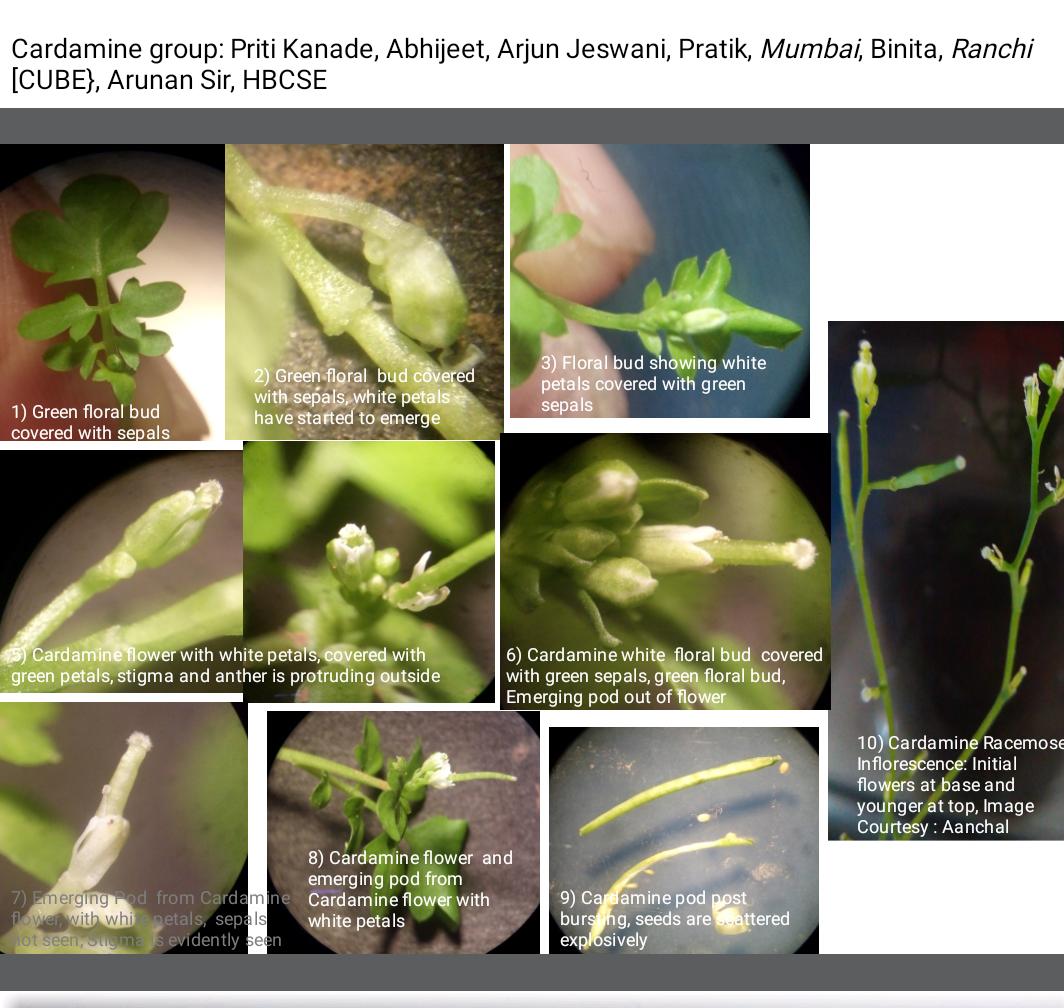
🔹Cardamine is close relative of plant model _Arabidopsis thaliana_
🔹They both differ in few characteristics
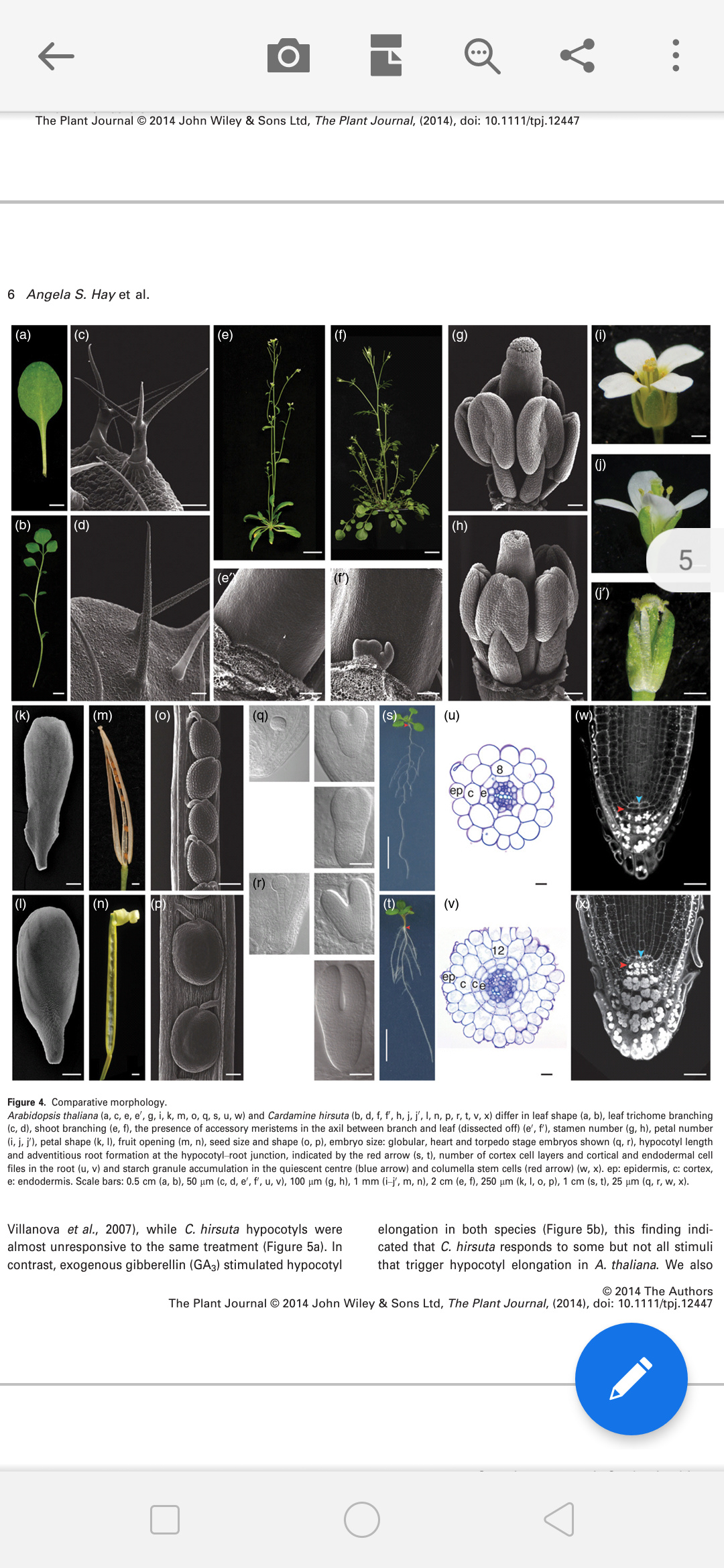
🔹Arabidopsis has simple leaves, whereas Cardamine has compound ones
🔹Floral dip method enables us to make transgenic Cardamine having simple leaves
🔹To perform this, we need a better understanding about lifecycle of Cardamine
This image gives an idea about progression of green floral bud to seed pod 😇
---
### Author:  [@dialecticalbiologist](https://metastudio.org/u/dialecticalbiologist)
#### Post date: [August 23, 2019, 12:52pm UTC](https://metastudio.org/t/cardamine-the-table-top-farm/1867/5 "2019-08-23T12:52:47Z")
> [@Priti\_Kanade](#):
>
> Floral dip method enables us to make transgenic Cardamine having simple leaves
Only this (“…enables us to make transgenic Cardamine having simple leaves”) can be done through floral dip?😟@Priti_Kanade
---
### Author:  [@dialecticalbiologist](https://metastudio.org/u/dialecticalbiologist)
#### Post date: [August 23, 2019, 1:06pm UTC](https://metastudio.org/t/cardamine-the-table-top-farm/1867/6 "2019-08-23T13:06:13Z")
## Background [Plant Methods](https://www.ncbi.nlm.nih.gov/pmc/articles/PMC1636043/#). 2006; 2: 19.
Published online 2006 Nov 6. doi: [10.1186/1746-4811-2-19](https://dx.doi.org/10.1186%2F1746-4811-2-19)
PMCID: PMC1636043
PMID: [17087829](https://www.ncbi.nlm.nih.gov/pubmed/17087829)
# A rapid and robust method of identifying transformed _Arabidopsis thaliana_ seedlings following floral dip transformation
[Samuel J Harrison](https://www.ncbi.nlm.nih.gov/pubmed/?term=Harrison%20SJ%5BAuthor%5D&cauthor=true&cauthor_uid=17087829),1 [Ellie K Mott](https://www.ncbi.nlm.nih.gov/pubmed/?term=Mott%20EK%5BAuthor%5D&cauthor=true&cauthor_uid=17087829),1 [Kate Parsley](https://www.ncbi.nlm.nih.gov/pubmed/?term=Parsley%20K%5BAuthor%5D&cauthor=true&cauthor_uid=17087829),1 [Sue Aspinall](https://www.ncbi.nlm.nih.gov/pubmed/?term=Aspinall%20S%5BAuthor%5D&cauthor=true&cauthor_uid=17087829),1 [John C Gray](https://www.ncbi.nlm.nih.gov/pubmed/?term=Gray%20JC%5BAuthor%5D&cauthor=true&cauthor_uid=17087829),1 and [Amanda Cottage](https://www.ncbi.nlm.nih.gov/pubmed/?term=Cottage%20A%5BAuthor%5D&cauthor=true&cauthor_uid=17087829) 1
_Arabidopsis_ transformation mediated by vacuum infiltration of inflorescences with an _Agrobacterium_ suspension was first introduced by Bechtold et al. [[1](https://www.ncbi.nlm.nih.gov/pmc/articles/PMC1636043/#B1)]. This method has been widely used in preference to tissue culture techniques as it directly produces transformed seed and negates lengthy and complicated tissue culturing procedures. This transformation method was further modified by Clough and Bent [[2](https://www.ncbi.nlm.nih.gov/pmc/articles/PMC1636043/#B2)] who demonstrated that the method was just as effective without vacuum infiltration. Immersion of _Arabidopsis_ inflorescences in a suspension of _Agrobacterium_ , with surfactant, was sufficient to generate transformed seed. This method remains the method of choice for _Arabidopsis_ transformation. Selection of transformants from non-tranformants requires the presence of a marker, usually in the form of either antibiotic or herbicide resistance. Selection for resistance, for example to kanamycin, typically takes 7–10 d following germination [[1](https://www.ncbi.nlm.nih.gov/pmc/articles/PMC1636043/#B1),[2](https://www.ncbi.nlm.nih.gov/pmc/articles/PMC1636043/#B2)].
Whereas advances in improving and simplifying the “floral dip” stage of the transformation have been developed, no significant advances in shortening or improving the selection process have been reported. Selection can be difficult; on germination, emerging cotyledons usually appear green, and transformed and non-transformed seedlings are frequently indistinguishable from each other. Over a period of 7–10 d, the non-transformants bleach and only the transformants remain green. During this lengthy period, fungal contamination may be a problem. Fungal contaminants may be present in seed stocks generated from floral dipping, because sucrose is used in the dipping medium and plants will have been, at least initially, kept in a warm damp environment providing ideal conditions for fungal growth. During seedling selection, fungal contaminants may deplete antibiotic or herbicide present in the selection medium, such that non-transformants are able to remain green. Crowding of seedlings on an agar plate may allow root growth above the medium and so result in a delay in bleaching of non-transformants due to decreased concentrations of selection agent. To address this problem, seedlings have been incubated in flasks of liquid growth medium on a rotary shaker instead of on agar-based medium [[3](https://www.ncbi.nlm.nih.gov/pmc/articles/PMC1636043/#B3)]. This ensures dispersal of the floating seedlings across the medium surface and ensures that all are exposed to the antibiotic or herbicide. Seedlings are then sorted to identify those that are green. However, the procedure does not always work well and seedlings can be of poor quality, appearing flaccid and waterlogged; these seedlings seldom survive transplantation to soil.
We have developed a method of seedling selection that results in rapid, easy identification of transformants; the protocol presented works well for screening for resistance to kanamycin, phosphinothricin and hygromycin B.
---
### Author:  [@dialecticalbiologist](https://metastudio.org/u/dialecticalbiologist)
#### Post date: [August 23, 2019, 1:07pm UTC](https://metastudio.org/t/cardamine-the-table-top-farm/1867/7 "2019-08-23T13:07:33Z")
# A rapid and robust method of identifying transformed _Arabidopsis thaliana_ seedlings following floral dip transformation
[Samuel J Harrison](https://www.ncbi.nlm.nih.gov/pubmed/?term=Harrison%20SJ%5BAuthor%5D&cauthor=true&cauthor_uid=17087829),1 [Ellie K Mott](https://www.ncbi.nlm.nih.gov/pubmed/?term=Mott%20EK%5BAuthor%5D&cauthor=true&cauthor_uid=17087829),1 [Kate Parsley](https://www.ncbi.nlm.nih.gov/pubmed/?term=Parsley%20K%5BAuthor%5D&cauthor=true&cauthor_uid=17087829),1 [Sue Aspinall](https://www.ncbi.nlm.nih.gov/pubmed/?term=Aspinall%20S%5BAuthor%5D&cauthor=true&cauthor_uid=17087829),1 [John C Gray](https://www.ncbi.nlm.nih.gov/pubmed/?term=Gray%20JC%5BAuthor%5D&cauthor=true&cauthor_uid=17087829),1 and [Amanda Cottage](https://www.ncbi.nlm.nih.gov/pubmed/?term=Cottage%20A%5BAuthor%5D&cauthor=true&cauthor_uid=17087829) 1
[https://www.ncbi.nlm.nih.gov/pmc/articles/PMC1636043/](https://www.ncbi.nlm.nih.gov/pmc/articles/PMC1636043/)
---
### Author:  [@Priti\_Kanade](https://metastudio.org/u/Priti_Kanade)
#### Post date: [September 1, 2019, 2:28pm UTC](https://metastudio.org/t/cardamine-the-table-top-farm/1867/8 "2019-09-01T14:28:18Z")
Floral dip
Enables to make transgenic plants
My objective was to make simple leaves in Cardamine which generally have compound leaves
---
### Author:  [@bivasnag](https://metastudio.org/u/bivasnag)
#### Post date: [September 4, 2019, 8:46pm UTC](https://metastudio.org/t/cardamine-the-table-top-farm/1867/9 "2019-09-04T20:46:53Z")
But why you wanted to see that? @Priti_Kanade
---
### Author:  [@Sjuday2527](https://metastudio.org/u/Sjuday2527)
#### Post date: [September 11, 2019, 5:51pm UTC](https://metastudio.org/t/cardamine-the-table-top-farm/1867/10 "2019-09-11T17:51:22Z")
I’m pretty sure If you will compare pictures of both ( Cardamine and Arabidopsis) and then state the differences , everyone could easily be able to understand and know much more about it.
---
### Author:  [@Priti\_Kanade](https://metastudio.org/u/Priti_Kanade)
#### Post date: [September 19, 2019, 7:11pm UTC](https://metastudio.org/t/cardamine-the-table-top-farm/1867/11 "2019-09-19T19:11:47Z")
Sure
I’ll do that
Morphological characteristics of Arabidopsis and Cardamine, _Ref_Cardamine hirsuta: a versatile genetic system for comparative studies doi: 10.1111/tpj.12447 Angela S. Hay1,\*, Bjorn Pieper1
---
### Author:  [@jaikishan](https://metastudio.org/u/jaikishan)
#### Post date: [September 20, 2019, 2:21pm UTC](https://metastudio.org/t/cardamine-the-table-top-farm/1867/12 "2019-09-20T14:21:48Z")
Nothing clear from photograph @Priti_Kanade why dont you explain what is in the picture?
---
### Author:  [@Priti\_Kanade](https://metastudio.org/u/Priti_Kanade)
#### Post date: [October 2, 2019, 6:04pm UTC](https://metastudio.org/t/cardamine-the-table-top-farm/1867/13 "2019-10-02T18:04:57Z")
The difference between Cardamine and Arabidopsis are shown pictographically
---
### Author:  [@jaikishan](https://metastudio.org/u/jaikishan)
#### Post date: [October 2, 2019, 7:32pm UTC](https://metastudio.org/t/cardamine-the-table-top-farm/1867/14 "2019-10-02T19:32:15Z")
What are salient differentiating characters in cardamine and arabidopsis, @Priti_Kanade
Please list them down as it is most important to be noted…
---
### Author:  [@dialecticalbiologist](https://metastudio.org/u/dialecticalbiologist)
#### Post date: [October 5, 2019, 5:36am UTC](https://metastudio.org/t/cardamine-the-table-top-farm/1867/15 "2019-10-05T05:36:05Z")
Urgent @Priti_Kanade Please tell us what are your ideas in culturing and maintaining and what exactly you would suggest a newcomer to address.
The Kolkata group at CUBE Sri Shikshayatan finds it difficult to start and maintain the culture. The Chandrayaan-2 syndrome!
---
### Author:  [@Priti\_Kanade](https://metastudio.org/u/Priti_Kanade)
#### Post date: [October 5, 2019, 6:30pm UTC](https://metastudio.org/t/cardamine-the-table-top-farm/1867/16 "2019-10-05T18:30:32Z")
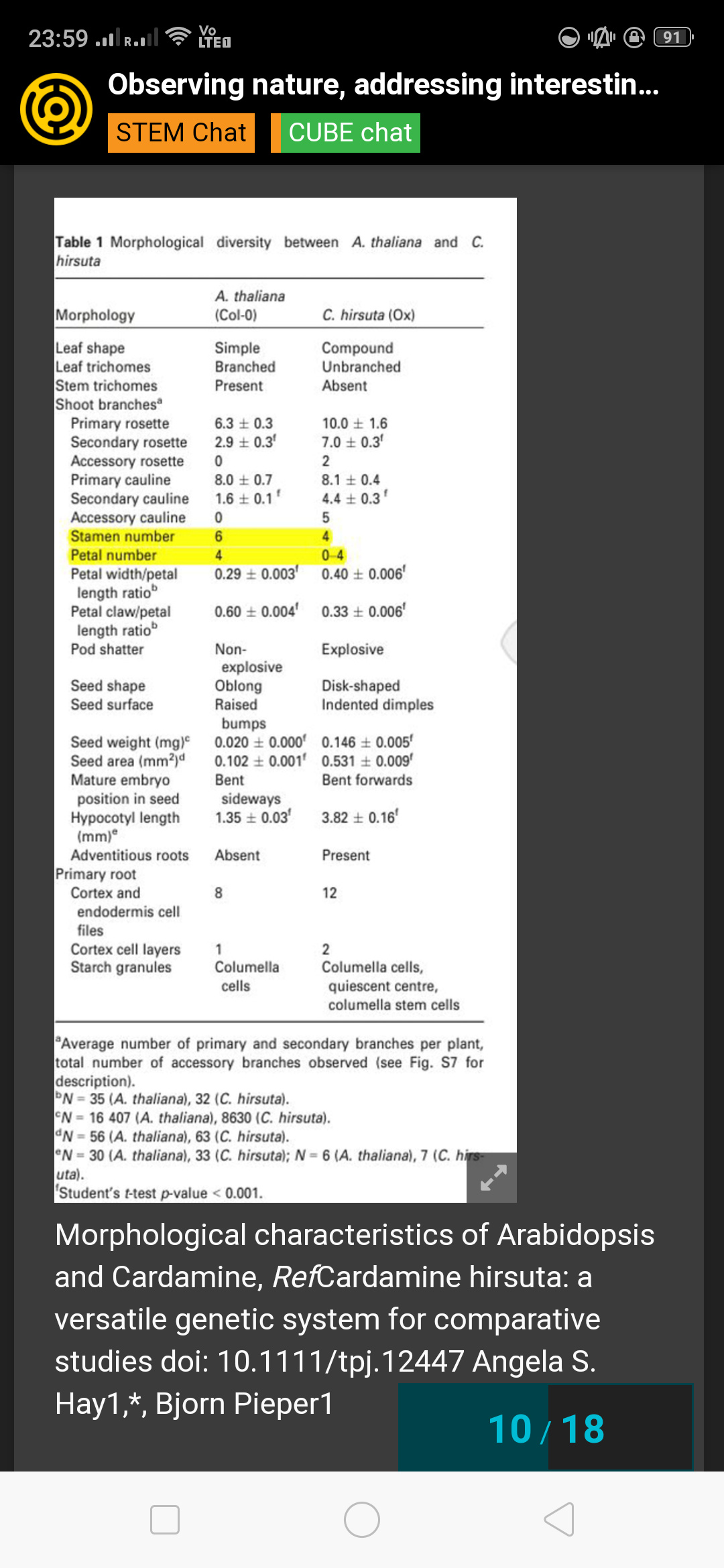
Morphological characteristics of Arabidopsis and Cardamine, _Ref_ Cardamine hirsuta: a versatile genetic system for comparative studies doi: 10.1111/tpj.12447 Angela S. Hay1,\*, Bjorn Pieper1
---
### Author:  [@Priti\_Kanade](https://metastudio.org/u/Priti_Kanade)
#### Post date: [October 5, 2019, 6:33pm UTC](https://metastudio.org/t/cardamine-the-table-top-farm/1867/17 "2019-10-05T18:33:59Z")
Cardamine is easy to culture
Thanks to its small size and life span
We get multiple generations in a year
From a seed to next generation seed
The time taken is 2 months!
What you need to take care is to add enough water to Cardamine and follow up 😇
---
### Author:  [@Arunan](https://metastudio.org/u/Arunan)
#### Post date: [October 6, 2019, 2:52pm UTC](https://metastudio.org/t/cardamine-the-table-top-farm/1867/18 "2019-10-06T14:52:22Z")
Can you suggest a protocol for culturing Cardamine to produce flower buds which can be used for transformation by means of floral dip method using agrobacterium plasmids with selection markers? @Priti_Kanade
---
### Author:  [@Priti\_Kanade](https://metastudio.org/u/Priti_Kanade)
#### Post date: [October 16, 2019, 6:50am UTC](https://metastudio.org/t/cardamine-the-table-top-farm/1867/19 "2019-10-16T06:50:58Z")
First
Sow 100 seedlings in petriplate with moist tissue paper
We expect sees to germinate in a week
We’ll observe radical, plumule and first cotyledon
Then we can transfer the seedlings into seedling tray
Water them daily
Follow their growth pattern
Take good pictures
Meanwhile make preparations for floral dip
Post 6 weeks
We expect first floral bud to emerge with 7th leaf state
Follow it from bud with green sepals to the one with white closed petals covered with green sepals
---
### Author:  [@Priti\_Kanade](https://metastudio.org/u/Priti_Kanade)
#### Post date: [October 16, 2019, 6:51am UTC](https://metastudio.org/t/cardamine-the-table-top-farm/1867/20 "2019-10-16T06:51:24Z")
We need
1. unopened floral bud of normal Cardamine
2. _A.tumefaciens_ strain with plasmid used for transformation with _GUS and / or Kanamycin resistance gene as reporter genes_ this will help us determine how many of our seeds have really tranformed as they will get selected in a selective medium like kanamycin, others won’t ( _here we have not introduced Gene of interest in plasmid, only marker)_
3. A proper growth media
I’ll read more about the components required
4. Black plastic bag to maintain humidity
5. Antibiotic to be put in media to allow selection and for generation of transformed seeds
[Next page](https://metastudio.org/t/cardamine-the-table-top-farm/1867.md?page=2)