 CUBE Chatshaala - Discussion Summary
Date: 30 October 2026
Participants recorded in the shared notes: Aarya Takke (Elphinstone College), Sailekshmi, Manali Bhujade (Elphinstone College, Mumbai), Khushbu Gupta (Chaitanya Science and Arts College, Pamgarh), Kiran, Arunan MC (Madel, Thivim, Goa), Kiran Varma, Rechel Tirkey (Ranchi), Prithviraj, Om Gupta (Saraswati Shishu Mandir High School, Rahod, Chhattisgarh), and Himanshu Joshi.
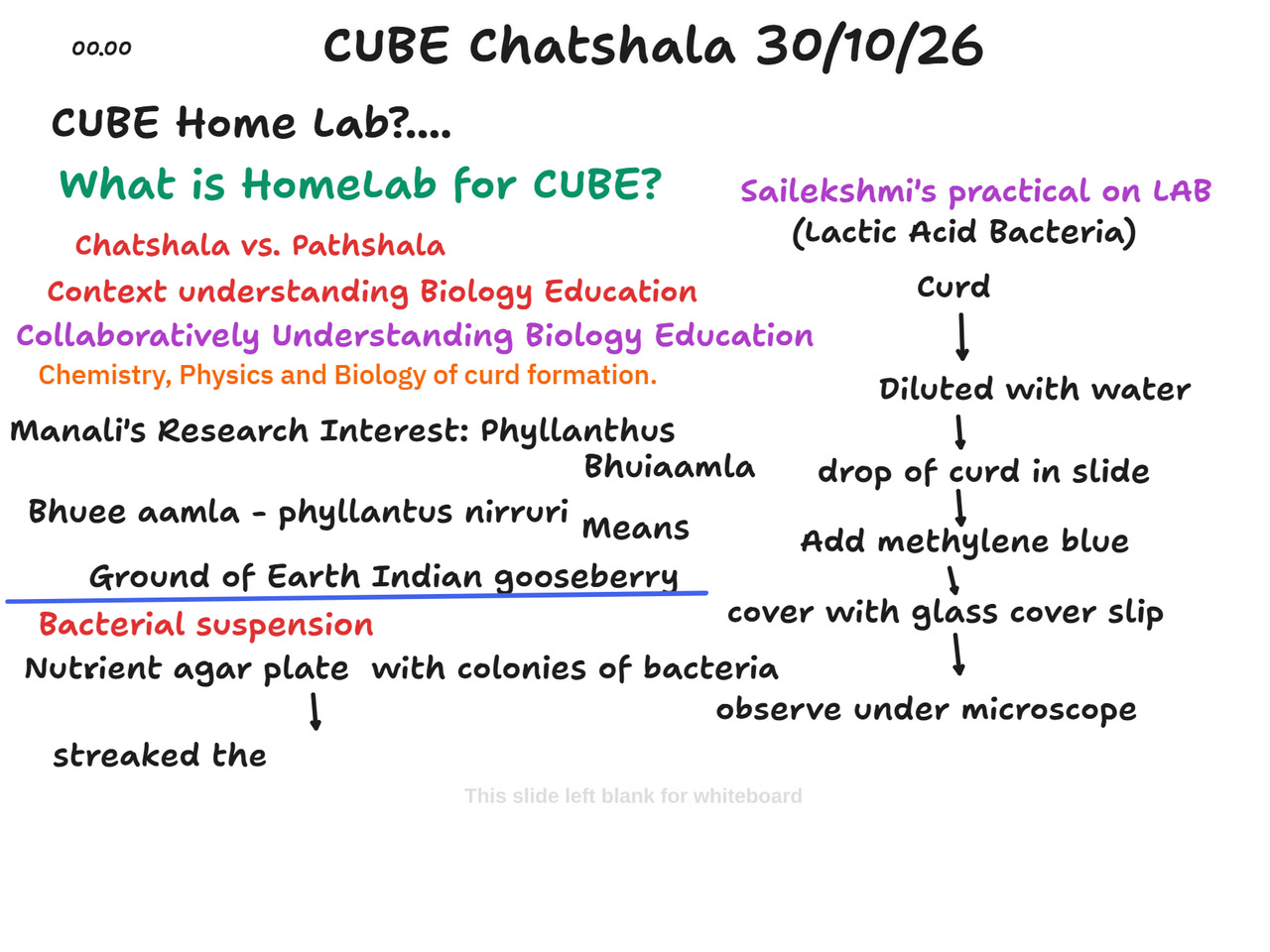
The evening began at about 7:30 pm with greetings from the moderators. The session then moved straight to a question on the opening whiteboard: what is a HomeLab for CUBE? The board paired this with a contrast between Chatshala and Pathshala. The idea is that a Pathshala delivers knowledge in a fixed direction, while a Chatshala builds understanding through conversation and shared observation. The board also spelled out the CUBE acronym as Collaboratively Understanding Biology Education and linked it to “Context understanding Biology Education”, which suggests that context is as important as content.
The main thread was curd. Arunan MC proposed looking at the “Chemistry, Physics and Biology of curd formation”, then reordered it to Physics, Chemistry and Biology. The point was that one everyday food can be studied through three sciences at once. Arunan also asked whether Sailekshmi’s classroom introduction to staining curd bacteria was an example of Pathshala or Chatshala. The question stayed open and shaped much of the later discussion.
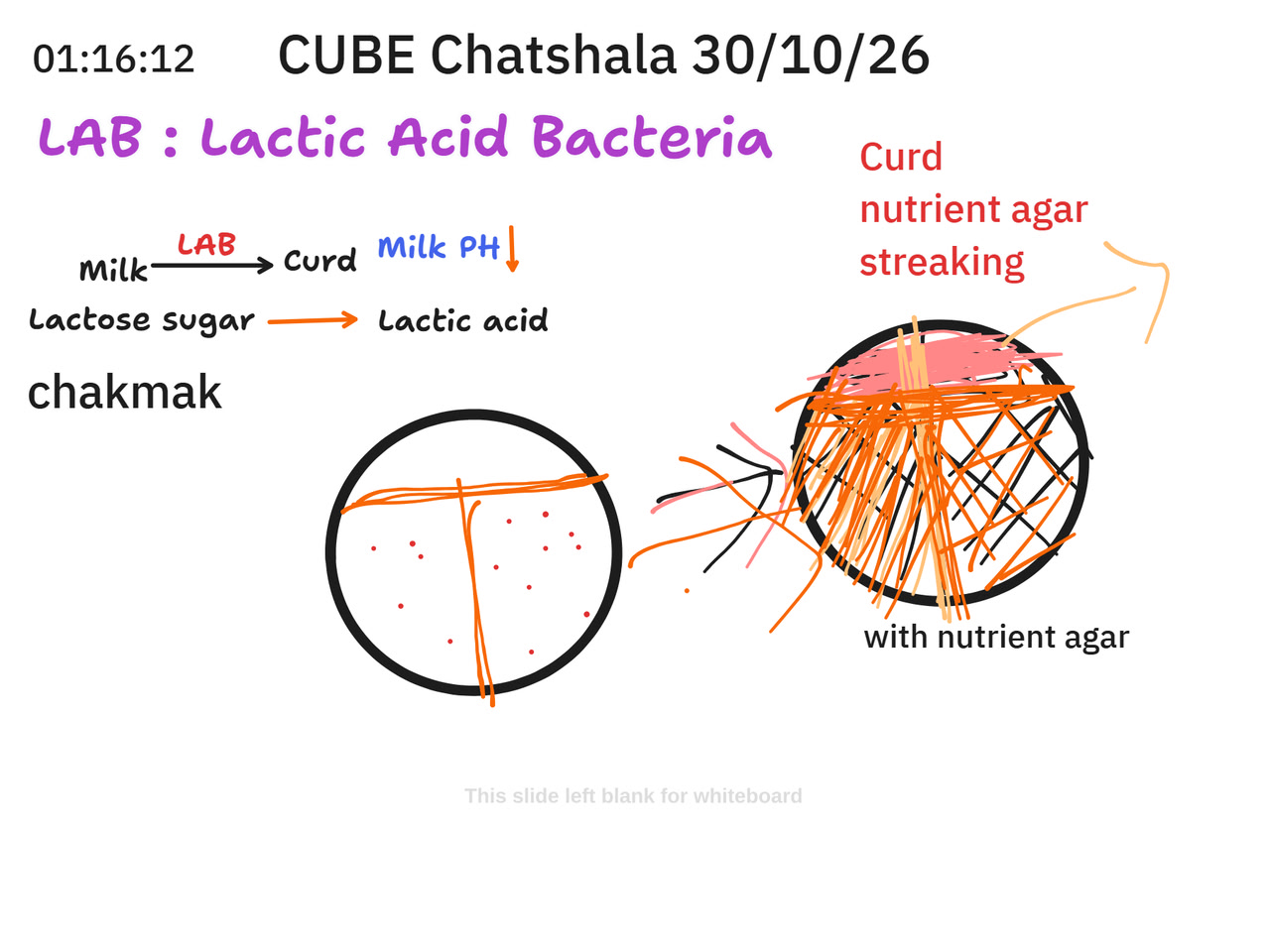
Sailekshmi wrote out the practical on Lactic Acid Bacteria (LAB) step by step on the board. A small amount of curd is diluted with water, and one drop is placed on a slide. Methylene blue is added, the drop is covered with a glass cover slip, and the slide is observed under the microscope. The second slide was moved from the slide to the culture plate. The board showed the chemical change as milk becoming curd through LAB, with the pH of the milk falling as lactose sugar is converted into lactic acid. It also described a bacterial suspension made from curd, which is streaked onto a nutrient agar plate so that separate colonies can develop. Two circles were drawn to compare an agar plate with scattered colonies against a plate that had been heavily streaked. The word “chakmak” was written beside the sketch as a reference to the shiny. It is a monthly Hindi children’s science and literature magazine published by the Eklavya Foundation in Bhopal, India, since July 1985. It is for children aged 7 to 15 years (primarily 11–14 years), along with teachers and parents. It focuses on scientific thinking, hands-on experiments, DIY activities, puzzles, stories, art, and local life. It encourages children to explore the world beyond traditional fairy tales.
The second theme was Manali’s research interest in Phyllanthus. The board recorded the local name Bhuee aamla, or Bhumi amla, and explained that it means “ground of earth Indian gooseberry”. A photograph of the plant from the home garden was shared. Aarya added that Phyllanthus niruri may not actually occur in India, and that there is a continuing debate about whether the plants called by that name are another species of Phyllanthus. Aarya had not yet taken these plants into the HomeLab and said this would be done as a follow-up. Arunan also shared the SciStarter page for CUBE. The session ran past 9 pm, and the recording had passed one hour and sixteen minutes when the second slide was drawn.
 Provocative Questions
-
If a HomeLab can be a kitchen, a balcony pot, or a school bench, what is the minimum a space needs to qualify as a laboratory?
-
When a teacher demonstrates curd staining and students ask questions, does the session become a Chatshala, or does it stay a Pathshala with extra talking?
-
Curd is explained through physics, chemistry, and biology. Which of the three do we usually teach first, and does that order change what students think curd is?
-
Milk pH falls as lactose becomes lactic acid. How would a student with no pH meter or paper show that this change has happened?
-
Why is diluting the curd necessary before staining, and what would the slide look like if we skipped it?
-
A streaked plate and a heavily crowded plate come from the same curd. What does each one teach us about how bacteria are separated and counted?
-
Is a common name like Bhumi amla a reliable identity for a plant, or does it hide several species behind one label?
-
How could a group of home gardeners, each with a different plant, settle a species debate that botanists have not resolved?
-
What does a student gain by growing a culture from food they eat every day, compared with studying an unfamiliar organism?
 What I Have Learned
The most important lesson for me was that a HomeLab is defined by the question being asked, not by the equipment. Curd is something almost every household has, yet the discussion showed that it holds a full chain of explanation, from the fall in pH to the growth of colonies on agar.
I also understood the staining procedure better as a sequence with a reason behind each step. Dilution makes single cells visible, methylene blue gives them contrast, and the cover slip flattens the drop so it can be focused. Seeing the streak plate drawn next to the slide helped me link two methods that I had thought of as separate.
The Pathshala and Chatshala question changed how I see the sessions themselves. Learning here depends on whether participants feel free to challenge a step, ask what a word means, or add their own observation. The discussion of Phyllanthus showed this clearly, because an uncertain species name became a shared project and not just a correction.
 TINKE Moments (This I Never Knew Earlier)
First, the same food can be studied through physics, chemistry, and biology together. Curd formation is not only a biology topic. The pH change, the sugar conversion, and the bacterial activity all belong to one process.
Second, the local name of a plant does not guarantee its scientific identity. The Bhumi amla discussion brought out that the name Phyllanthus niruri may be applied to plants that are not that species. A name on a label needs to be checked before it is trusted.
Third, observing bacteria is a two-part skill. A stained slide shows the cells, and a streaked plate shows the colonies. Each answers a different question, and a learner needs both.
 Gaps and Misconceptions
The notes do not record how the curd suspension was prepared for the plate, the incubation time, or what the colonies looked like after growth. The magnification used for the slide was also not stated. The meaning of “chakmak” was not explained in the material I have. For the plant, no one has yet tested which Phyllanthus species is actually growing in the garden, so the identity question is still open. The Pathshala versus Chatshala question was raised but not answered during the session.
A common misconception is that curd is simply “spoiled milk”. The board corrected this by showing a specific process in which LAB convert lactose into lactic acid and the pH falls. Another is that bacteria can be seen clearly in an undiluted drop, when in fact dilution is what separates individual cells. A third is that a familiar local name settles a plant’s identity. The discussion of Phyllanthus showed that identification may need closer examination, and that the debate over the species is still going on.
 Referance