CUBE Chatshaala - Discussion Summary
During today’s session on 16th septmber 2026, the discussion focused on the developmental biology and life history traits of the fruit fly (Drosophila melanogaster), exploring why it serves as a quintessential model system in biological research.
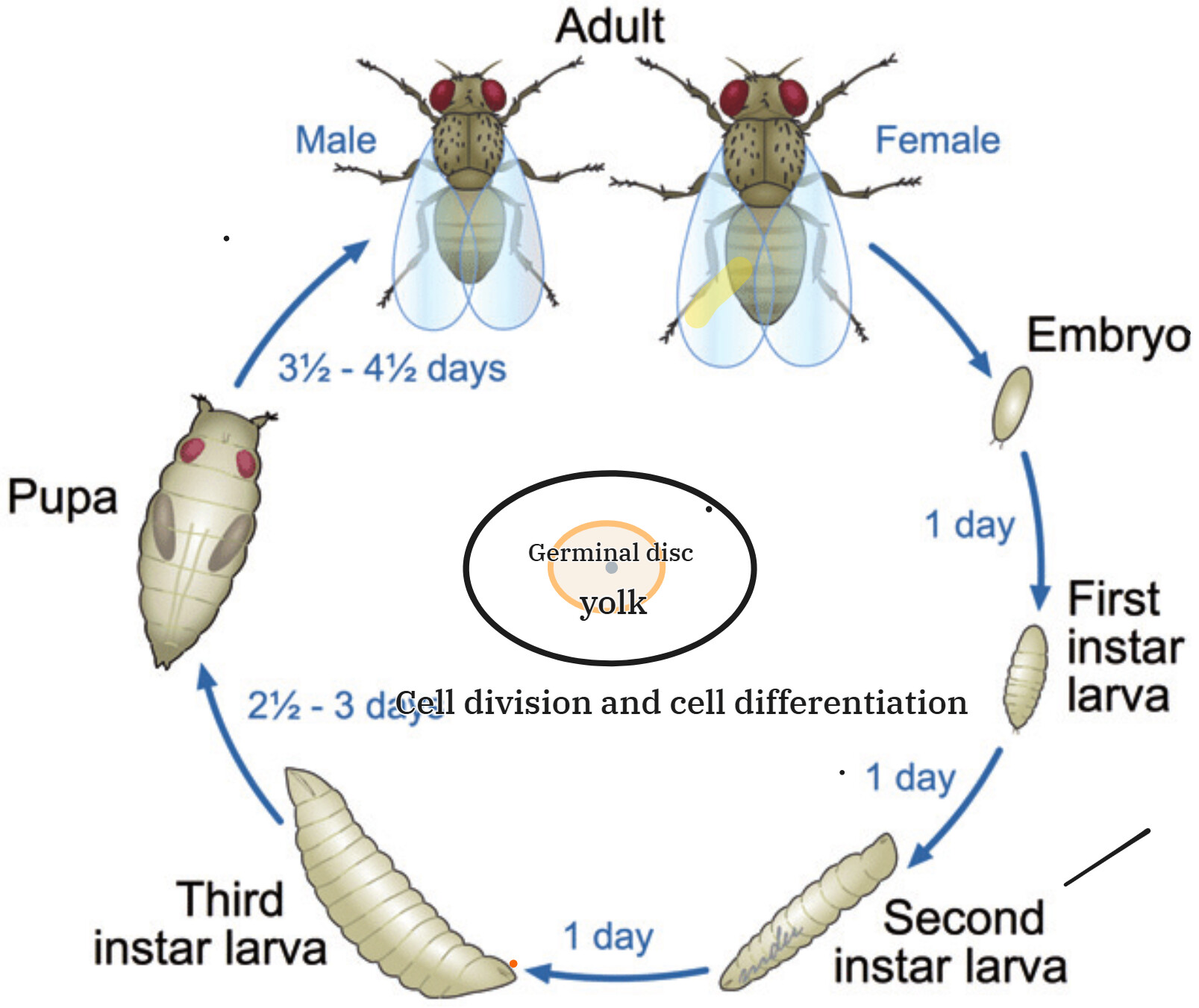
The conversation began by contrasting lifespan (the duration an individual organism lives from birth/hatching to death) with lifecycle (the sequential biological stages an organism progresses through during development). The overall lifespan of a fruit fly typically extends beyond a month depending on environmental conditions, whereas its developmental lifecycle—from egg to adult—is remarkably rapid.
Participants examined the specific stages and timelines of Drosophila development:
-
Embryo/Egg Stage: Eggs hatch into larvae within approximately 1 day (24 hours). At the center of the egg structure lies the yolk and germinal disc, where early cell division and differentiation take place.
-
Larval Stage: The larval development spans 3 distinct instars (First, Second, and Third instar), taking roughly 4 to 5 days in total (with about 1 day per instar phase).
-
Pupal Stage: Metamorphosis occurs during the pupa phase, lasting around 3.5 to 4.5 days (or 2.5 to 3 days depending on temperature/instar progression) before the adult fly emerges.
-
Adult Stage: Sexual dimorphism is clearly visible, with distinct physical characteristics differentiating adult males and females.
The group also discussed practical field collection techniques for culturing fruit flies, noting that they are easily attracted and sampled using damp organic matter, half-cut fruits, or near waste areas.
 Provocative Questions
-
How do environmental variables such as ambient temperature and humidity affect the rate of cell division and transition time between larval instars?
-
Why is the distinct structural organization of the germinal disc and yolk critical during the early embryonic phase of Drosophila?
-
In what ways does the short developmental lifecycle (roughly 8 to 10 days total) make the fruit fly a superior model system compared to organisms with longer developmental timelines?
-
What evolutionary advantages do the quick transition times between the three larval instars offer when flies breed in ephemeral food sources like rotting fruit?
 What I Have Learned
-
Distinction Between Lifespan and Lifecycle: Clarified that lifespan measures temporal survival from origin to death (measured in days, months, or years), whereas lifecycle refers to structural and developmental stages .
-
Detailed Drosophila Developmental Timeline: Learned that the transition from egg to first instar takes 1 day, larval development progresses through three instars over 4–5 days, and pupation to adult eclosion takes roughly 3.5–4.5 days.
-
Model System Suitability: Understood how rapid generation time, distinct sexual dimorphism, and simple field attraction methods make Drosophila ideal for laboratory and citizen science investigations.
 TINKE Moments (This I Never Knew Earlier)
-
Misinterpreting Lifespan vs. Lifecycle: A notable moment arose when discussing the duration of the fly’s lifecycle versus its lifespan. It is easy to conflate a short developmental cycle (~10 days) with a short lifespan, overlooking that adult flies can live for over a month.
-
Visualizing Embryonic Differentiation: Grasping how initial cell division occurs around the yolk and germinal disc within the eggshell before hatching into a first-instar larva required careful visual analysis of the embryology diagram.
 Gaps and Misconceptions
-
Gaps: Further quantitative detail is needed on how specific laboratory culture media (e.g., cornmeal-agar vs. simple fruit setups) alter the exact timing of each developmental stage.
-
Misconceptions: Assuming that fruit flies only live for a few days total. In reality, while the developmental stages (egg to pupa) take about 8–10 days, the full lifespan of the adult fly is significantly longer under suitable conditions.
 Photographs during Chatshaala