 CUBE Chatshaala - Discussion Summary
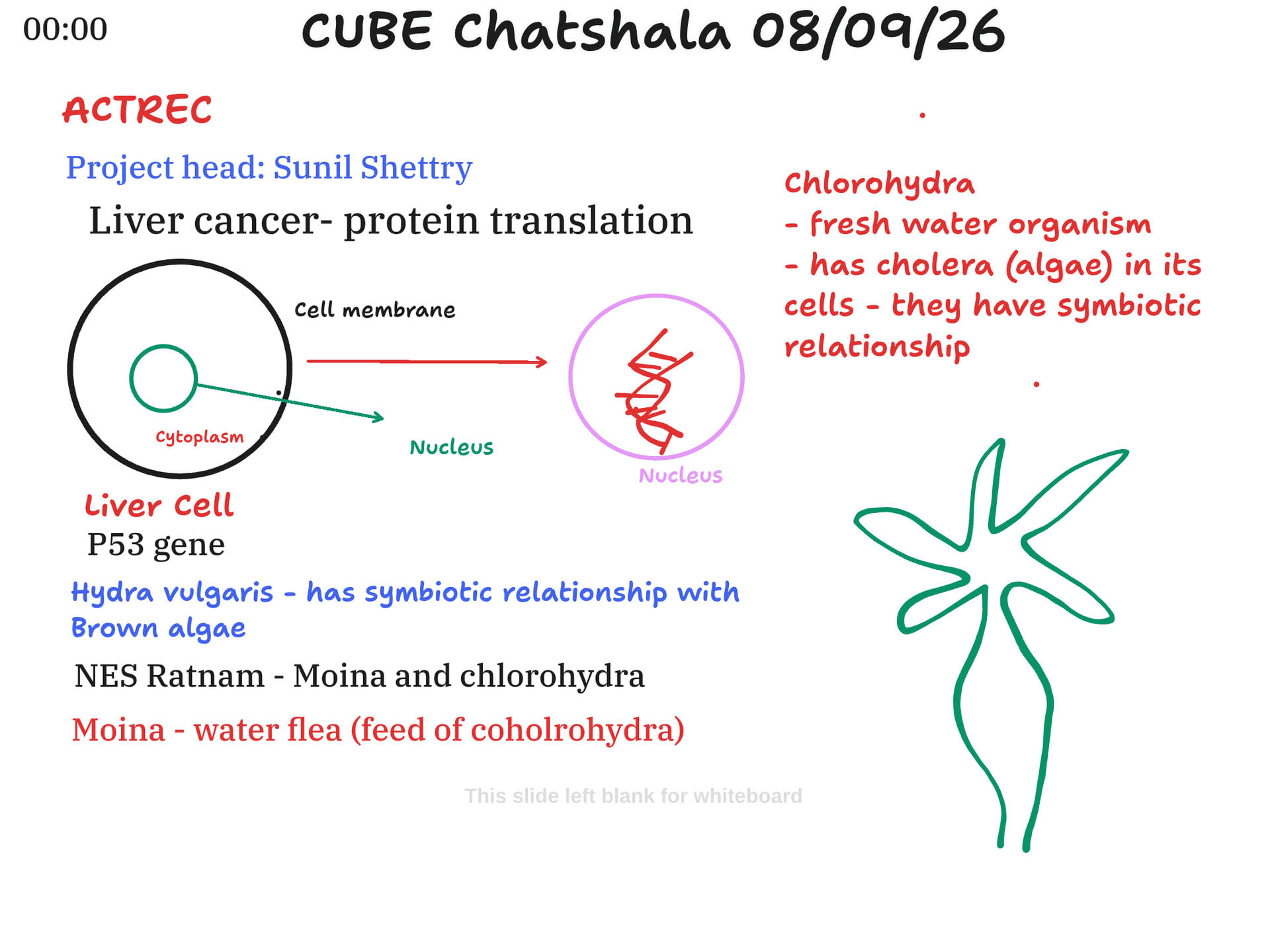
The 8 October 2026 session opened with Sakshi Beloshe presenting her work from ACTREC, where the project head is Sunil Shettry. Her project looks at liver cancer through the lens of protein translation. The whiteboard diagram showed a liver cell with its membrane, cytoplasm, and nucleus, with the nucleus enlarged to show DNA. Arunan asked her to simplify and explain exactly what she does, and the talk moved to fundamentals, which Kiran welcomed.
Sailekshmi then shared a plain-language definition of cancer. Normal cells divide only when the body needs them and die when damaged. Cancer cells ignore those stop signals, divide continuously, and form tumours. Benign tumours stay in place, while malignant ones invade nearby tissue and can spread through blood or lymph. Arunan linked a reference on plant tumours and raised the question of warts and cancer. Warts were described as benign skin growths caused by the human papillomavirus (HPV), whereas “tumour” is a general term for an abnormal mass that may be benign or malignant.
Sakshi explained that several proteins are involved in cancer. One example is the P53 gene, a tumour suppressor whose mutation can lead to cancer. Aarya summarised this as uncontrolled division after a p53 mutation, and asked whether that mutation alone decides if a tumour is benign or malignant.
The second half turned to the whiteboard’s right-hand side: Chlorohydra, a freshwater organism with Chlorella algae living inside its cells in a symbiotic relationship. Sakshi worked through the idea that the algae photosynthesise while the hydra gives them a home, and that the hydra uses its tentacles to catch Moina, the water flea that serves as its food. Ayana confirmed that Chlorella is rich in chlorophyll. Arunan connected the two halves of the evening with a Science article on why hydras, though they show no typical ageing, are useful for studying how tumours arise. Hydra tumours can pass from parent to offspring, and reducing food intake lowers the transmissibility. The session closed with links to Metastudio threads on Moina culture in Sakshi’s HomeLab and on Moina as an epigenetic model organism.
 Provocative Questions
- If p53 guards the cell against uncontrolled division, which other changes must accumulate before a tumour turns malignant?
- Why would a symbiotic hydra be a better model for cancer than a mouse or a cultured cell line?
- Hydra tumours became less transmissible when feeding was reduced. What does this say about the role of environment and nutrition in human cancer?
- If the Chlorella inside a hydra cell survives and works, why does the host not treat it as foreign?
- Cancer is a disease of translation as much as of DNA. Which step between the gene and the finished protein would you expect to fail first?
- Could Moina, as a food source, shape the health of the hydra it feeds?
What I Have Learned
Cancer is better understood as a failure of regulation than as a single event. Cells divide, rest, and die under constant control, and p53 is one of the key controllers. I also learned that “tumour” and “cancer” are not synonyms, and that warts are a useful everyday example of benign growth. The hydra segment showed me how an organism can be a symbiotic community, with an alga and an animal sharing one body. Finally, a well-chosen simple organism can open up questions about complex human disease. Arunan’s request to simplify also reminded me that being able to explain your work plainly is part of doing science.
 TINKE Moments (This I Never Knew Earlier)
On cancer biology: the benign versus malignant question became explicit. A tumour is only a mass; what makes it dangerous is invasion and spread. The p53 discussion made clear that a single mutated gene starts the trouble but may not explain the whole outcome.
On symbiosis: Aarya’s guess that “chlorohydra” meant a hydra with its own chlorophyll was corrected. The chlorophyll belongs to Chlorella living inside the hydra’s cells, not to the hydra.
On model organisms: the idea that an animal considered biologically immortal can still develop, and even transmit, tumours was new and striking.
On communication: the evening showed how much follow-up questions and shared links improve understanding.
 Gaps and Misconceptions
- The whiteboard reads “cholera (algae)”. Cholera is a bacterial disease; the alga is Chlorella.
- The board also says Hydra vulgaris has a symbiotic relationship with “Brown algae”. Chlorella is a green alga, and the hydra species classically associated with it is the green hydra, Hydra viridissima. This line should be checked against a source before publication.
- Aarya’s assumption that hydras “don’t move” is only partly right. They are mostly attached, but they can glide and somersault. Tentacle trapping of Moina was nonetheless correct.
- The slide titled “protein translation” never showed the actual translation step. P53 is a transcription factor, so the link from the gene to the translated protein was not drawn.
- Aarya’s question on what decides benign versus malignant was left open. A fuller answer involves several accumulated mutations and invasive behaviour, not p53 alone.
- The relationship between HPV, warts and cancer needs care. Most warts are benign, but only certain HPV types are cancer-linked.
- The whiteboard header says 08/09/26, but the attendance sheet and chat timestamps place the session on 8 October. Please confirm the date before posting.
- Small spelling slips on the board (“coholrohydra”, “Shettry”) should be fixed.
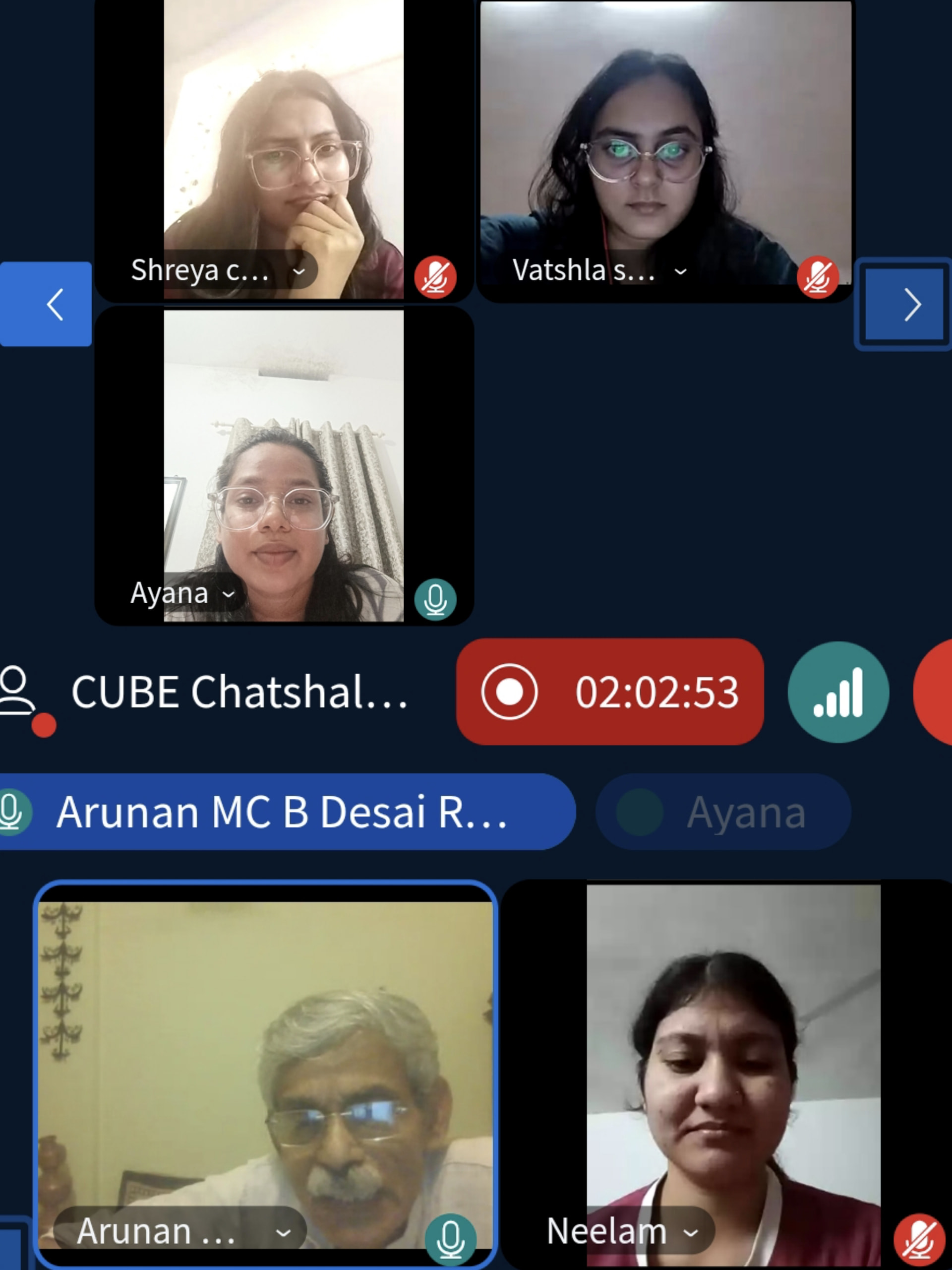
 Photographs during ChatShaala
 Reference