 CUBE Chatshaala - Discussion Summary
The CUBE ChatShaala session of 4 November 2026 began with a continuation of the previous day’s topic, the Secchi disc. M S Sailekshmi opened as presenter at 19:24, and the Wikipedia page on the Secchi disc was shared at 19:40. Presenter duties then moved between Sailekshmi, Niharika Baghari, Kiran Varma, Kiran Kalakoti, and Khushbu Gupta of Chaitanya Science and Arts College, Pamgarh. Arunan MC moderated and added reference links as the discussion widened. Kiran Kalakoti noted in the chat that she was taking screenshots and uploading them, which is why the session record survives.
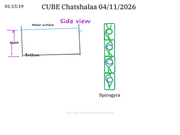
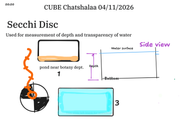
The board carried the heading “Secchi Disc” with the line “Used for measurement of depth and transparency of water.” Below it were three working areas. The first showed the pond near the Botany department, drawn as a box with a shaded band along its bottom. The second was a sketch of the disc itself: a circle divided into black-and-white quadrants, hanging from a wavy line representing the rope. The third was a blank, water-coloured box numbered 3. On the right was a side view with the water surface, the bottom, and a bracket labelled “Depth” running between them.
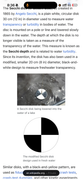
The reference page filled in the history. Angelo Secchi created the disc in 1865. The original was a plain white disc 30 cm across, still the standard for marine work. In 1899, George Whipple introduced the smaller 20 cm version with alternating black and white quadrants, which is now the standard for freshwater studies. Lower the disc until it disappears; that point is the Secchi depth, a measure of water clarity. The page also describes a more careful method: note the depth where the disc vanishes, lower it a little further, then note where it reappears on the way up, and take the average. Readings are best taken on the shady side, in the middle of the day, by the same observer each time. The board sketch matches the freshwater black-and-white design.
Later in the session, the board turned to Spirogyra, introduced through a Britannica link at 20:54. The drawing at the 01:15:19 mark of the recording shows a filament of four rectangular cells, each with a spiral green chloroplast and a blue nucleus. Britannica describes Spirogyra as a freshwater green alga of unbranched filaments, named for its spiral chloroplasts. It can form floating masses near the surface of ponds and streams, and it is a favourite for laboratory demonstrations. It reproduces by fragmentation and by conjugation. This tied the pond sketch to a living organism that could plausibly be found in the same water.
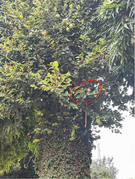
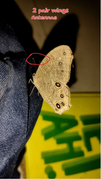
The final part of the session moved to insects. A photograph of a brown butterfly with eyespots on its wings was annotated “2 pairs of wings” and “Antennae”, with the antennae circled in red. The Wikipedia page on Melanitis leda, the common evening brown, was shared at 21:22. The species is common in Africa, South Asia and South-east Asia, flies erratically at dusk, and has seasonal wet and dry forms. Its caterpillars feed on grasses such as rice and bamboo, and the adults feed mainly on nectar. A link on how to tell a butterfly from a moth followed at 21:31. A last photograph showed a tree thick with foliage, creepers and ferns, with one rounded green fruit circled in red. The circle suggests it was meant for closer observation, but I could not find out from the materials what was said about it.
 Provocative Questions
-
The board says the Secchi disc measures “depth and transparency”. Which of the two does it actually measure, and why does the depth number depend on the water and not just on the rope?
-
If two people lower the same disc into the same pond and record different depths, whose reading is right? What would you change in the method to make them agree?
-
Why would a disc painted in black and white quadrants be easier to judge than a plain white one in freshwater?
-
Suppose the pond near the Botany department were sampled in the morning and again in the afternoon. What could change the Secchi depth even though the pond itself had not changed?
-
Spirogyra forms floating mats near the surface. Would a pond full of it necessarily give a shallow Secchi reading? What kind of algae would affect the reading more?
-
The butterfly photo is labelled “2 pairs of wings”. Is that a feature that separates a butterfly from a moth, or something both share? What would be a better feature to circle?
-
The evening brown flies at dusk. If butterflies are supposed to fly by day, what does this species tell us about how reliable that rule is?
-
If you were to design a citizen science project around the Secchi disc using only things found at home, what would you build, and how would you record your readings so someone else could trust them?
 What I Have Learned
The most useful lesson was a quiet one. The Secchi disc is a clarity tool, not a depth gauge. The depth at which the disc vanishes tells us how far light can be seen through the water, and the rope is only the ruler. Seeing “depth and transparency” written side by side on the board showed me how easily the two ideas blur together, and why a title deserves as much checking as a number.
I also learned that a simple instrument still demands careful method. Taking the average of the disappearing and reappearing depths, working in the shade, choosing the middle of the day, and using the same observer are all small steps that make a cheap tool dependable. That is the real spirit of citizen science: honest, repeatable observations rather than expensive equipment.
The session also showed how one question can lead to another. A disc in a pond led to the algae living in it, and the algae led to the wider question of how we describe living things, down to the antennae and wings of a butterfly. Finally, I was reminded that a photograph becomes evidence only once someone marks what matters in it. The red circles on the butterfly and the fruit were small acts of scientific attention.
 TINKE Moments (This I Never Knew Earlier)
The first moment was the difference between a measurement of depth and a measurement of transparency. The disc does not tell us how deep the pond is. It tells us how far a person can see into it.
The second was that the black-and-white disc is not simply a decorated version of the white one. The 30 cm white disc belongs to marine work, and the 20 cm black-and-white version was adapted for freshwater, which is why the pond sketch shows quadrants.
The third was that the Secchi depth is best found by averaging two readings, one as the disc disappears and one as it reappears, instead of trusting a single glance.
The fourth was that Spirogyra is named for its spiral chloroplast and that its cells hold a nucleus suspended in a large central vacuole. The sketch with blue nuclei and green spirals made that structure easy to remember.
The fifth was about the butterfly. Having two pairs of wings is not what separates butterflies from moths, because both groups have them. The antennae are the more helpful clue, which is probably why they were circled. The evening brown, which flies at dusk, also showed that the old rule of day-flying butterflies and night-flying moths has exceptions.
 Gaps and Misconceptions
Depth versus transparency. The board heading describes the disc as measuring depth, but its purpose is to measure clarity. The Secchi depth is a result that depends on turbidity, light, and the observer, and it should not be read as the depth of the pond. This was the same confusion that surfaced in the previous day’s discussion, so it clearly needs reinforcing.
Reliability of a single reading. A reading from one person at one moment is easily affected by sun glare, eyesight, and timing. The session did not show how the pond readings were standardised, and the sketch alone does not tell us whether the method of averaging was applied.
Incomplete pond sketch. The numbered boxes on the board (1 and 3) are not fully explained, and box 3 was left blank. It is unclear whether they were meant to show different ponds, different conditions, or different stages of an experiment. The link between the pond drawing and Spirogyra was also not stated openly, so it remains an assumption that the alga was found in that water.
Spirogyra and clarity. It would be easy to assume that any alga makes water murky. Spirogyra grows as long floating filaments, and its effect on a Secchi reading is not the same as that of tiny suspended algae. This relationship was not examined and is worth testing.
Butterfly features. The annotation “2 pair wings” could mislead a beginner, since moths also have two pairs. The distinguishing feature, the shape of the antennae, needs to be stated and checked on the photograph.
The tree photograph. The circled fruit had no label, so the plant could not be identified from the materials. A sketch of the fruit, the leaf arrangement, and the location would be needed before naming it.
 Photographs during Chatshalaa
 Reference