 CUBE ChatShaala Summary — 20/10/2025
Topic: Cardamine Seed Germination & Plant Genetic Engineering in HomeLabs
 Meeting Overview:
Today’s ChatShaala centered around exploring how genetic engineering concepts can be brought into simple HomeLab experiments using the Cardamine plant as a model organism. The discussion moved from basic seed germination to advanced ideas like gene transfer using Agrobacterium tumefaciens and its plasmid system.
 Key Points Discussed
- Cardamine Seed Germination:
-
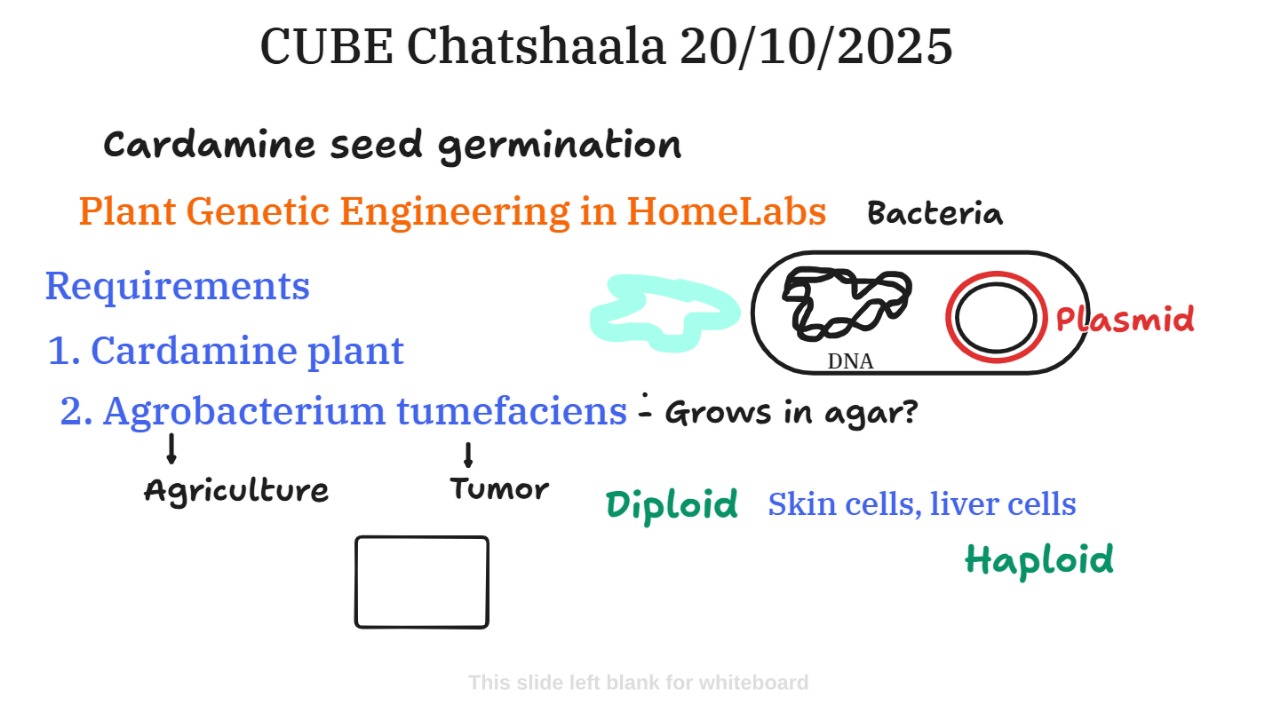
The session began with a focus on Cardamine, a small flowering plant ideal for studying early seed germination under home-lab conditions.
-
Participants discussed environmental factors affecting germination and how Cardamine could serve as a model to understand plant developmental biology.
- Introduction to Plant Genetic Engineering in HomeLabs:
-
The ChatShaala then transitioned into a deeper exploration of plant genetic modification, connecting Cardamine experiments to the mechanisms used in agricultural biotechnology.
-
Emphasis was placed on Agrobacterium tumefaciens—a soil bacterium known for its ability to transfer genes into plant cells via a Ti (tumor-inducing) plasmid.
- Role of Agrobacterium tumefaciens:
-
Students discussed how Agrobacterium can be cultivated on agar media and used to introduce desired genes into plant tissues, transforming them at the genetic level.
-
The dual nature of Agrobacterium in agriculture (as a genetic engineering tool) and pathology (as a tumor-inducing agent) was highlighted.
-
The discussion also connected this to the concept of diploid and haploid cells—showing how genetic material integrates differently in various cell types.
- Case Study: Bt Cotton & Bt Cardamine:
-
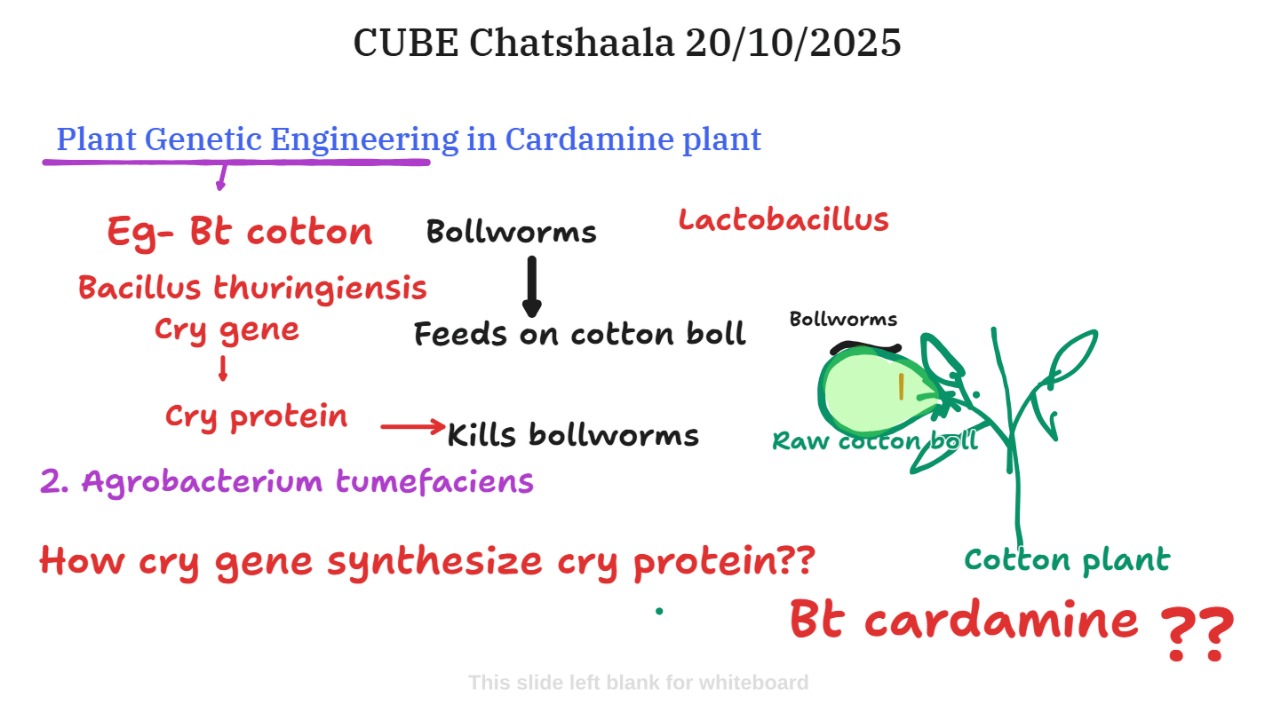
A fascinating parallel was drawn between Bt cotton and a hypothetical Bt Cardamine.
-
Bt cotton is genetically modified using the Cry gene from Bacillus thuringiensis, which produces a Cry protein toxic to bollworms.
-
The group discussed how similar genetic mechanisms could theoretically be demonstrated in Cardamine, sparking the question:
“How does the Cry gene synthesize the Cry protein once introduced into the plant cell?”
- This raised curiosity about transcription and translation processes and how genes from bacteria function efficiently inside plant systems.
 Thought-Provoking Queries for the Community
-
Can Cardamine serve as a model plant for demonstrating genetic transformation similar to Bt cotton in HomeLabs?
-
What are the safety and ethical considerations of attempting plant genetic modification at a small scale?
-
How can we visualize gene expression in plants without sophisticated lab tools?
-
What experiments can help us understand how Agrobacterium integrates DNA into plant genomes?
 Gaps and Misconceptions Identified
-
Misconception 1: Some participants initially thought Agrobacterium tumefaciens was harmful in all contexts, not realizing it can be harnessed beneficially for genetic transfer.
-
Misconception 2: Confusion between plasmid DNA and chromosomal DNA, especially regarding which carries the transgene.
-
Gap: Lack of clarity on how the Cry gene from Bacillus thuringiensis expresses in plant cells and produces Cry protein.
-
Gap: Uncertainty about how to culture Agrobacterium under simple, non-lab conditions (e.g., on agar or nutrient media suitable for HomeLabs).
 TINKE Moments (This I Never Knew Earlier)
-
Realized that genetic engineering doesn’t always require complex setups—conceptual understanding can begin in HomeLabs using accessible plants like Cardamine.
-
Understood how Agrobacterium tumefaciens acts as a natural genetic engineer, capable of transferring DNA across species.
-
Learned the power of model analogies, like comparing Bt cotton to potential Bt Cardamine, to grasp complex biotechnological concepts.
-
Experienced a “eureka” moment when understanding that the Cry gene, once inserted, uses the plant’s own transcription machinery to produce the Cry protein.
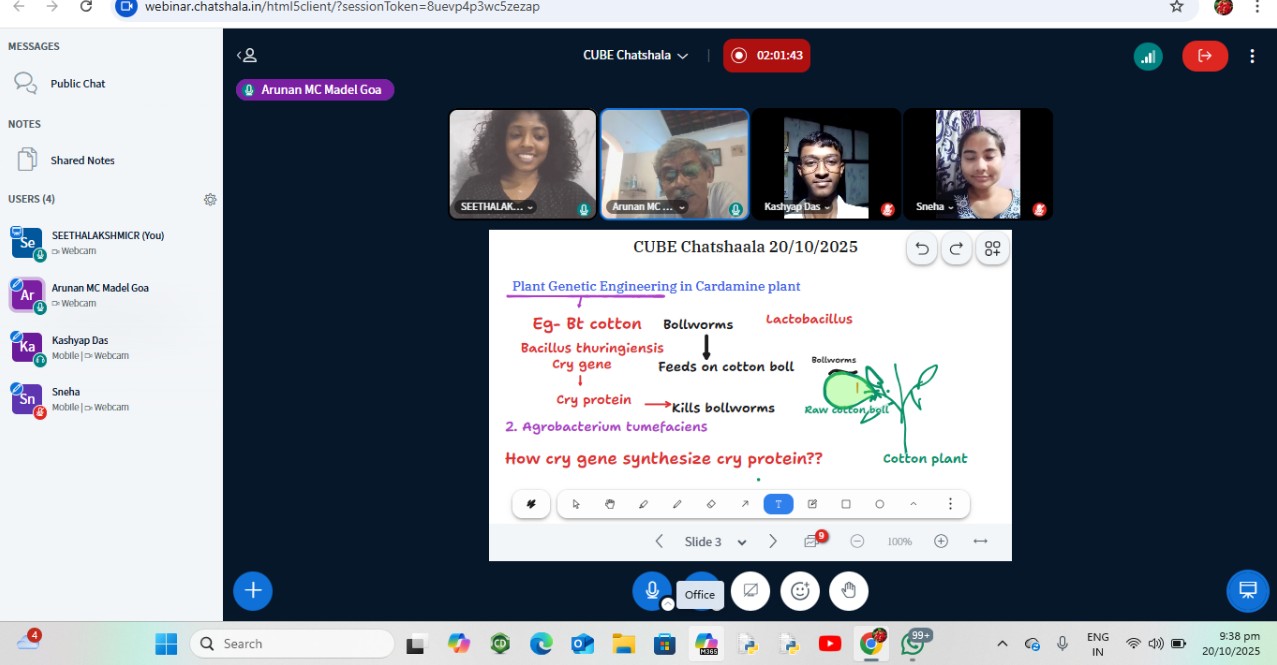
 photographs during Chatshaala

 Reference
@Arunan @SN1261 @sakshiconsultant2002 @magpie @Susanta_Tanti @2020ugchsncnseethala and others.