 CUBE Chatshaala - Discussion Summary
Date: 03/11/2026
Participants : Sailekshmi, Aarya Takke, Khushbu Gupta, Kiran Mam, Shreya Dalvi, Arunan MC (Madel, Thivim, Goa), Prithviraj, Pooja Verma, Susanta Tanti, Rechel Tirkey (Ranchi), and Manali Bhujade.
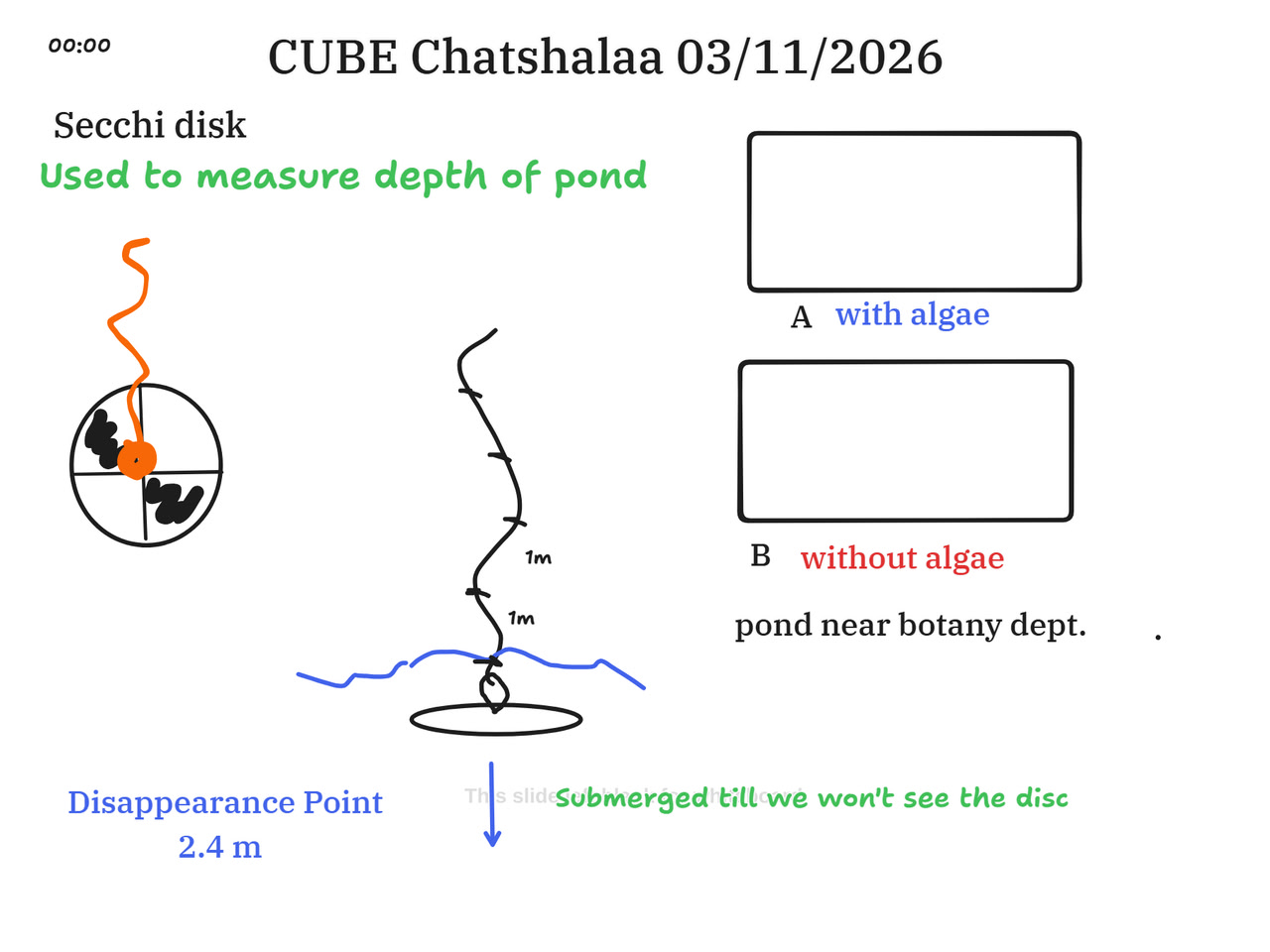
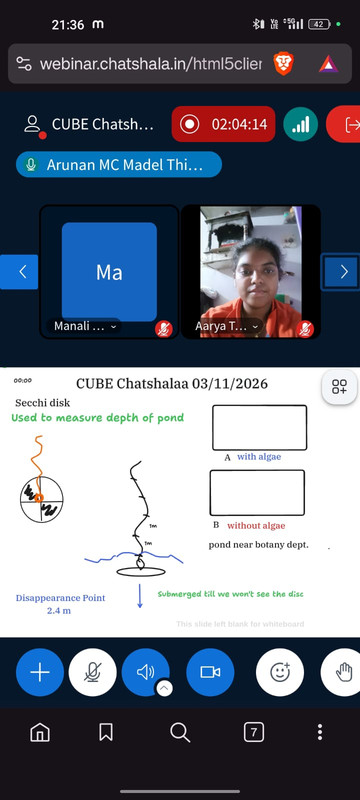
Today’s session was anchored in a single, deceptively simple instrument, the Secchi disk. Sailekshmi took the presenter’s role at 19:24 and opened with a whiteboard titled “Secchi disk”. Her sketch showed a round disk divided into black and white quadrants, hung from a line. A second drawing showed a graduated line marked off in metre intervals, lowered through the water surface until the disk could no longer be seen. She marked the disappearance point at 2.4 m, which she had recorded at the pond near the Botany department. Two empty boxes on the right of the board were labelled A (with algae) and B (without algae). They set up a comparison of how the same pond, or two ponds, might behave under different algal loads.
The first thing to be settled was what the instrument actually does. Her heading described the disk as a tool “used to measure depth of pond”. Shreya immediately asked, “What is a Secchi disk?”, and Arunan Sir then supplied a precise definition in the chat. The disk is lowered into a water body until it vanishes and is then raised until it reappears, and the average of those two depths is recorded as the final visibility depth. Kiran Varma summed it up in two words, “water clarity”. So the disk does not measure how deep the pond is. It measures how far light, and therefore sight, can travel into the water. The 2.4 m on the board is a measure of transparency, not of pond depth.
Arunan Sir then pressed on method, asking how the 2.4 m figure was measured and confirmed. This turned the session from definition to scientific practice. A single reading is open to doubt. Standard practice is to take both the disappearance and reappearance depths and average them. It is also usual to repeat the reading and, if possible, have a second observer take it, because eyesight, sun glare and ripples all affect where the disk seems to vanish.
The group’s attention then shifted to the A and B boxes on the board. Water with more algae should show a shallower Secchi depth, because suspended cells absorb and scatter light. Clearer water should show a deeper one. Sources on pond monitoring note, however, that low transparency does not always mean a heavy algal bloom, since silt and suspended organic matter also cloud the water.
Around 19:55 the session suffered technical trouble. Aarya reported that voices were breaking up, and she left briefly to change her network and refresh her phone. Later, at 20:47, Susanta Tanti apologised for a load-shedding power cut that had disconnected his wifi. In the middle of this, at 20:34, Arunan Sir posted a note of encouragement, “Celebration of goof-ups!”, which set the tone for the later discussion. Mistakes were treated as material for learning, not as embarrassments.
The second half of the session moved to the physics of light in water. After 21:00 Aarya confirmed she was listening again, and Rechel Tirkey explained that water acts like a filter for light, so colour changes with depth. Aarya asked how the wavelength of light changes, because she only knew that the angle changes. She explained that when light enters water, refraction bends it, which she had learnt as a textbook idea in Class 12. Rechel Ma’am shared a figure on the penetration of light at different wavelengths in Lake Superior. She added that the refractive index of water varies with salinity, temperature, pressure and wavelength, and that different colours are absorbed and attenuated at different depths. Kiran Varma also explained why the disk is black and white. The contrast makes it easier to see underwater, so transparency can be judged more accurately.
By the end of the session, the simple disk had opened onto several larger ideas. It touched on water quality, algal growth,th and how deeply light reaches, and it also touched on the way an observation becomes trustworthy data.
 Provocative Questions
-
The disk measures how far we can see, not how deep the pond is. If we wanted the true depth at the same spot, what would we need to add to the setup?
-
The 2.4 m reading came from a pond near the Botany department. If a different student repeated the reading tomorrow, how close would the two numbers need to be before we trust them?
-
Boxes A (with algae) and B (without algae) were left empty on the board. What would you expect to write in each, and what evidence would you collect to fill them honestly?
-
A shallow Secchi depth suggests murky water, but is murky always the same as algae-rich? What else could make the disk vanish early?
-
Why would the average of the disappearance and reappearance depths be a better figure than either reading alone?
-
If water filters light by colour, would a green disk or a red disk vanish at the same depth as the black and white one? What might that tell us about the algae present?
-
Refraction changes the direction of light, while absorption changes its intensity and colour. If both happen in the same pond, how would you design a simple experiment to separate them?
-
Light is needed for photosynthesis, so what does a Secchi depth of 2.4 m suggest about how deep underwater plants and algae can grow in that pond?
-
Arunan Sir called the session a celebration of goof-ups. What is the most useful mistake you have made in a home-lab or field observation, and what did it teach you?
 What I Have Learned
The most important lesson for me is that naming a tool correctly is the first step of good science. I wrote that the Secchi disk is used to measure the depth of a pond. The moderators’ questions showed me that it measures water transparency, and the pond’s depth is a separate matter. Once that was clear, the rest of the sketch made sense. The line with the metre marks is a way of reading how far light travels, not how deep the pond is.
I also learned that one reading is only an observation, and a confirmed value needs a method. Arunan Sir’s question about how I could confirm 2.4 m made me realise that the average of the disappearance and reappearance depths, repeated readings and honest records are what turn a number on a whiteboard into data.
A third lesson came from the algae comparison. Transparency is linked to what is suspended in the water, and algae are a major part of that. However, a murky pond is not automatically an algae-rich one, because soil particles and organic matter also reduce clarity.
Finally, I learned that light behaves differently in water than my school diagrams suggested. Refraction is only one part of the story. Absorption and attenuation by wavelength explain why colour changes with depth, which is something Rechel Ma’am and Aarya’s exchange brought out clearly. I also valued how the group handled network problems and power cuts. The session kept going because people came back, listened and kept asking questions.
TINKE Moments (This I Never Knew Earlier)
-
The Secchi disk measures clarity, not depth. The board heading said it measures the depth of a pond, but the definition shared in the chat made it clear that the disk records transparency. The reading is a depth that describes light, not the bottom of the pond.
-
The reading is an average. The final Secchi depth is not simply the point where the disk disappears. It is the average of the depth at disappearance and the depth at reappearance.
-
Colour changes with depth because water acts like a light filter. Rechel Ma’am’s point was that different wavelengths are absorbed and attenuated at different rates, so the colours we see underwater change as we go deeper.
-
Refraction is not the only thing light does in water. Aarya’s question exposed the gap between the Class 12 idea of the angle changing and the fuller picture. Refraction bends light, while absorption and the refractive index’s dependence on wavelength, salinity, temperature and pressure affect which colours reach which depths.
-
The black and white pattern has a purpose. Kiran Varma explained that the high contrast makes the disk easier to see underwater, which helps in judging transparency accurately.
-
Mistakes are part of the method. Arunan Sir’s remark, “Celebration of goof-ups!”, turned the technical glitches and the corrected definition into a shared learning moment.
 Gaps and Misconceptions
Misconception: “The Secchi disk measures the depth of the pond.” This was written on the whiteboard and corrected during the session. The disk measures water transparency. Its reading depends on how much light is scattered or absorbed by suspended particles and dissolved colour.
Misconception: “Light only changes its angle in water.” The Class 12 idea of refraction is correct but incomplete. Water also absorbs and scatters light, and it does so differently for different wavelengths. This explains the change in colour with depth.
Gap: confirming the measurement. The 2.4 m disappearance point was recorded, but the session did not establish how it was verified. Missing details include whether both disappearance and reappearance depths were taken, how many repeats were made, the time of day, the weather and who read the disk. Without these, the figure cannot be compared with later readings.
Gap: The A and B boxes remained empty. The comparison of a pond with algae and one without was set up on the board but was not filled in with observations. It remains a good home-lab project, with the same disk, several readings and a note of water colour for each pond.
Gap: low transparency does not always mean algae. Soil particles and suspended organic matter also reduce clarity, so the disk alone cannot confirm an algal bloom. A microscope check or a chlorophyll test would be needed for that.
Gap: the physics of light was left half-explained. The exchange between Aarya and Rechel Ma’am raised wavelength-dependent penetration but did not settle how it links to the Secchi reading. A follow-up could cover how light extinction in water relates to Secchi depth.
 Photographs during Chatshaa
 Reference
- https://www.researchgate.net/publication/355900140_Optical_Design_and_Optimization_with_Genetic_Algorithm_for_High-Resolution_Optics_Applied_to_Underwater_Remote-Sensing
- https://www.sciencedirect.com/topics/agricultural-and-biological-sciences/secchi-disk
- https://www.researchgate.net/figure/Penetration-of-light-at-different-wavelengths-11-In-Lake-Superior-the-penetration_fig4_355900140