 CUBE ChatShaala - Discussion Summary
Date: 2 November 2026
The Thirteen Cubists signed in, writing from different colleges and cities, among them Manali Bhujade, Kiran Kalakoti, Niharika Baghari, Saileksmi, Aarya Takke, Arunan MC, Kiran Varma, Khushbu Gupta of Chaitanya Science and Arts College in Pamgarh, Rutuj Rajendra Nachankar, Himanshu Joshi, Rechel Tirkey from Ranchi, Kashyap Das, and Chitralekha.
The early part of the evening was about people as much as plants. Arunan introduced Bivas Nag, a second-year PhD candidate in Alex Pollen’s laboratory at UCSF. Bivas studies what makes the human brain distinctive by looking at the molecular, structural, metabolic, and functional changes that accompany neuronal maturation. Arunan linked Bivas’s 2019 reply in the Drosophila group thread on Metastudio. In that post, Bivas urged the group to trace the causes behind a phenomenon instead of stopping at its effects, which is a good habit for any learner. Arunan asked why Bivas had worked across so many model systems, and Kiran said he would try to invite Bivas back to a future ChatShaala.
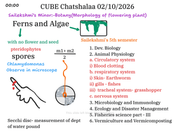
The botanical core of the session came from Sailekshmi’s third-semester Minor paper in Botany, which deals with the morphology of flowering plants, meaning the study of their outer physical parts. Her notes recorded two ideas from this paper. The first was the term tepal, used where petals and sepals cannot be told apart. The second was a set of identifying features of Phyllanthus amarus: an obtuse leaf apex, a rounded stem, greenish fruits, and tepals bearing white flowers. Arunan shared the Wikipedia page for Phyllanthus urinaria as a comparison. That page describes it as a summer annual, woody at the base, with leaves that fold at night, greenish-white flowers in the leaf axils and small warty green-red fruits along the underside of the stem.
The board then moved to Ferns and Algae. Sailekshmi described ferns as non-flowering vascular plants that reproduce through spores and not through seeds, and placed them among the pteridophytes. She shared the Britannica definition in the chat. Arunan, Manali and Kiran Varma widened the picture with resources on algae, green algae, terrestrial algae and gymnosperms. Kiran named Chlamydomonas as an example of an alga, and the board noted that it can be observed under a microscope. Aarya asked a basic but important question: what are spores, and how does a spore give rise to a new plant?
The board also carried a sketch of a Secchi disc. It showed a circular disc divided into four quadrants and lowered on a rope, with the expression (m1 + m2) / 2 written beside it. In the standard method, m1 is the depth at which the disc disappears from view, m2 is the depth at which it reappears when raised, and the two readings are averaged. The caption described it as a pond measurement. A small finger-with-blood sketch sat on the same slide and linked to the blood clotting topic from her fifth-semester syllabus.
Sailekshmi then listed her fifth-semester subjects on the right side of the board. They were Developmental Biology; Animal Physiology, covering the circulatory system (blood clotting), the respiratory system (skin in earthworms, gills in fishes, the tracheal system in grasshoppers) and the nervous system; Microbiology and Immunology; Ecology and Disaster Management; Fisheries Science Part III; and Vermiculture and Vermicomposting.
This comparison of syllabi led to the most animated stretch of the evening. Aarya explained that she and Manali study Biotechnology, with Genetics, Molecular Biology, and Medical Microbiology in their curriculum, while Kiran is a Zoology major. Aarya is in her third semester and expects Immunology, Biochemistry, and Biophysics next semester. She asked Sailekshmi for a preview of Immunology. She offered what she already knew: that it is the study of the immune system, antibodies, and antigens. Kiran Varma supplied a fuller definition of the discipline as the study of immunity and the body’s defence against infection. Manali and Aarya both had network trouble and followed part of the session on a hotspot.
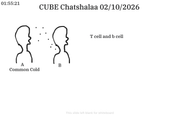
At the 1 hour 55 minute mark, the whiteboard moved to Immunology. Two heads were drawn facing each other, person A with a common cold and person B nearby, with dots of droplets travelling between them and the words “T cell and B cell” on the right. Aarya’s working description was that when B is exposed to the cold, the immune system fights it and keeps B healthy.
 Provocative Questions
-
A fern has no flowers and no seeds, yet it thrives. If spores can do the work of reproduction, why did seeds evolve at all, and what advantage did they give seed plants over fern-like ancestors?
-
Gymnosperms bear seeds but not flowers. Does the broad phrase “with no flower and seed” describe ferns accurately, and where would gymnosperms sit on that same slide?
-
Chlamydomonas is a single cell that swims, photosynthesises, and reproduces. Should we call it a plant, an animal, or neither, and what does the answer tell us about how we draw biological categories?
-
A Secchi disc is lowered on a rope and then raised again. Why do we take two readings, m1 and m2, and average them, and what does that tell us about the limits of a single human observation?
-
If the disc measures how deep we can see into water, what is it really measuring about the pond itself, and which living organisms might change the reading?
-
Tepals are described as petals and sepals that look alike. Why might a plant gain from not separating these two whorls?
-
If B is exposed to the same common cold droplets as A, what decides whether B falls ill or stays healthy, and where do T cells and B cells enter that decision?
-
Why does the board write “T cell and B cell” together? What different jobs do these two cell types perform, and why would the body need both?
-
Bivas Nag asked the Drosophila group to trace the cause behind an effect. Take any one sketch from tonight’s whiteboard, and ask: which cause lies behind it, and have we looked for it yet?
-
Sailekshmi’s fifth-semester list moves from blood clotting to vermicomposting. What common thread could connect such different subjects, and how might a student build that bridge?
 What I Have Learned
The first thing I learned is that a single board can hold a whole scientific journey. In one evening we moved from the shape of a flower to the spores of a fern, from a pond disc to the cells that guard the body against a cold. That range showed me that biology is best understood as connected pieces and not as separate chapters.
Second, I learned the real meaning of a tepal. It is the term for a flower part that cannot be neatly called a petal or a sepal, and the plant’s perianth shows the same appearance across both. Learning this helped me understand why botanists need such a word.
Third, I now understand that ferns and algae share the absence of flowers and seeds but are not close relatives in every other way. Ferns are vascular plants that reproduce by spores, whereas algae are simpler organisms. The Wikipedia page on green algae also surprised me by explaining that land plants arose from within the green algae.
Fourth, the Secchi disc taught me that a simple tool can give a respectable scientific measurement. The idea of lowering the disc until it vanishes, raising it until it returns, and averaging the two depths is a lesson in careful observation.
Fifth, I saw how much we gain when learners from different courses sit together. Aarya, Manali, and Kiran study different syllabi, yet each of their questions made the explanation clearer for everyone. A question like “what are spores?” is never small.
Finally, I took home Bivas Nag’s reminder to look for the cause behind the effect. It is a habit I want to bring to every observation I write up in the future.
 TINKE Moments (This I Never Knew Earlier)
TINKE moment 1: Algae are not only found in water. The Wikipedia category page on terrestrial algae, shared in the chat, shows that algae also live on soil, rocks, and tree bark. The green algae article adds that Trentepohlia can live independently on humid soil, rocks, or tree bark. For many of us, algae meant ponds, and this link changed that picture.
TINKE moment 2: Seeds without flowers. The gymnosperm link posted by Manali drew attention to a group that bears seeds without flowers. This sharpened the board’s statement about ferns, because “no flower and seed” is true for ferns and algae but not for gymnosperms.
TINKE moment 3: Land plants emerged from within the green algae. The Green algae page explains that the embryophytes arose deep within the charophytes, so the green algae and land plants form one green lineage. Chlamydomonas, written on the board as a microscope exercise, belongs to that wider family story.
TINKE moment 4: A Secchi disc is read twice. The expression m1 + m2 over 2 on the board shows that the final figure is an average of the depth at which the disc disappears and the depth at which it reappears. Many of us had assumed one reading was enough.
TINKE moment 5: Tepals are not a fused structure. The shared notes recorded tepals as fused petals and sepals, but the more accurate meaning is that these parts look alike and cannot be told apart. Seeing this correction made the term much easier to remember.
TINKE moment 6: Immunology has two cellular partners. Aarya arrived with antibodies and antigens, and the evening added T cells and B cells to the picture as the cell types written on the second board. This gave a first, useful map to someone about to begin the subject.
 Gaps and Misconceptions
Gap 1: The Secchi disc is not a depth gauge. It was described during the session, and written on the board, as a measurement of the depth of pond water. The disc actually measures water transparency, or clarity, by finding the depth at which it can no longer be seen. The rope length is only the tool used to take the reading. Turbidity from silt or dense algal growth shortens the reading, so a clear shallow pond and a murky deep one can give very different values. The mention of a “long method” suggests the group may have been unsure of the purpose, and a short practice at a real pond would settle it.
Gap 2: Tepals are not fused petals and sepals. The shared note describes tepals as petals and sepals fused. The term is used when the two outer whorls of a flower look alike and cannot be told apart. Fusion is a separate feature and can occur in either case.
Gap 3: “No flower and seed” does not describe every plant group on the board. It fits ferns and algae, but gymnosperms, which were linked in the chat, bear seeds without flowers. The slide would be clearer if it separated spore-bearing plants from seed-bearing ones.
Gap 4: Algae and ferns are not the same kind of organism. They were placed side by side on one slide, and they do share the absence of flowers and seeds. Ferns are vascular plants with true roots, stems, and leaves, while algae are far simpler. The Green algae page notes that the group includes everything from single cells to large seaweeds.
Gap 5: Spores need a clearer explanation. Aarya asked what spores are and how they produce a new plant, and the written chat shows no full answer. In ferns, a spore is a tiny reproductive cell that, in suitable conditions, grows into a small gametophyte stage, and that stage later produces the new fern plant. The two-stage life cycle is worth a short session of its own.
Gap 6: The immune system does not simply guarantee health. The statement that B’s immune system will fight the cold and keep B healthy is a good starting point but is incomplete. Exposure does not always lead to illness, and illness is not always avoided. The outcome depends on the dose of virus, previous exposure and the strength of both the early, general defences and the later, specific defences carried out by T and B cells. Many of the symptoms of a cold are also produced by the immune response itself.
Gap 7: T cells and B cells are not interchangeable. The board names them together, but B cells are the cells that make antibodies, whereas T cells help coordinate the response and destroy infected cells. A learner meeting Immunology for the first time may take “T cell and b cell” as one object, and the lowercase “b” on the board may add to that confusion.
Gap 8: Small writing errors can carry real scientific meaning. The board reads “dept of water pound,” and the notes use “Phyllanthus amerus”. The correct forms are “depth”, “pond,” and “Phyllanthus amarus”. Careful spelling of scientific names is part of good scientific practice.
 Photographs during Chatshalaa


 Reference