# S3E15 Cube chatShaala: Exploring new ways of Learning
**URL:** https://metastudio.org/t/s3e15-cube-chatshaala-exploring-new-ways-of-learning/5249
**Category:** Events
**Created:** [November 23, 2020, 9:19am UTC](https://metastudio.org/t/s3e15-cube-chatshaala-exploring-new-ways-of-learning/5249 "2020-11-23T09:19:51Z")
**Posts on this page:** 3
**Page:** 1
### Author:  [@KiranKalakotiR](https://metastudio.org/u/KiranKalakotiR)
#### Post date: [November 23, 2020, 9:19am UTC](https://metastudio.org/t/s3e15-cube-chatshaala-exploring-new-ways-of-learning/5249/1 "2020-11-23T09:19:51Z")
Meeting URL
[webinar.hbcse.tifr.res.in](https://webinar.hbcse.tifr.res.in/b/kir-vgc-6jf)

### [HBCSE Webinar](https://webinar.hbcse.tifr.res.in/b/kir-vgc-6jf)
A front-end for HBCSE web conferencing server. You can create your own rooms to host sessions, or join others using a short and convenient link.
Please click on the **HBCSE Webinar** above to join the **CUBE ChatShaala**
**Timing:5.30 pm to 9.30 pm**
Webinar will be recorded and recording link will be post in the same thread after the webinar.
Looking forward to your participation.
Thank
---
### Author:  [@drishtantmkawale](https://metastudio.org/u/drishtantmkawale)
#### Post date: [November 23, 2020, 5:30pm UTC](https://metastudio.org/t/s3e15-cube-chatshaala-exploring-new-ways-of-learning/5249/2 "2020-11-23T17:30:11Z")
**CUBE Chatshaala on 23rd November 2020**
**43 CUBists** from **35 centres** joined the webinar.
[Map](https://www.google.com/maps/d/u/0/edit?mid=1lbHsjc7S2xAUbw4v_xnI6YyZ7wIed4DL&usp=sharing)
**ANDHRA PRADESH:**
Nellore: Anoopa.O, Indira, Tejasree
**ASSAM:**
Narsing High School, Silchar: Hasina Begam
Sonari: Susanta Tanti
**BIHAR:**
Sitamarhi: Anamika Singh
**DELHI:**
AND College: Sarita Kumar
**GOA:**
Jivisha Kolwalkar
**KARNATAKA:**
Bangalore: Deepika Iyyangar
**KERALA:**
Varkala: Aavani RG
Muvattupuzha: Abhijith Vinod
Kozhikode: Arunima
Ernakulam: Ashikha Farzana K.M., Essabell Philomina
Kandassankadavu: Lakshmy
Thrissur: Rayis
Palakkad: Shrudhiga
Thanniam, Thrissur: Sidhy PP
**MAHARASHTRA:**
South Bombay: Arunan MC
Ambernath: Aakanksha Sunilkumar
Ghatkopar: Aashutosh Mule
Thane: Anshu Kadam
Nerul: DK
Powai: Lydia Mathew
Kalyan: Mayur Gaikwad
Thane: Prashant Palane, Priti Kanade
Dahanu Road, Palghar: Sachin Pradhan
Bandra: Saida Sayyed
Panvel, Navi Mumbai: Shraddha Sonavane
Murbad, Kalyan: Shubham Isame
**UTTAR PRADESH:**
Kanpur: Bareera Javed, Hina Mudgal
Moradabad: Kiran Yadav
**WEST BENGAL:**
GHS, Kalyani: Aranyak Sarma, Koulab Mukherjee, Sharanya Basu, Sreemanti Das
Kolkata: Batul Pipewala
Adith
Deepthy Maria
Pooja CK
Sreya A.S.
---
### Author:  [@drishtantmkawale](https://metastudio.org/u/drishtantmkawale)
#### Post date: [November 23, 2020, 7:24pm UTC](https://metastudio.org/t/s3e15-cube-chatshaala-exploring-new-ways-of-learning/5249/3 "2020-11-23T19:24:35Z")
**CUBE ChatShaala: 23rd Nov 2020**
The discussion started with fruitflies in West Bengal.
**CUBists** from **Garden High School Kalyani, WB and Kolkata, WB** are trapping fruitflies using several baits.
@magpie in Kolkata says that the frequency/number of fruitflies coming towards the bait has decreased and that in Kalyani, the fruitflies are gathering in considerable numbers (~40 flies).
**Why is there a change in the number of flies between two places that are just 65kms apart?**
Temperature?
@magpie said that the weather in Kolkata has changed from 3-4days and it has become cool around.
If we talk about temperatures in the respective places;
**Kolkata** -Max:27’C Min:14’C
**Kalyani** -Max:27’C Min:13’C
[https://www.accuweather.com/en/in/kolkata/206690/weather-forecast/206690](https://www.accuweather.com/en/in/kolkata/206690/weather-forecast/206690)
[https://www.accuweather.com/en/in/kalyani/196709/weather-forecast/196709](https://www.accuweather.com/en/in/kalyani/196709/weather-forecast/196709)
Is it a drastic change? What if we try to focus on other parameters such as **the tidiness of the surroundings, type of bait(s) used, location of bait, etc.**
**These are the variables that are giving us a different outcome(s) (maybe)!**
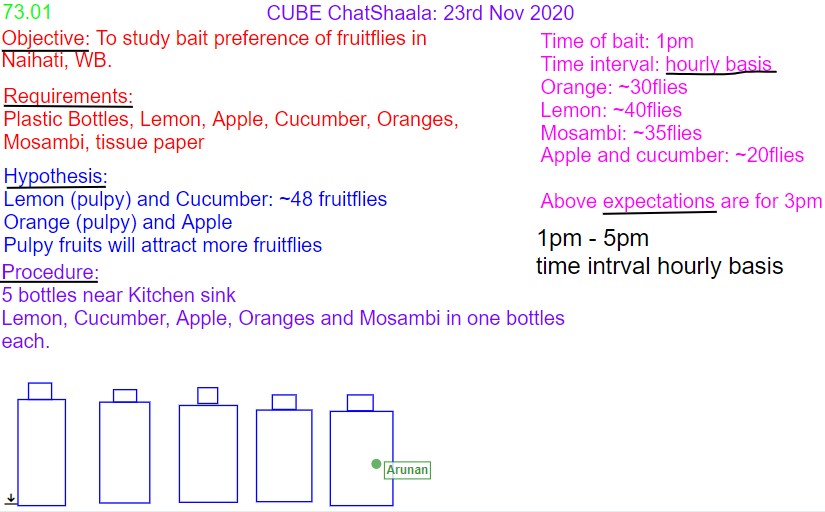
Sharanya from Naihati, WB was successful in **observing fruitflies in some of the baits that were kept.**
The baits that were kept; **Lemon, Orange, Mosambi, Banana peels, Apple and Cucumber slices (Oh what a buffet!)**
One of her observations was that **pulpy fruits such as Lemon, Orange, Mosambi, Cucumber attracted more flies as compared to Banana peels and Apple.**
Why that? What is the **special thing that pulpy fruits** have (that is absent in nonpulpy ones)?
**Are they carbonated? If so, then will the fruitflies get attracted to any carbonated drinks/beverages😅?**
To see if fruitflies really get attracted to pulpy fruits is large numbers, Sharanya **designed an experiment** that is depicted in the picture above. It is a self-explanatory slide.
**Do ask questions for clarification and suggest improvements in the design!**
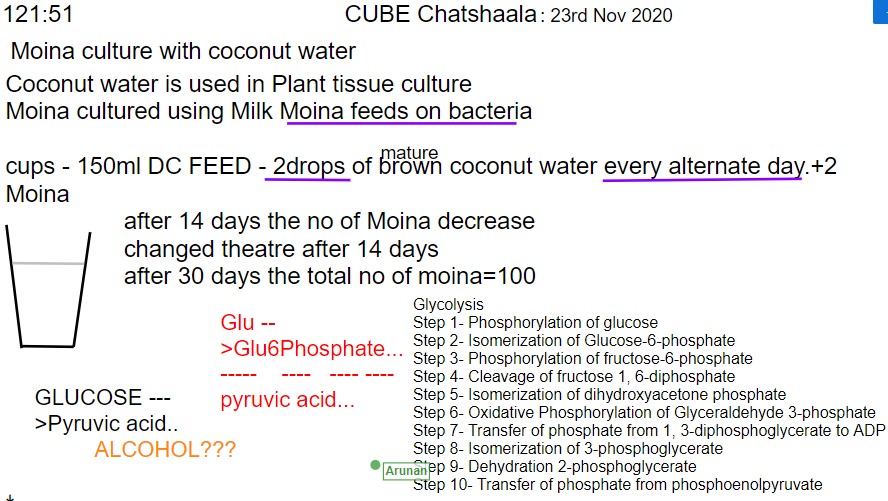
**Ever heard of culturing Moina with coconut water?** \*
Yes! CUBist Abhijith Vinod from Kerala has been culturing/maintaining Moina by feeding them coconut water!
Isn’t it surprising?
Abhijith had tried this out of curiosity as he knew that coconut water is effective in Plant Tissue Culture (PTC), and it worked!
**“A preliminary study has shown that the addition of 15% (v/v) coconut water (CW) to the culture medium significantly improved callus growth, shoot-regenerative capacity, and shoot growth in leaf disk cultures of spinach (Spinacia oleracea L.).”**
[https://www.researchgate.net/publication/279463326](https://www.researchgate.net/publication/279463326)
But he didn’t know on **what are Moina exactly feeding on?** In the **conventional method of maintaining Moina in CUBE,** we use **milk (having carbs, fats, proteins, vitamins, minerals) as the feed for bacteria** upon which Moina feed.
**What happens when we add coconut water?**
Here, **mature coconut (brown) water** is being used and **not tender (green) coconut water.**
If we apply the same theory (of milk and bacteria) here as well, there comes a question.
What in coconut water are the bacteria feeding on?
**“Ounce (~28g) per ounce, most unflavored coconut water contains 5.45 calories, 1.3 grams of sugar, 61 milligrams of potassium, and 5.45 milligrams of sodium.”**
[https://www.webmd.com/food-recipes/features/truth-about-coconut-water](https://www.webmd.com/food-recipes/features/truth-about-coconut-water)
1.3grams of sugar!! 1.3grams of carbs!! **Carbohydrates are what the bacteria want (majorly) for energy!**
Is it not? When we take any organism, **it will need energy (in the form of ATP) to reproduce, to metabolise (degrade and synthesise).**
Where is this energy coming from?
We talk about **Glycolysis, Krebs cycle and Electron Transport Chain (ETC)** if we want energy.
The **former gives 2ATP molecules** (on glucose breakdown) and the **latter two give 36ATP molecules** combined.
Also, we talk of fermentation by **_Yeast,_ fermenting bacteria.**
What is fermentation? **Is it not the breakdown of carbs into simple molecules that are further processed to give energy?** If we take breakdown of Glucose (a monosaccharide), it undergoes Glycolysis (the breakdown of glucose)
And in the process, **by-products such as ATP, acid, alcohol, carbon dioxide (effervescence)** are given out.
**Procedure for _maintaining Moina by adding coconut water_ is described in the self-explanatory slide!**
We also discussed **how Glycolysis and Krebs Cycle are related?**
The intermediary molecule **_pyruvic acid/pyruvate_ undergoes _oxidative decarboxylation_ (removal of carbon dioxide as a result of oxidation reactions) to become _Acetyl-CoA_ that becomes a reactant alongwith _Oxaloacetate_ in the first step of Krebs cycle.**
[http://oregonstate.edu/instruction/bb350/spring12/highlightscitricacid.html](http://oregonstate.edu/instruction/bb350/spring12/highlightscitricacid.html)
Why are we studying topics like these if we are leaving out the intermediary connections that occur in two different organelles altogether!
**These crucial steps often get ignored in the longer race!**
Models such as _Fruitflies, Moina, Earthworms_ provide us _context to study topics of the curriculum like these!_
For a short while, we discussed the **maintenance of _Zebrafish_ (this time in detail).**
Tejasree and other collaborators from Nellore, AP have been maintaining zebrafish in their institute.
Zebrafish eggs are fertilised externally!
While discussing, we came to know that zebrafishes eat their own eggs (if not separated).
Why do they eat their own eggs? Do they even know that these are eggs?
**We often humanise such instances.**
For them, it maybe just another thing in the water! Who knows?
To prevent the fish from eating the eggs, after egg-laying )and maybe fertilisation) is done, a nylon net is placed so that the fishes do not reach the eggs.
Tejasree also shared that they had brought fishes in their homelabs and due to some reasons, they didn’t survive.
They suspect that there maybe two reasons for this to happen;
**i) fluctuation in pH ii) fluctuation in dissolved oxygen concentration.**
If these are the reasons, **how do the fishes survive in the freshwater bodies?**
**Zebrafishes are found in the Ganges, rivers of the east. Is it not a matter of concern there?**
_In fact, the fishes are prone to death in those conditions because if we see, human activities do prevail (in these rivers/freshwater bodies) that can cause a change in pH, dissolved oxygen and what not!?_
This rules out both of the reasons.
What could be the reason(s)? Let’s discuss!
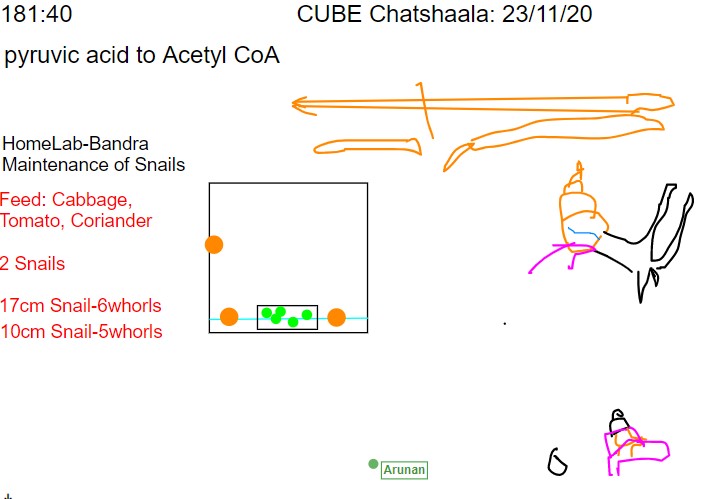
Later, **we wriggled towards the Snail model system😅.**
@saida786110 from Mumbai has been maintaining snails that are suspected to be giant (really giant) African land snails!
One of them in ~17cms (centimetres) long having 6whorls in its shell and the other one is ~10cms long having 5whorls.
**The setup of maintenance is described in the slide.**
If a newly hatched snail has two whorls in its shell, then we see that as the snail ages, the shell size as well as, the number of whorls increase gradually. **How are new whorls added in the existing ones?**
From which end do the whorls grow/get added? Distal (away from the body) or Proximal (close to the body) end?
In the end, we discussed a few brainstorming points on **earthworm immunity.**
Everyone, kindly add to it so that our group doesn’t remain silent!