CUBE ChatShaala – Discussion Summary
Day 2407 | 21st October 2026
Today’s ChatShaala brought together ten Cubists from ten centres across India: Uttarakhand (Dehradun, Bageshwar), Goa (Thivim), Maharashtra (Mumbai), Kerala (Panipally and Trivandrum), Uttar Pradesh (Noida) and Chhattisgarh (Pamgarh). The whiteboard ran for roughly an hour and a half and moved between two linked themes: how we measure growth in the human body, and how some animals rebuild lost body parts.
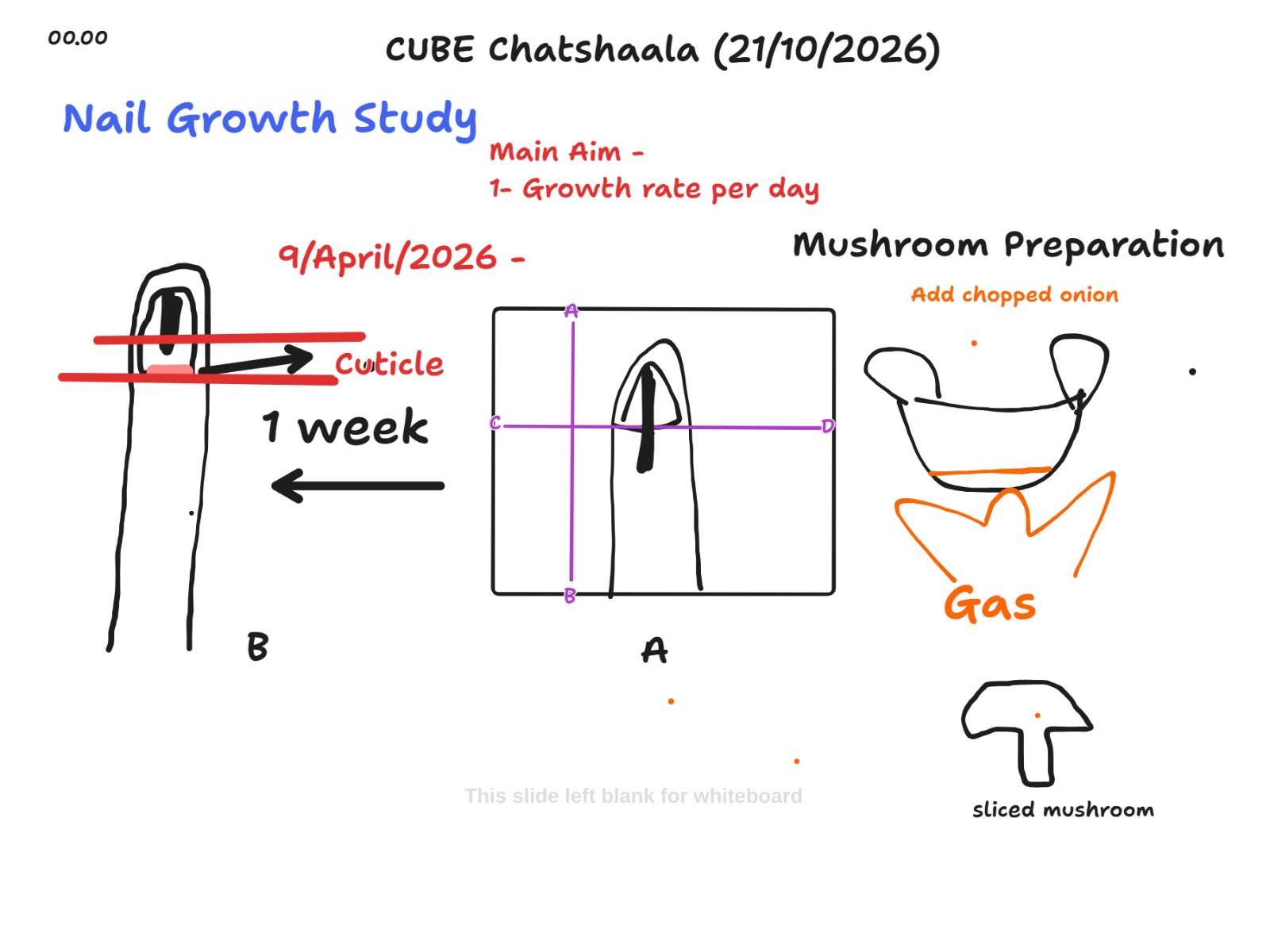

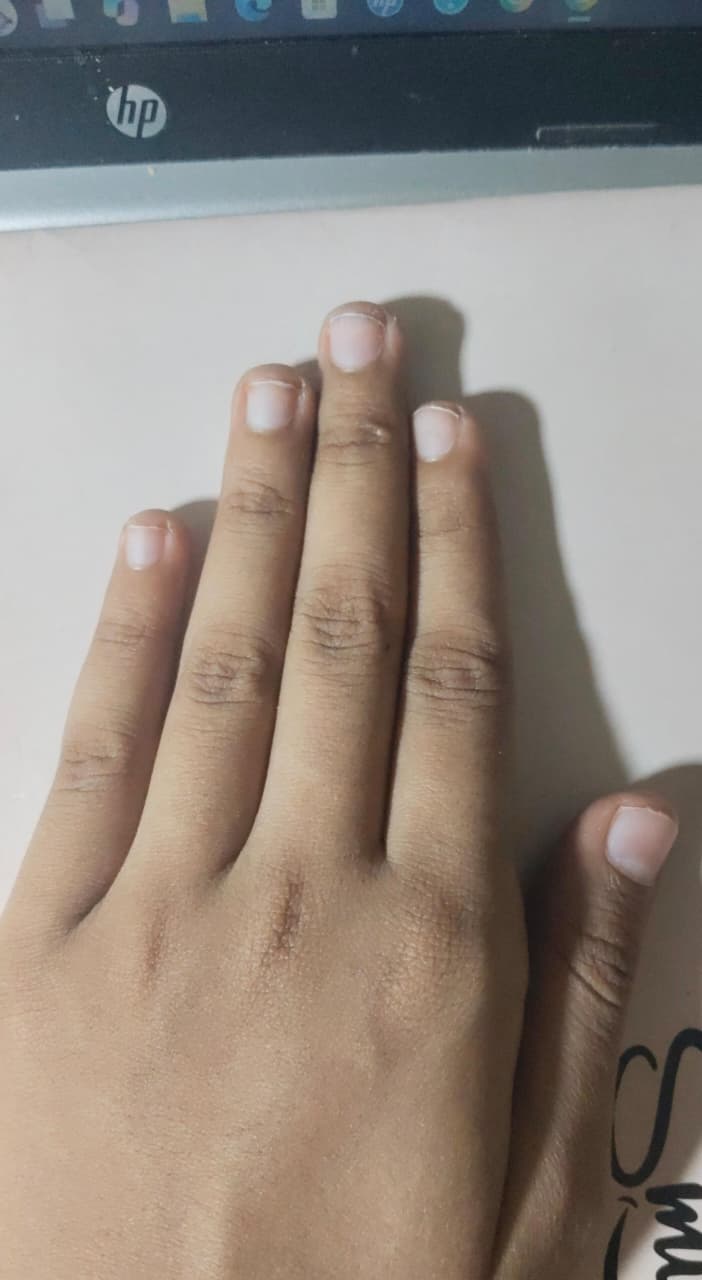
The session opened with the Nail Growth Study, a citizen science exercise documented by one of our members. The stated aim was to work out the growth rate of a nail per day. The nail was marked on 9 April 2026, and the mark was tracked as the nail grew out from the cuticle. The whiteboard showed a fingertip with two reference lines, one at the cuticle and one at the marked edge. An arrow indicated how far the mark moved over one week. A second sketch showed the finger placed on graph paper with perpendicular axes, A–B running along the length of the finger and C–D running across it. This setup gives every photograph the same frame of reference, so the distance moved can be read off the grid. The photo series reviewed in the session ran from the day of marking, 9 April, through 10 April, 16 April, 20 April, 26 April, 7 May, 27 May, 10 June and 25 June 2026. In the earliest images, the marking is bold and sits at the base of the nail. It shifts steadily towards the tip, and by late June it has almost disappeared. A later photograph of the hand was also shown as a record of the nails after the study.
The next whiteboard section was headed Mushroom Preparation. It showed a pan with chopped onion added, a flame labelled gas, and a sliced mushroom drawn beside it.
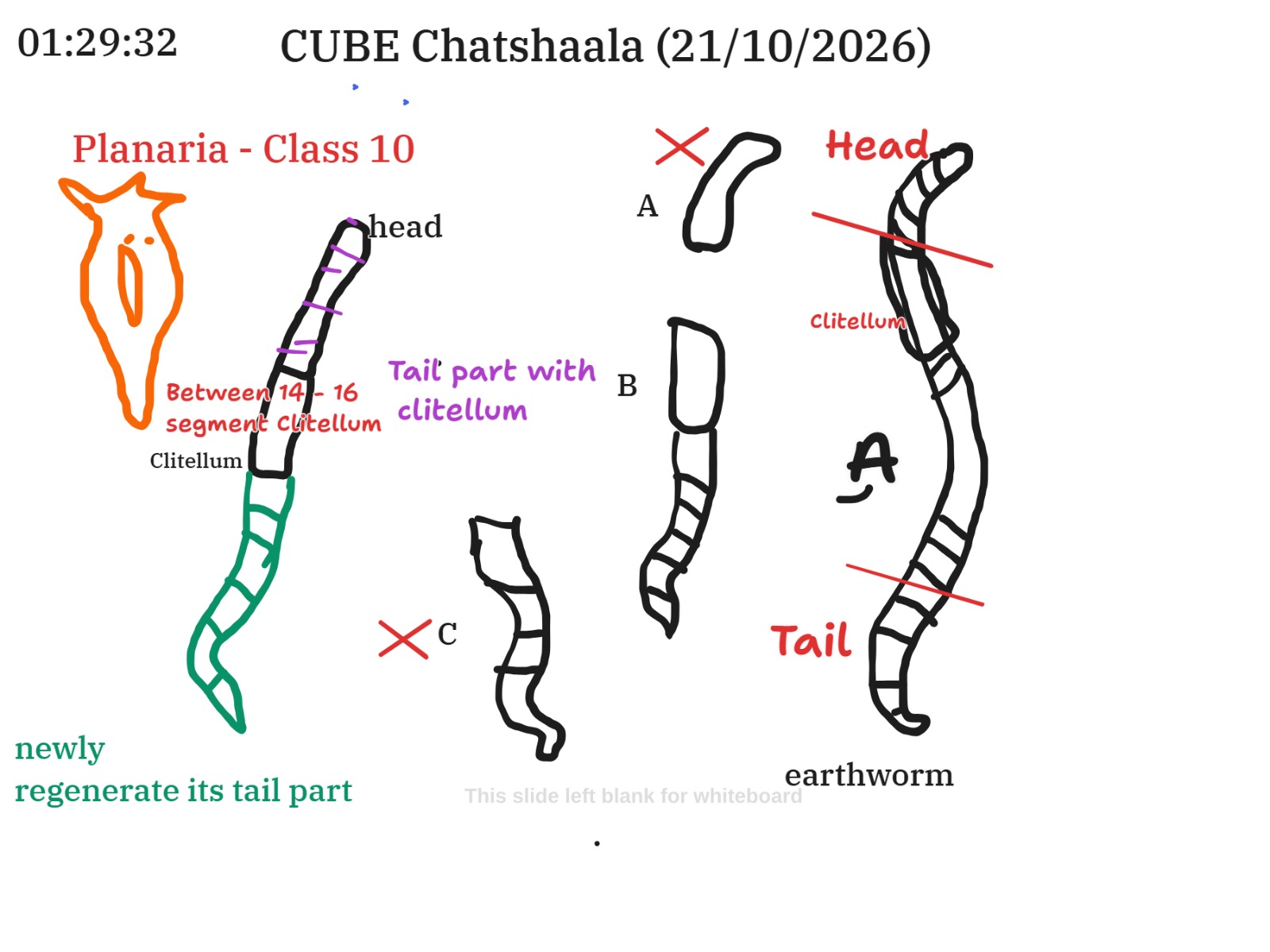
The discussion then turned to regeneration, beginning with Planaria as it appears in the Class 10 syllabus. The flatworm was sketched with its head region, eye spots and central pharynx. This led into a longer exercise on the earthworm, which the group linked to the older Metastudio thread on regeneration in earthworms. The earthworm was drawn with its head, tail and clitellum, the thickened glandular band, marked at segments 14 to 16. A cut worm was then shown as three fragments, labelled A, B and C. Fragment A, the head end alone, and fragment C, a tail piece without the clitellum, were both crossed out. Fragment B, the piece carrying the clitellum, was left unmarked. A separate sketch showed a worm with its tail portion newly regenerated, drawn in green. The whiteboard therefore posed a question: which piece of a cut worm has the best chance of rebuilding itself, and what decides this?
 Provocative Questions
-
In the nail study, the mark moves because the nail grows, not because the skin does. How can we be sure that the line we are tracking is a reliable stand-in for the nail plate alone?
-
Why did we need graph paper with fixed A–B and C–D axes? What errors would creep in if each photograph were taken freehand, from a slightly different height or angle?
-
The marking nearly vanished by June. Is that a sign of fast growth, of the ink wearing off, or of both? How could the study be designed to tell these apart?
-
If a single person’s nail grows at a certain rate, how much can we say about nail growth in general? How many participants would turn a personal observation into a dependable finding?
-
A planarian can regrow an entire body from a fragment, yet an earthworm does not seem to do so equally from every piece. What does that tell us about regeneration being a matter of degree and not a yes-or-no ability?
-
Why do the crossed-out fragments A and C fail while fragment B is left standing? Is the clitellum a cause of regeneration, or does it simply mark which part of the body is present?
-
Segments 14 to 16 hold the clitellum in the worm we drew. Would the same count apply to every earthworm species, and what does that mean for using segment numbers as a rule?
-
If we cut a worm at a different level, such as a few segments further back, would the outcome change? How would a home lab test this safely and ethically?
 What I Have Learned
The most useful lesson for me was that a good experiment depends as much on its method as on its question. The nail study is simple in idea, yet it only becomes reliable when the reference frame is fixed, the dates are logged, and the photographs are comparable. The graph paper and axes turned a casual photo into a measurement.
I also learned to read a long photo series as a story in time. Looking at the images from April to June, I could see the mark move and fade, and I understood why a growth rate per day needs repeated readings and not a single before-and-after comparison.
On regeneration, I learned that the answer to what a cut worm can regrow depends on which piece survives and where the cut falls. The whiteboard made me think about the clitellum as a landmark in the body, not only as a structure with its own function. Placing Planaria next to the earthworm helped me see regeneration as a range, with some animals far more capable than others.
Finally, I was reminded that careful observation in a home lab, shared across ten centres, can raise questions as sharp as those from a formal laboratory.
 TINKE Moments (This I Never Knew Earlier)
-
A mark can act as a ruler. I had not thought of marking the nail near the cuticle and following it as a way of measuring growth over time. The marking turns an invisible, slow process into something we can see and measure.
-
Graph paper is a scientific tool. The A–B and C–D axes showed me that a fixed frame is what makes photographs from different days comparable.
-
Not every piece of a cut worm is equal. The crossed-out fragments A and C and the unmarked fragment B showed that the outcome depends on which part of the body a piece carries.
-
The clitellum sits at segments 14 to 16 in the worm we sketched. Having a numbered position gave the structure a place on the body map and made the cut-and-regrow question easier to reason about.
-
Planaria in Class 10 is a doorway to a larger idea. A school-level example connects directly to research questions about how bodies rebuild themselves.
 Gaps and Misconceptions
Gap in the data: the nail photographs show the mark moving and fading, but the session did not settle on a number for growth per day, since the board only carried the aim and the one-week interval. A calculated rate, with the distance in millimetres between marking and measurement, would complete the study.
Gap in controls: ink fading, washing, and trimming can all change what the camera sees. Noting these in the log would strengthen the conclusions.
Gap in sample size: one person’s nail is a single case. Comparing it with other Cubists would show how much of the rate belongs to the individual.
Misconception: that any piece of a cut earthworm will grow into a new worm. The whiteboard marks only one fragment as promising, and the outcome depends on where the cut falls and which segments remain. The popular idea that cutting a worm in half produces two worms is therefore too simple.
Misconception: that regeneration works the same way across animals. Planaria and earthworms differ widely in what they can rebuild, and the difference matters when comparing them.
Misconception: that the clitellum is only about reproduction. It is a useful landmark for reading the body plan, and its position helps in judging what a fragment contains.
 Photographs during Chatshaala
 Referance