 CUBE Chatshaala - Discussion Summary
The CUBE Chatshaala session on September 4, 2026, brought together citizen science researchers to discuss home laboratory investigations and formulate testable biological hypotheses. The meeting opened with updates from Niharika in Bageshwar, Uttarakhand, who detailed her recent experiments on water solubility and the dynamics of root nodule development in leguminous plants.
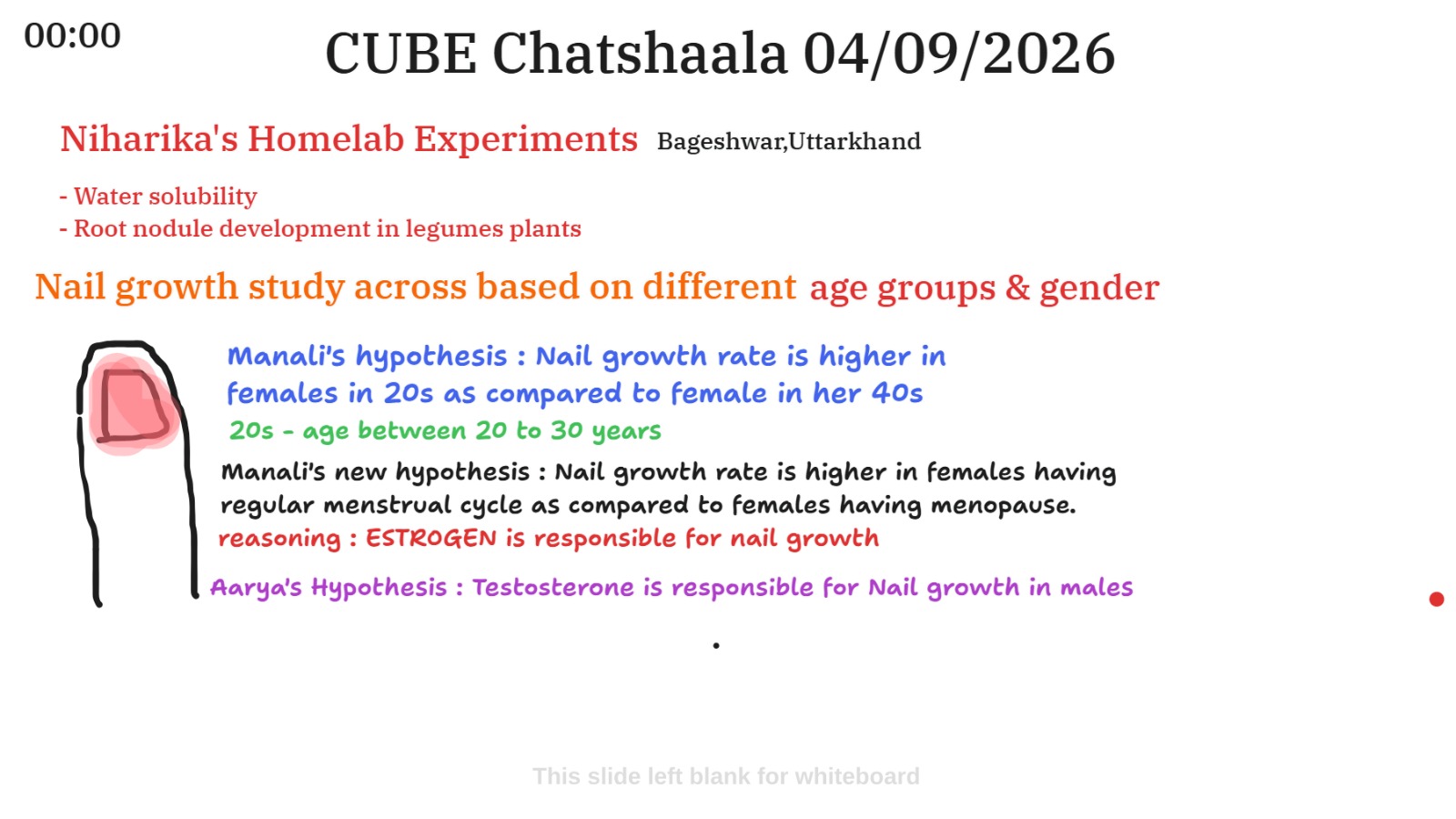
The centerpiece of the session was an interactive evaluation of the nationwide citizen science study tracking human nail growth using voter’s ink markers. Participants discussed how demography and endocrine changes influence growth rates. Manali initially proposed that females in their 20s experience a higher nail growth rate than females in their 40s. As the conversation evolved, she refined this into a mechanism-driven hypothesis: females with regular menstrual cycles display faster nail growth rates than post-menopausal females, citing estrogen as the primary driver behind nail matrix activity.
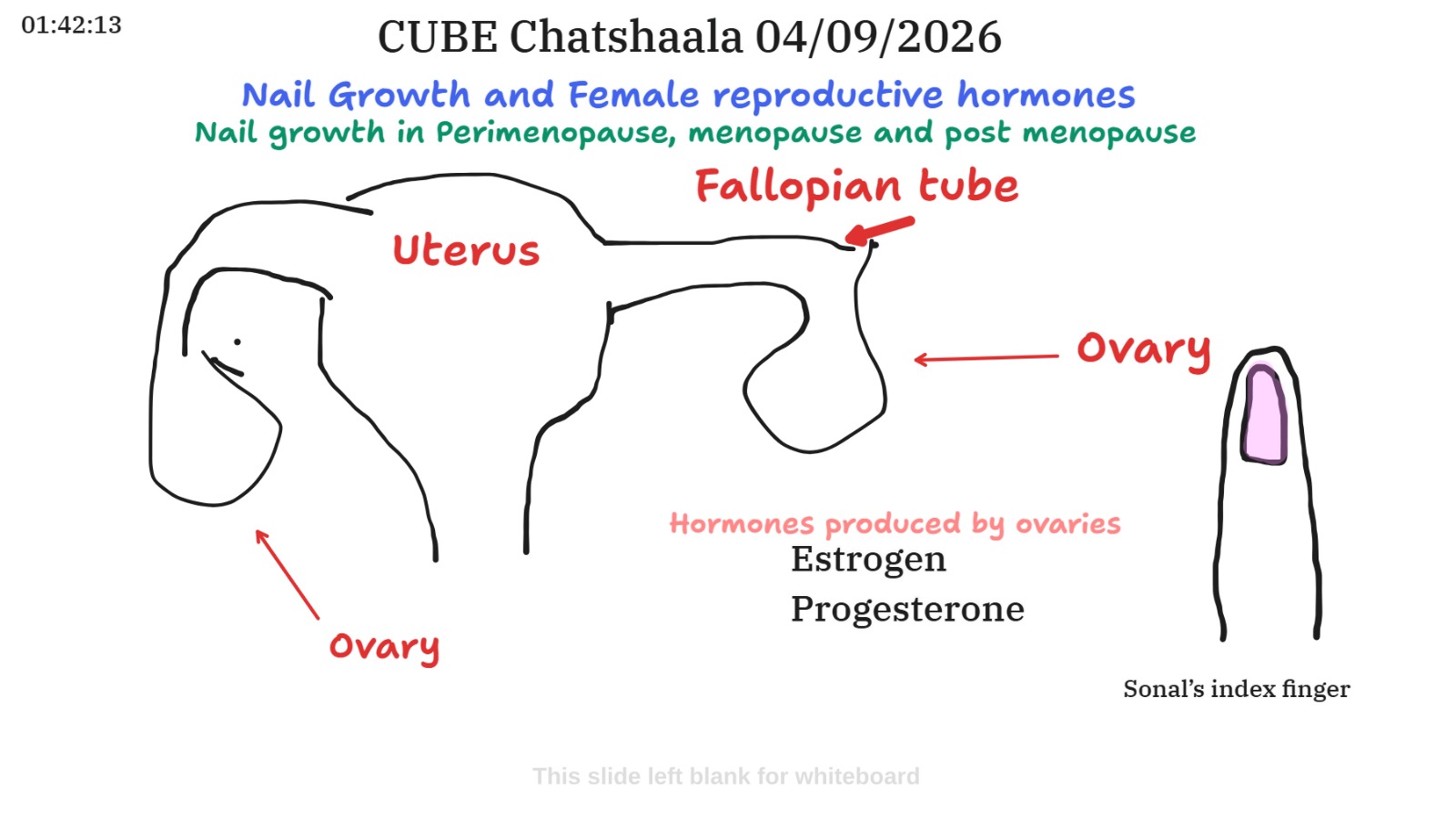
In response, Aarya put forward a complementary hypothesis for male physiology, suggesting that testosterone is the primary factor governing nail growth in males. To ground these hypotheses in biological structure, the group examined female reproductive anatomy—including the uterus, fallopian tubes, and ovaries—and discussed how ovarian production of estrogen and progesterone connects systemic hormonal regulation to localized physical traits like nail regeneration.
Provocative Questions
-
How can we effectively isolate the influence of systemic hormones like estrogen or testosterone on keratinocyte proliferation from confounding variables such as seasonal temperature shifts, physical activity, or dietary protein intake?
-
What baseline protocols can citizen science home laboratories implement to separate age-related reductions in capillary blood flow from primary endocrine declines during menopause?
-
Is voter’s ink displacement sensitive enough to measure micro-scale weekly variations, or should the project transition to standardized macro-photogrammetry across all participating home labs?
-
If estrogen and testosterone drive matrix cell division in females and males respectively, how would nail growth patterns behave in individuals undergoing hormonal therapy or experiencing endocrine imbalances?
What I Have Learned
-
Mechanistic Over Correlative Thinking: Refining a research question from a simple age comparison (20s vs. 40s) to a physiological hypothesis rooted in hormonal status (menstrual cycle vs. menopause) creates a far more rigorous scientific inquiry.
-
Systemic-to-Local Biological Links: Small physical indicators—such as the growth rate of a fingernail—can serve as accessible, non-invasive proxies for monitoring broader systemic physiological processes and endocrine activity.
-
Power of Decentralized Collaboration: Homelab experiments become significantly stronger when diverse participants benchmark their individual measurements against shared anatomical and physiological frameworks.
 TINKE Moments (This I Never Knew Earlier)
-
Ink Line Degradation: A notable hurdle during data collection is the gradual fading and blurring of voters’ ink marks on the nail plate due to daily hand washing and friction, which complicates precise long-term tracking without clear macro imaging protocols.
-
Menstrual Phase Variations: Accounting for normal fluctuations of estrogen and progesterone across different phases of the menstrual cycle makes establishing a single “baseline” growth rate for pre-menopausal females difficult without detailed cycle logging.
 Gaps and Misconceptions
-
Single-Hormone Oversimplification: Attributing nail growth exclusively to estrogen or testosterone ignores the interconnected nature of the endocrine system; thyroid hormones, human growth hormone, and vascular microcirculation play equally critical roles in matrix cell proliferation.
-
Gender-Exclusive Hormonal Roles: Assuming testosterone acts exclusively in males and estrogen in females overlooks the presence and necessity of both hormones across sexes, as well as processes like testosterone aromatization into estrogen that impact local tissue circulation.
-
Digit Uniformity Assumption: Treating a single digit (such as an index finger) as a complete representative of an individual’s systemic growth rate ignores localized variations caused by dominant hand usage, daily mechanical stress, or minor physical trauma.
 Photographs during Chatshaala

 Referance
- 🗳️✨ Ballot Mark Through Real Science
- Nails During Perimenopause and Menopause: The Complete Science-Based Guide - Womeno
- Distinctive nail pattern following androgen replacement therapy - PMC
- https://healthinmenopause.co.uk/looking-after-your-skin-nails-and-hair/
- Nail Growth study using voter's ink ,Loksabha Election 2024