 CUBE ChatShaala Summary – 29.07.2025
 Focus of the Day
Today’s ChatShaala investigated Tarannum’s objective — Making curd without adding any starter culture. The session bridged microbiology and chemistry to explore how milk curdles through natural or induced changes in pH and the behavior of casein proteins.
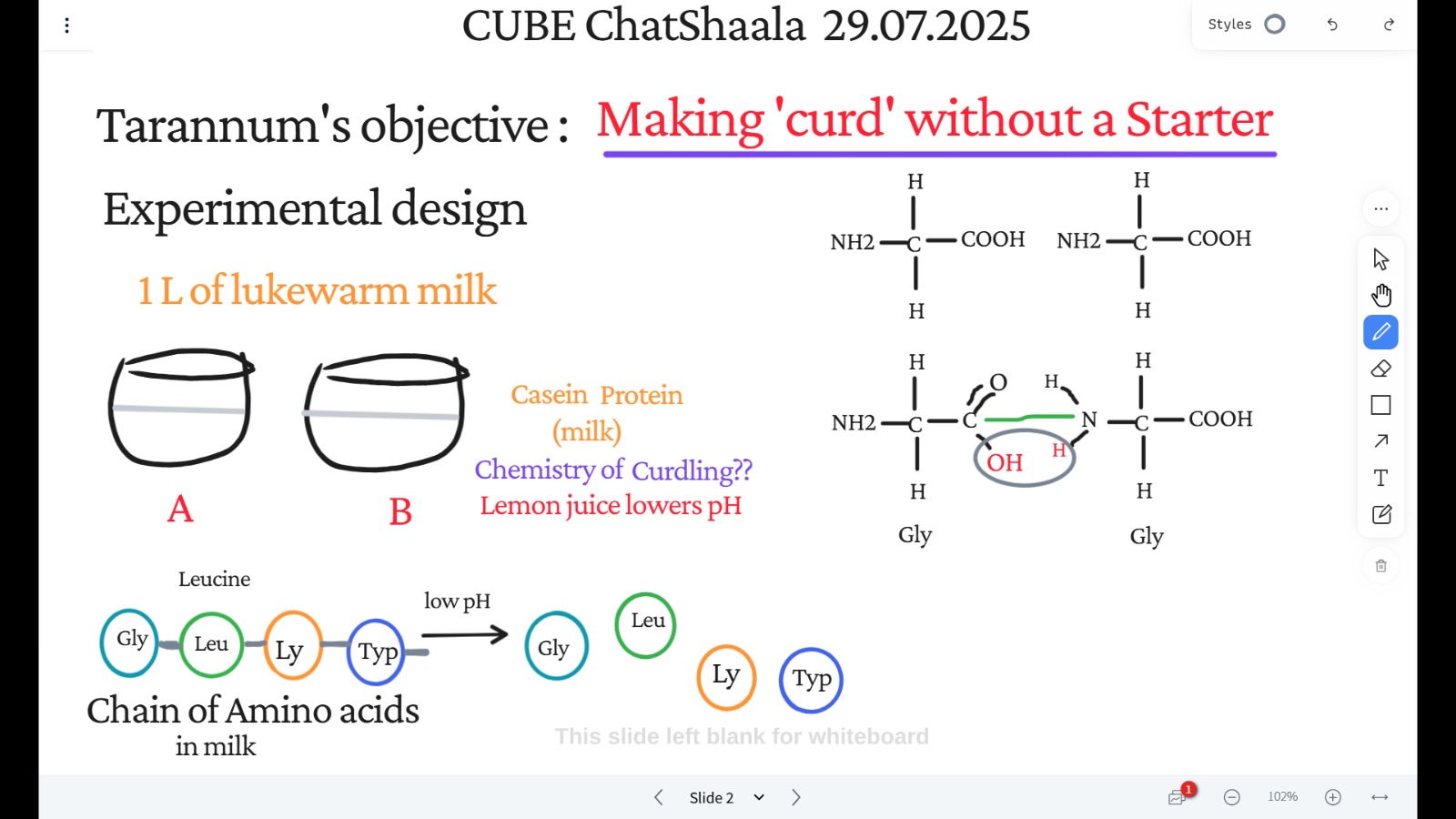
 Experimental Setup – 1L Lukewarm Milk in Two Containers
-
Container A: 1 L lukewarm milk (used as control).
-
Container B: Same milk but subjected to a variable — such as lemon juice (acidic pH shift).
The discussion explored how milk proteins (primarily casein) respond to acid and temperature.
 Protein Chemistry of Curdling
Casein, a major milk protein, exists in long chains of amino acids like Glycine (Gly), Leucine (Leu), Lysine (Lys), and Tryptophan (Trp).
These proteins are usually dispersed in milk, but when the pH drops (via lemon juice or fermentation), the casein denatures.
The structure breaks and reorganizes into clumps (curds), separating from whey.
The slide also depicted a peptide bond and hydrogen interaction between amino acids, emphasizing how the chemical environment (pH) disrupts protein structure.
 Hydrophilic vs Hydrophobic Behavior
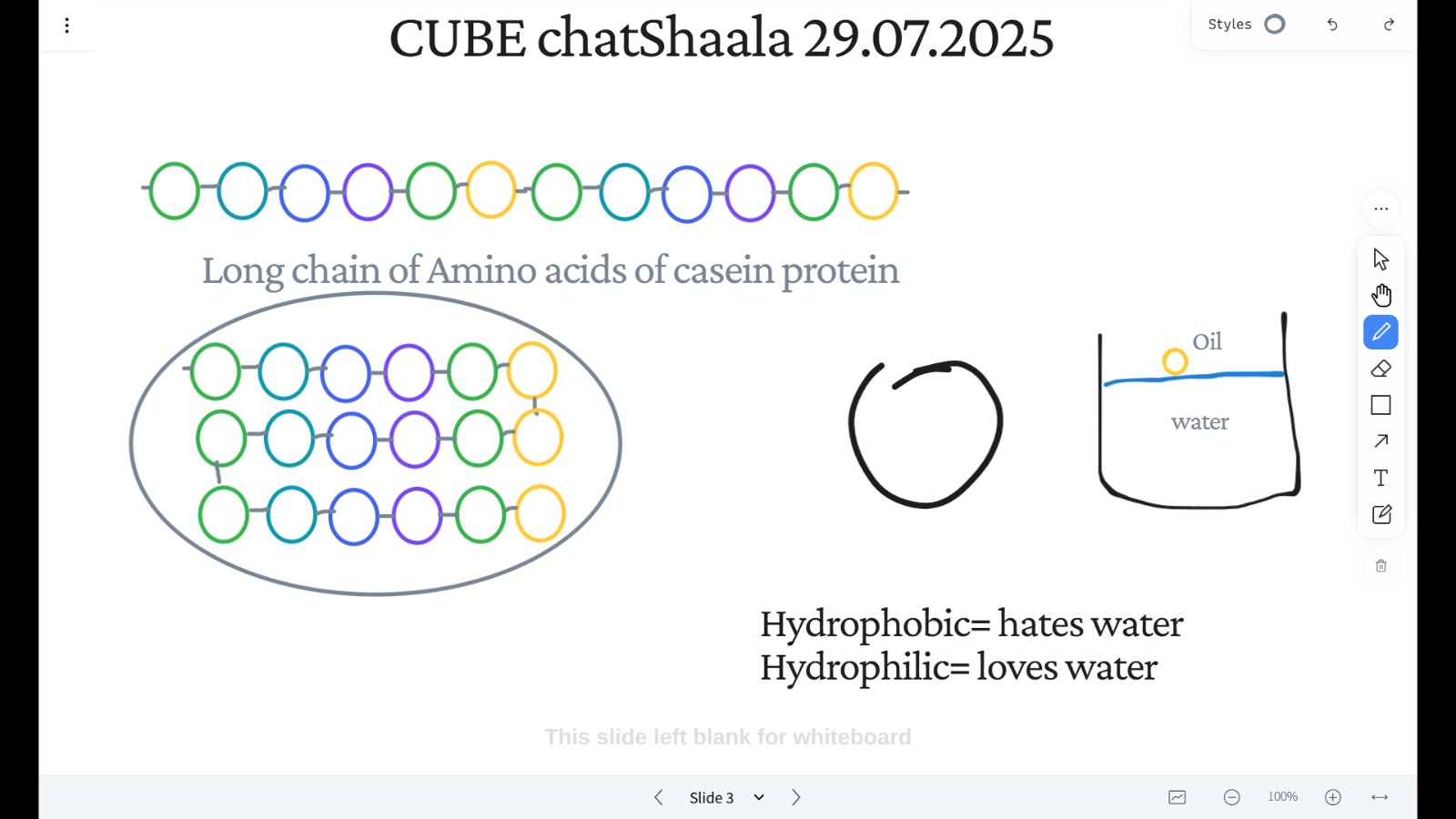
A conceptual model illustrated how some amino acids are hydrophilic (water-attracting) and others hydrophobic (water-repelling).
In milk, casein forms micelles — aggregates with hydrophilic surfaces and hydrophobic cores.
A fall in pH alters these interactions, causing micelle collapse and curdling.
 Provocative Questions of today’s discussion
-
Can we use only lemon juice and still get curd similar to one formed with starter curd?
-
What happens if we stir milk after adding lemon juice? Will the curd be softer or grainier?
-
What is the exact pH at which casein begins to denature?
-
Do different types of milk (cow, buffalo, packet) curdle at different rates with acid?
-
Can we reverse curdling once casein coagulates?
 What I Personally Learned Today
Today’s session deepened my appreciation of everyday biochemistry. The fact that adding lemon juice changes the protein structure of milk and leads to curdling is not just kitchen wisdom—it’s pure science in action. Understanding how pH disrupts peptide bonds and causes a hydrophobic collapse of micelles showed me how simple food preparation is rich with molecular events.
It also raised curiosity : Could we replace lemon juice with vinegar or tamarind pulp and still observe the same pattern? How does traditional knowledge align with molecular mechanisms?
 Reference
-
https://www.scirp.org/journal/paperinformation?paperid=42817&utm_source=chatgpt.com
-
https://www.sciencebuddies.org/stem-activities/milk-curdling-enzyme?utm_source=chatgpt.com
@Arunan @sakshiconsultant2002 @ajitadeshmukh13 @akanksha @2020ugchsncnseethala and others.