 CUBE Chatshaala — Discussion Summary
Date: 14th May 2026
Today’s CUBE Chatshaala brought together participants from multiple locations across India, making it a geographically rich and intellectually lively session. The discussion wove together real-time weather observations, an ongoing germination experiment, field photography of fruit flies, and a conversation about plant identity — specifically, what we commonly refer to as “Indian badam.” Each thread connected naturally to broader questions in biology and ecology, keeping the session grounded in genuine inquiry rather than textbook recitation.
Opening: Temperature as a Shared Context
The session began with participants sharing local temperature data — a practice that has become a meaningful ritual in CUBE Chatshaala, since it grounds the discussion in actual environmental conditions that directly affect experiments.
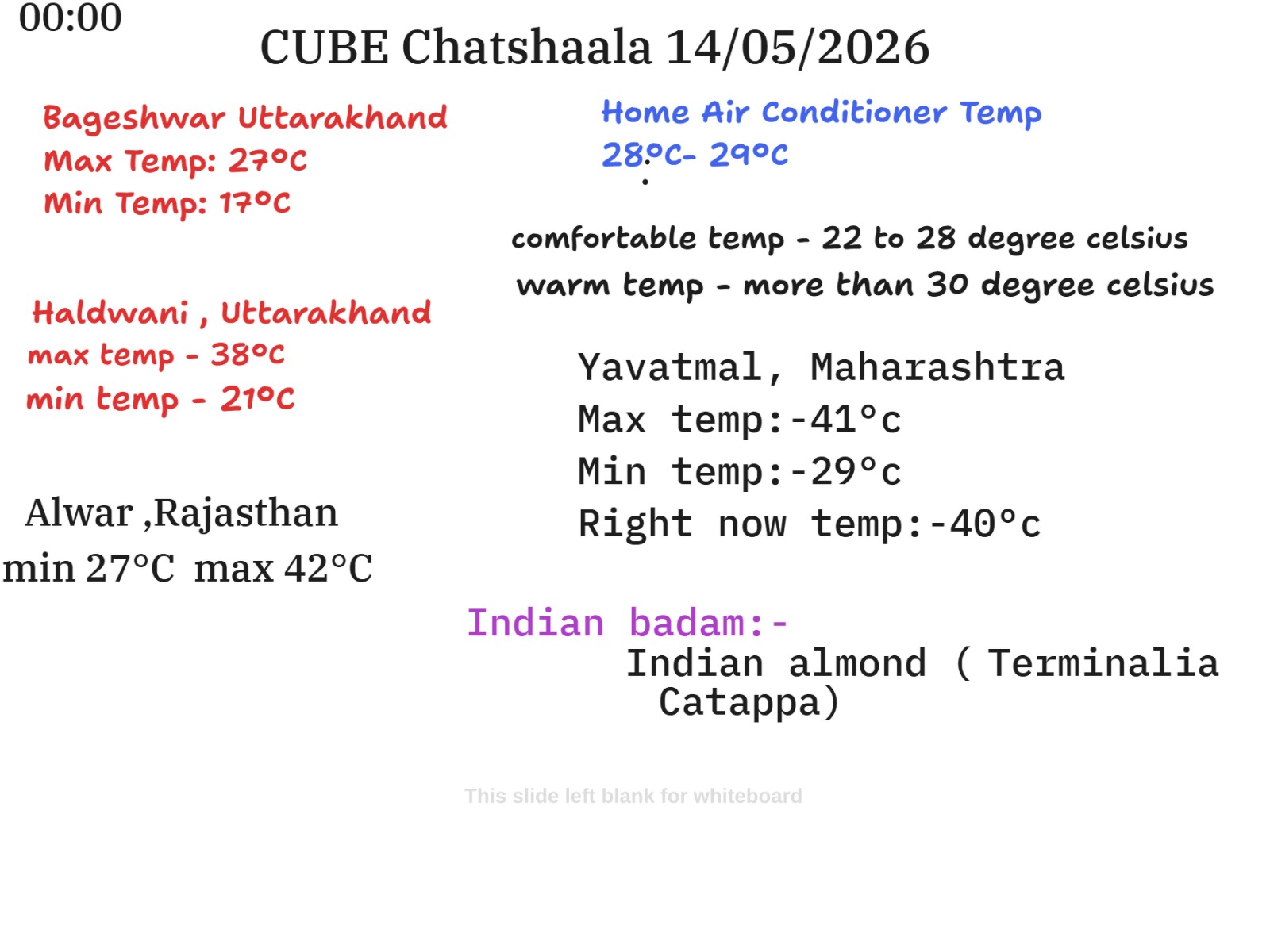
Niharika Baghari, reporting from Bageshwar, Uttarakhand, noted a maximum temperature of 27°C and a minimum of 17°C — a relatively cool and comfortable range for a mid-May day. By contrast, participants from Haldwani (also in Uttarakhand) reported much warmer conditions, with a maximum of 38°C and a minimum of 21°C. The difference within the same state was striking and prompted discussion about how even short distances in hilly terrain can produce dramatically different microclimates.
From Alwar, Rajasthan, temperatures were reported between 27°C (minimum) and 42°C (maximum), reflecting the intense heat of the plains. Perhaps the most extreme data of the day came from Yavatmal, Maharashtra, where the current temperature was noted at 40°C, with a daily maximum of 41°C and a minimum of 29°C. These numbers made the group pause and reflect on what such heat means for organisms — plants, insects, and humans alike.
This led naturally into a discussion about air conditioning and what counts as a “comfortable” temperature. The whiteboard noted that home air conditioners are typically set between 28°C and 29°C, while human comfort is generally considered to fall in the range of 22°C to 28°C. Temperatures above 30°C are noted as “warm.” One participant brought up that 24°C is widely promoted as the ideal AC setting in India, citing both energy efficiency and comfort — a claim worth examining critically.
Niharika’s Germination Experiment
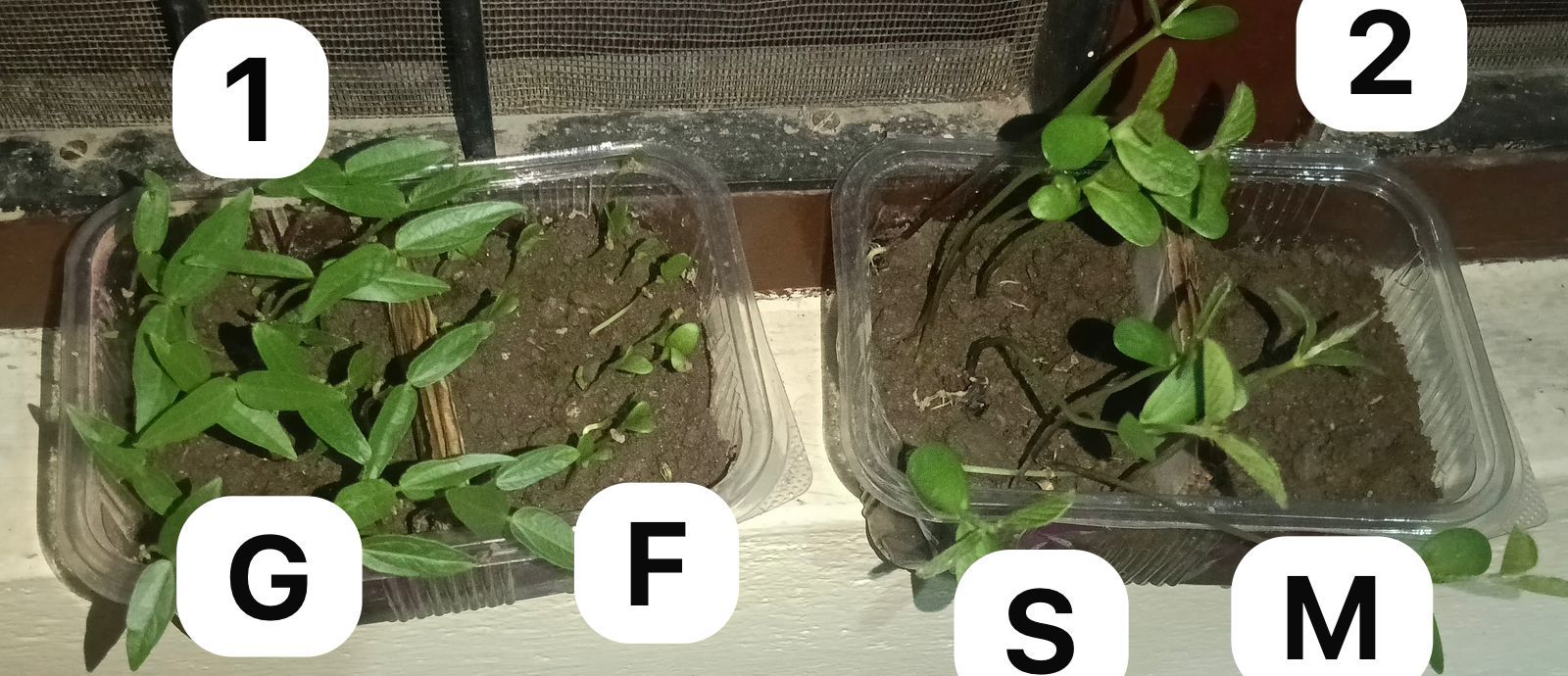
The centrepiece of today’s session was Niharika’s structured germination study, which she began on 5 May 2026 and observed on 13 May 2026 — eight days after sowing. The experiment compared seed germination and early plant growth across four species: Green Gram (G), Fenugreek (F), Soybean (S), and Mustard (M). Two containers were used, each holding two species side by side for easy visual comparison.
Twenty seeds of each species were sown. The results as of Day 8 were as follows: Green gram showed the strongest germination, with approximately 16–18 healthy seedlings; Fenugreek followed with 8–10 seedlings; Soybean produced 7–9 seedlings; and Mustard showed no germination at all.
The images shared showed Container 1 with Green Gram and Fenugreek, and Container 2 with Soybean and Mustard. The contrast was visually clear — one side of Container 2 was thriving while the other remained bare soil.
The group spent considerable time discussing why mustard had not germinated. Niharika’s explanation was that mustard is primarily a winter crop, and the warm May conditions in Bageshwar — even though relatively moderate compared to other regions discussed — may not be suitable for mustard germination. This is a sound hypothesis, and participants appreciated that she was reasoning from the plant’s seasonal biology rather than simply concluding that the seeds were “bad.”
The group also noted the broader experimental design: three of the four plants (green gram, fenugreek, soybean) are leguminous, while mustard is non-leguminous. The original aim included observing root nodule formation, which is a feature of leguminous plants due to their symbiotic relationship with nitrogen-fixing bacteria. This aspect of the experiment was flagged for future follow-up — nodule observation requires uprooting plants carefully, which the group decided should be done at a later stage.
Fruit Flies on Ripe Mango — A Field Observation
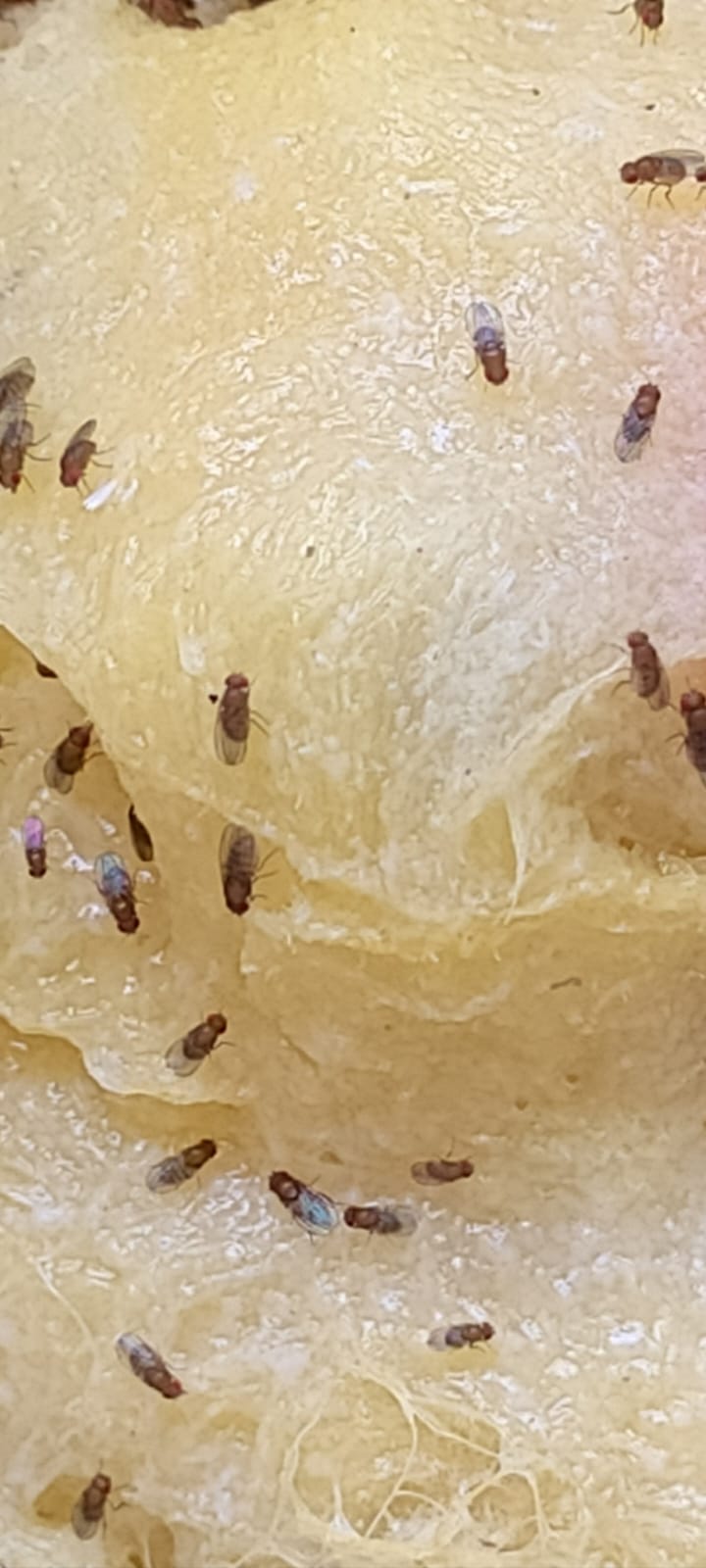
A photograph taken at 8:40 a.m. on 14 May 2026 by M.C. Arunan from Madel, Thivim, Goa, showed a dense congregation of fruit flies on the flesh of a ripe mango that had been squeezed for juice. The image was striking — dozens of small, dark-bodied flies scattered across the pale, fibrous mango surface, clearly attracted by the sugar-rich, fermenting pulp.
This sparked a brief but enthusiastic discussion. The flies visible in the image are almost certainly Drosophila species, which are famously drawn to ripe and fermenting fruit. The group discussed why fruit flies are so strongly attracted to overripe or damaged fruit — the answer lies in the production of volatile compounds like ethanol and acetic acid during fermentation, which act as powerful chemical signals for these insects.
The photograph itself was appreciated as a model of situated scientific observation: date, time, location, and photographer all documented clearly, making it replicable and verifiable. This is the CUBE ethos — science done from wherever you are, with what you have.
Indian Badam — A Question of Identity
The whiteboard noted “Indian badam — Indian almond (Terminalia catappa)” as a topic of discussion. This plant, commonly called “Indian badam” or “desi badam” in many parts of India, is frequently confused with the true almond (Prunus dulcis), which is native to southwestern Asia and is the source of the commercially sold almond nut.
Terminalia catappa is a large, spreading tree found along coastlines and in tropical regions. Its seed kernel does resemble an almond in taste and can be eaten, which is likely why the name “badam” has been informally applied to it. However, it is taxonomically unrelated to Prunus dulcis. The Britannica reference shared in the session noted that the true almond is grown primarily in Mediterranean and semi-arid climates between 28°–48° N and 20°–40° S, with California alone producing nearly 80% of the global supply.
This naming confusion is a small but meaningful example of how common names can obscure biological reality — something the CUBE community returns to often.
 Provocative Questions
-
Niharika observed zero germination in mustard seeds after 8 days in May conditions in Bageshwar. If she had conducted the same experiment in November or December, how might the outcome differ? What specific environmental cues does mustard require to break dormancy and germinate successfully?
-
The three leguminous plants in Niharika’s experiment (green gram, fenugreek, soybean) all germinated to varying degrees. What factors could explain the significant difference in germination rates among them — was it seed quality, seed coat thickness, water uptake rate, or something else entirely?
-
Root nodule formation is a defining feature of leguminous plants, but nodules do not form at germination — they develop as the plant grows and encounters the right soil bacteria. At what stage should Niharika uproot her plants to observe nodules, and what would she expect to see if the soil lacks the appropriate Rhizobium species?
-
The fruit flies photographed on the mango in Goa were observed at 8:40 a.m. Would the density of flies on the same mango be different at midday or evening? What does this tell us about the activity patterns and thermal tolerance of Drosophila in tropical conditions?
-
Yavatmal recorded a current temperature of 40°C with a minimum of 29°C — meaning even at night, it does not cool below 29°C. What effect does such sustained heat have on ectothermic organisms like insects and reptiles that rely on external temperature to regulate their body functions?
-
The “ideal” AC temperature of 24°C is promoted for energy efficiency and comfort. But whose comfort? Is 24°C equally comfortable for someone accustomed to Bageshwar’s 17°C nights versus someone living year-round in Yavatmal at 29°C minimums? How does thermal acclimatisation shape our perception of comfort?
-
Terminalia catappa and Prunus dulcis are both called “badam” in India, yet they belong to entirely different plant families. How many other such cases of misleading common names exist in Indian botany, and what problems can this cause in ecology, medicine, or nutrition?
-
Mustard is classified as a rabi (winter) crop. Does this mean mustard seeds need cold stratification to germinate, or is it simply that high temperatures inhibit the germination process? How would you design an experiment to distinguish between these two explanations?
 What I Have Learned
Today’s session reminded me that good science is not always done in a laboratory with sophisticated equipment — it is done by people who are paying attention to their surroundings. Niharika’s experiment is a perfect example of this. She used simple plastic containers, garden soil, and seeds that are available in any Indian kitchen or market. Yet the questions her experiment raises — about seasonal biology, legume-bacteria symbiosis, and the limits of controlled observation — are genuinely complex and scientifically rich.
I was also struck by how much information is contained in a single photograph. The image of fruit flies on a mango, taken by Arunan in Goa, carries within it questions about chemosensory biology, insect behaviour, fermentation ecology, and field documentation practices. A photograph taken with intention and care is itself a scientific instrument.
The temperature data shared across locations drove home something I often take for granted: temperature is not just background information. It is the primary variable shaping nearly every biological process discussed today — germination success, insect activity, human comfort, production, and crop substantially. Comparing Bageshwar’s 17°C minimum with Yavatmal’s 29°C minimum is not just trivia; it is a window into entirely different ecological worlds existing simultaneously across one country.
Finally, the Indian badam discussion was a small but sharp lesson in the importance of scientific nomenclature. Common names are culturally meaningful, but they can carry serious inaccuracies that matter when we are talking about nutrition, biodiversity, or conservation.
 TINKE Moments (This I Never Knew Earlier)
TINKE 1: Mustard’s silence is meaningful.
Most participants initially assumed that zero germination in mustard could mean bad seeds or poor watering. The shift in understanding came when the seasonal biology of mustard was considered — that it is a rabi crop with specific temperature requirements. The “failure” in the experiment is actually a biological signal worth studying, not a mistake to be dismissed. This was a genuine TINKE moment: the absence of germination is data.
TINKE 2: Not all legumes germinate equally.
There was an implicit assumption that all three leguminous plants would behave similarly since they share the legume classification. The fact that green gram produced nearly double the seedlings of soybean prompted a useful realisation — taxonomic relatedness does not guarantee identical physiological responses. Each species has its own germination ecology.
TINKE 3: “Indian badam” is not an almond.
For several participants, it was new information that Terminalia catappa — the tree commonly seen along roadsides and coastlines — is entirely different from the Prunus dulcis almond sold in shops. The name “badam” has created a conflation that most people never question. This was a clear TINKE moment, and it opens a much larger discussion about how naming shapes perception.
TINKE 4: Fruit flies are early risers.
The photograph from Goa was taken at 8:40 a.m., and already the mango surface was covered in flies. Many people assume insects are more active later in the day when temperatures peak. This observation suggests that Drosophila may be most active in the cooler early morning hours — a hypothesis that deserves direct investigation.
 Gaps and Misconceptions
Gap 1: Root nodule observation is pending.
The experiment’s stated aim includes comparing root nodule formation between leguminous and non-leguminous plants. This has not yet been done. Nodule observation is a critical part of understanding the legume-Rhizobium relationship, and without it, the comparison between the four plant types remains incomplete. A plan needs to be made for when and how to carefully uproot selected plants and examine their roots under magnification.
Gap 2: Mustard germination conditions are not yet tested.
Niharika hypothesised that warm temperature is responsible for mustard’s non-germination, but this has not been tested. A follow-up experiment — perhaps germinating mustard seeds in a cooler environment or during cooler months — would be needed to confirm this. Without a controlled comparison, the explanation remains a reasonable hypothesis rather than a confirmed conclusion.
Gap 3: Fruit fly species identification.
The photograph of fruit flies on the mango has not yet led to species-level identification. While Drosophila is the likely genus, other fruit fly genera (such as Bactrocera, the mango fruit fly) are also common in Goa and Maharashtra. Are the flies in the image attracted to the surface of the mango pulp, or are they ovipositing? This distinction matters for understanding their biology and behaviour, and deserves closer examination.
Misconception 1: “If a seed doesn’t germinate in 8 days, the experiment has failed.”
This framing came up subtly in the discussion and is worth addressing directly. Different seeds have different germination periods. Some seeds take 10–14 days or longer. The fact that mustard has not germinated by Day 8 is an observation, not a verdict. The experiment should continue, and if mustard still does not germinate after 14–21 days, then the conclusion becomes more defensible.
Misconception 2: Leguminous plants always form root nodules.
This is not unconditionally true. Nodule formation depends on the presence of compatible Rhizobium bacteria in the soil. If the soil used in the experiment is a sterilised potting mix or has been treated in a way that eliminates soil bacteria, nodule formation may not occur even in leguminous plants. This is an important caveat that should be recorded as part of the experimental context.
Misconception 3: “Indian badam” and “almond” are the same thing.
As discussed, Terminalia catappa and Prunus dulcis are taxonomically unrelated. While the seeds of both can be eaten and carry some superficial similarity in taste, treating them as equivalent in nutritional or botanical terms is inaccurate. This is a widespread folk misconception that today’s discussion helpfully began to address.
 Photographs during ChatShaala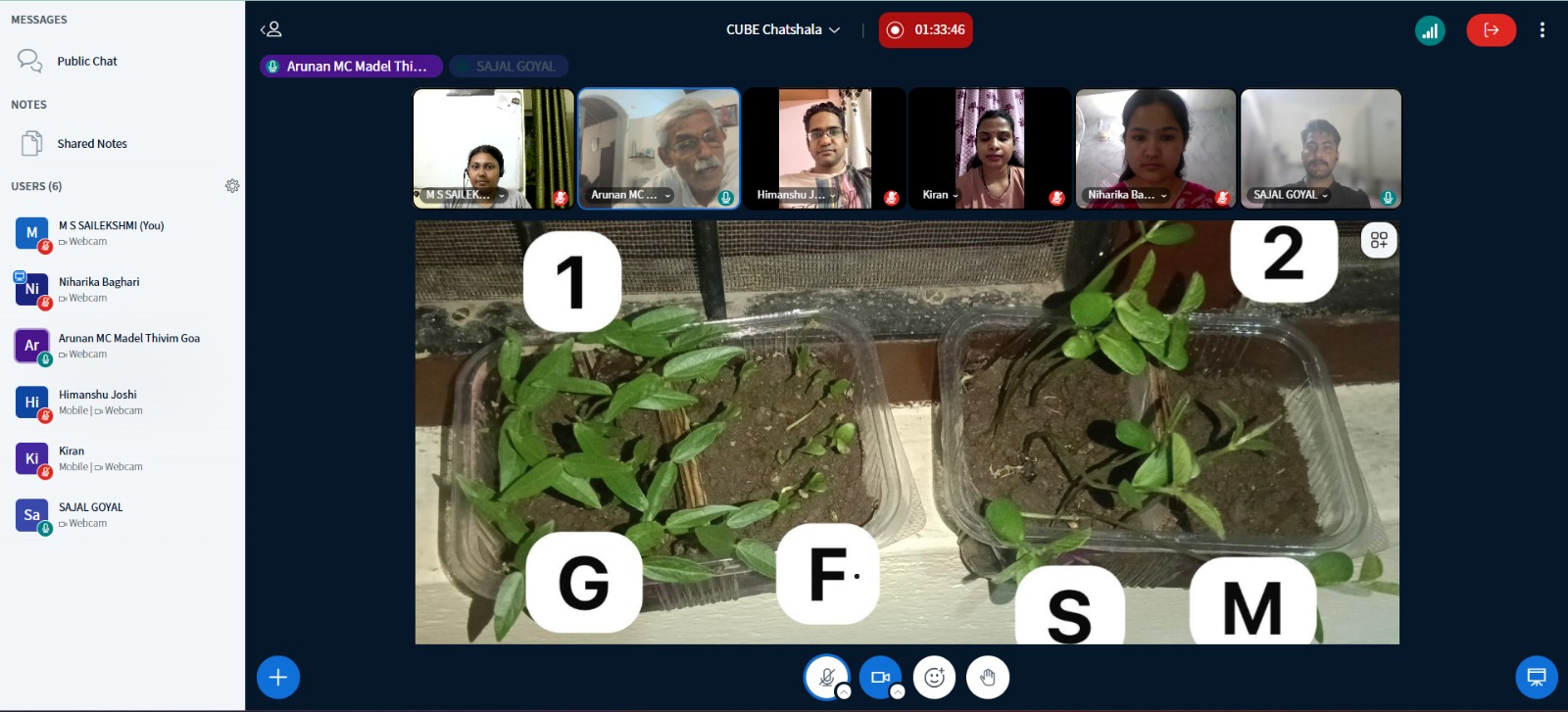
 Reference