 CUBE Chatshaala - Discussion Summary
Date: 31 October 2026
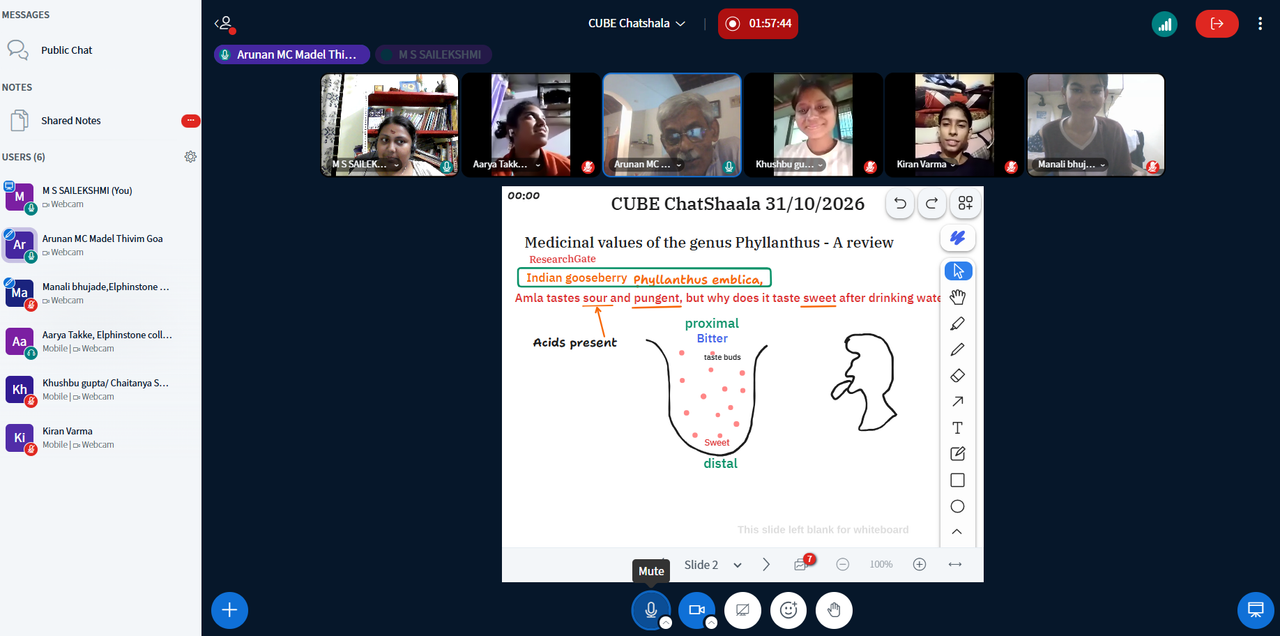
Sailekshmi, Manali Bhujade (Elphinstone College, Mumbai), Khushbu Gupta (Chaitanya Science & Arts College, Pamgarh), Kiran Kalakoti, Aarya Takke (Elphinstone College, Mumbai), and Kiran Varma participated, along with Arunan MC.
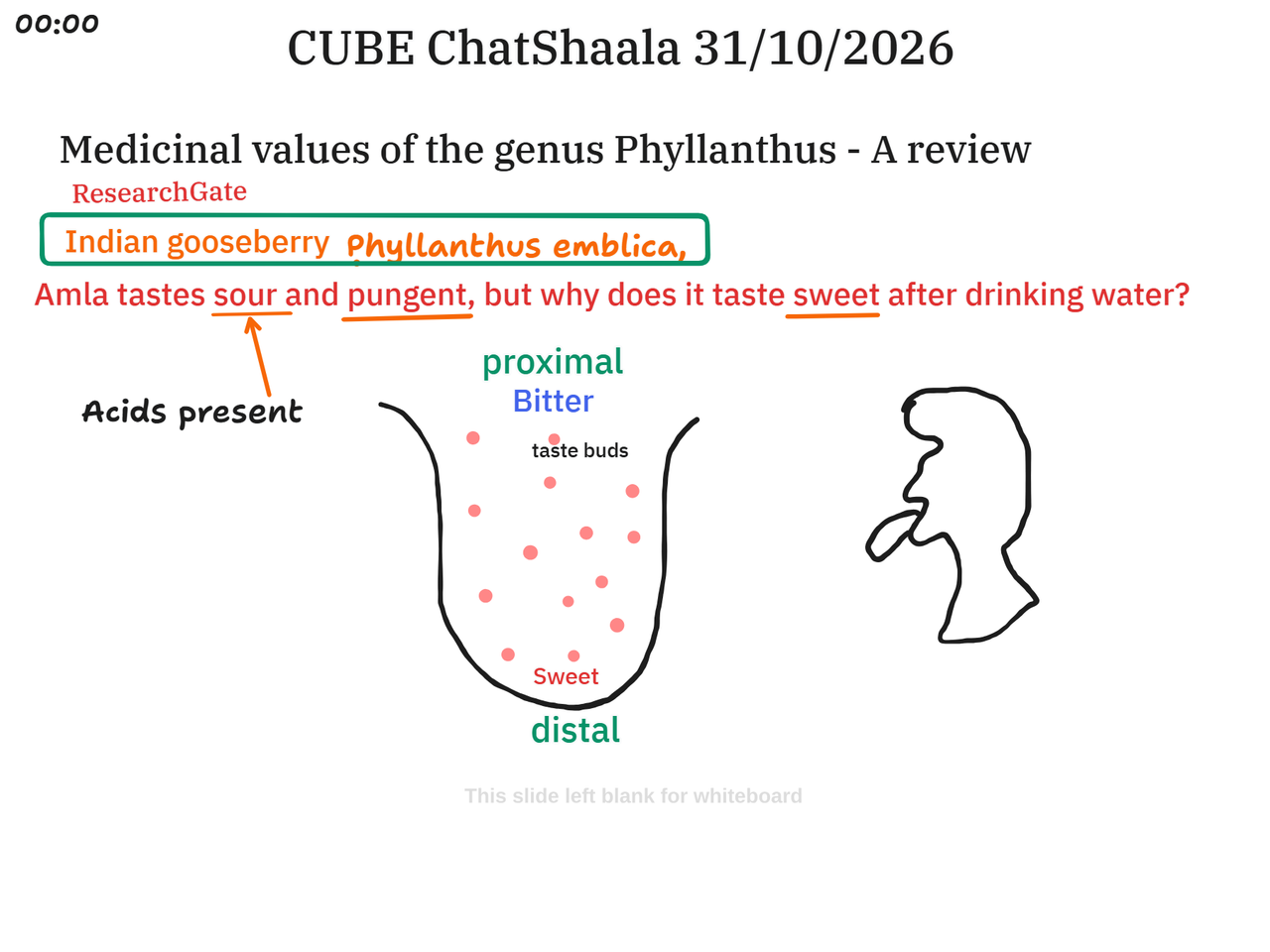
The discussion began with a review article Manali brought to the group, “Medicinal values of the genus Phyllanthus - A Review”. Sailekshmi summarised it for the room. The review brings together the traditional medicinal uses of Phyllanthus species and the phytochemicals found in their different plant parts. It also surveys reported antioxidant, antiviral, antimicrobial, antidiabetic, anti-inflammatory, and liver- and kidney-protective effects. Aarya encouraged everyone to contribute their own inputs so that each topic is understood collaboratively. She also admitted she had not known that ResearchGate is a website, and then recalled that earlier sessions had explained it as an online repository of journals, research papers and review papers.
Sailekshmi also shared the profile of the Journal of Current Biomedical Research, a peer-reviewed, open access journal that publishes six issues a year. It accepts original research, reviews, case reports, and letters to the editor. It also welcomes preliminary findings and studies with negative results. This helped the group see where a review article actually comes from and how such work is published.
Kiran Kalakoti then pointed out that the review reports Phyllanthus niruri inhibiting the growth of E. coli. Since Manali had shown interest in medicinal properties, she invited her to design a research question around this finding. Manali and Sailekshmi supported the idea with further reading from PubMed Central and ScienceDirect.
The conversation then moved to Indian gooseberry, Phyllanthus emblica (amla), the species written inside the green box on the whiteboard. Aarya read out the Wikipedia description of the fruit. It is rich in ascorbic acid and has a bitter taste that may come from a high density of ellagitannins, such as emblicanin A, emblicanin B, punigluconin and pedunculagin. Other polyphenols are also present, including flavonoids, kaempferol, ellagic acid, and gallic acid. This led Aarya to ask whether tannin is a protein, and so whether ellagitannins could be some kind of protein. Sailekshmi clarified that ellagitannins are plant polyphenols built from linked galloyl groups, joined by carbon-carbon bonds and often forming ring-shaped structures. When broken down, some release ellagic acid, and gut microbes can convert ellagic-acid derivatives into urolithins. They are also found in plants such as pomegranate.
The main question of the day was written in red on the whiteboard: amla tastes sour and pungent, but why does it taste sweet after drinking water? The words sour, pungent, and sweet were underlined, and an arrow linked “sour” to the note “Acids present”, tying that taste to the acids in the fruit. The question was then connected to the tongue. A bowl-shaped sketch represented the tongue, with scattered dots for taste buds. The base was labelled proximal and bitter, and the tip was labelled distal and sweet. A side profile of a head with the tongue extended was drawn beside it for orientation. Aarya explained the anatomical terms: distal means away from the body, so the distal end of the tongue is its tip, while proximal means towards the body, so the proximal end is the base. The session closed with Arunan sharing the Cleveland Clinic article on taste buds as further reading.
 Provocative Questions
-
Amla is described as sour and pungent, yet water afterwards tastes sweet. Is the sweetness actually in the water, or is it created by what happened on the tongue just before?
-
If the water contains no sugar, which part of the chain is responsible for the sweet sensation: the taste bud, the nerve, or the brain?
-
The whiteboard places bitter at the base of the tongue and sweet at the tip. If taste buds for all tastes are spread across the tongue, how should we redraw this sketch?
-
Ellagitannins are blamed for the bitterness of amla, yet the fruit is also loaded with acids. How can we tell which compounds are responsible for which part of the flavour?
-
Could the same compounds that make amla taste bitter and astringent also be the ones that give it medicinal value? How would we test this?
-
P. niruri is reported to inhibit E. coli. What would a simple, home-lab-level experiment look like to check an antibacterial claim, and what controls would it need?
-
If water makes amla taste sweet, would other liquids, such as warm water, salty water, or lemon water, change the effect? What would that tell us?
-
A review article summarises many studies. How should a beginner decide how far to trust its claims before designing an experiment on them?
-
Both the base and the tip of the tongue are exposed to the same fruit juice. Why would an effect appear only after a drink of water and not while the fruit is still in the mouth?
 What I Have Learned
The most valuable lesson for me was how a single everyday experience, the sweetness that follows a bite of amla, can open up an entire line of scientific inquiry. A simple question written on a whiteboard brought together plant chemistry, human anatomy, and the physiology of taste.
I learned that Phyllanthus is a large genus with a long history in traditional medicine, and that a review article is a map of existing research rather than a final verdict. Reading such an article carefully, and then asking what is still untested, is how a research question like Kiran’s suggestion about P. niruri and E. coli gets born.
I also learned that ellagitannins belong to the polyphenols, not the proteins, and that their structure is built from galloyl units. I understood that these compounds are linked to the bitterness of amla, while its sourness is tied to the acids the fruit contains.
On the anatomy side, I now have a clear picture of the terms proximal and distal, and I can place them on a structure as familiar as the tongue. Finally, the session reminded me that a drawing on a whiteboard is a starting point for discussion and not always a finished truth, which is why checking it against a reliable source, as the Cleveland Clinic article allowed us to do, matters so much.
 TINKE Moments (This I Never Knew Earlier)
The first TINKE moment came from Aarya, who had not realised that ResearchGate is a website. It is an online platform that holds journals, research papers, and review papers, and she connected this with what she had learned in earlier sessions. For many beginners, the idea that research is stored, shared, and searched on dedicated platforms is genuinely new, and it opens the door to doing their own literature reading.
The second came from the question of whether tannin is a protein. Aarya’s guess was a natural one, and putting it into words made it possible to correct it. Tannins are polyphenols, and ellagitannins in particular are assembled from galloyl groups and can break down into ellagic acid. This moment showed how a plain question asked aloud can turn a vague assumption into clear knowledge for everyone listening.
The third was the vocabulary of position. By working out that distal means away from the body and proximal means towards it, the group fixed these two words by applying them to the tongue, with the tip as the distal end and the base as the proximal end. A term that is often memorised without meaning became something the group could actually picture.
The fourth was the discovery that a journal can welcome negative findings. The description of the Journal of Current Biomedical Research mentions publishing studies with negative results and preliminary research letters. This was a useful reminder that an experiment that does not work as expected still contributes to science.
 Gaps and Misconceptions
Gap: The central question was left open. The whiteboard asks why amla tastes sweet after water, but the discussion as recorded in the chat did not arrive at a firm explanation. The ideas on the board, acids present and taste buds spread across the tongue, are a good beginning. Still, a convincing answer needs more. One approach would be to look for what the acids and tannins do to the taste receptors and to the lining of the mouth, and then to test whether plain water after other sour or astringent foods produces the same effect. Until that is done, any explanation remains a hypothesis.
Misconception 1: the tongue map. The whiteboard places bitter at the base of the tongue and sweet at the tip, as though each taste had its own zone. The Cleveland Clinic article shared at the end of the session states that this is a common misconception. Taste buds for sweet, salty, bitter, sour and umami are scattered across the tongue, and only some regions are slightly more sensitive to certain tastes. The back of the tongue is especially sensitive to bitterness, which is probably an evolutionary safeguard against toxic substances. So the drawing is partly right in spirit, since bitterness is indeed more strongly sensed at the back, but it should not be read as a strict map. It is also worth remembering that the dots on the sketch represent taste buds, which sit inside the small bumps called papillae.
Misconception 2: tannin is a protein. As clarified in the session, tannins are polyphenols. The confusion is understandable, because tannins are known for binding proteins, which is part of why they feel astringent, but binding to proteins does not make a tannin a protein itself.
Misconception 3: spelling and term. “Distil” was used in the chat for the position term that is actually written distal. Distil is a verb that refers to purifying a liquid by heating and condensing it, whereas distal describes a position farther from the point of attachment or the centre of the body.
Gap: The research question for P. niruri and E. coli was proposed but not yet shaped. A workable question would need a clear plant part, a way of preparing the extract, a defined bacterial strain and a comparison with a control. Deciding these details would be a good task for the next session.
Gap: The sources shared during the session ranged from a peer-reviewed review to Wikipedia. The group would benefit from agreeing on how to treat each kind of source, using encyclopedic pages for orientation and primary or review literature for claims that need evidence.
 Photographs during Chatshaala
 Reference
- https://www.researchgate.net/publication/378688102_Medicinal_values_of_the_genus_Phyllanthus_-_A_review#:~:text=The%20plant%20has%20been%20used%20for%20a.,is%20the%20largest%20genus%20of.%20Phyllanthaceae%20family
- Journal of Current Biomedical Research
- An Overview of Important Ethnomedicinal Herbs of Phyllanthus Species: Present Status and Future Prospects - PMC
- https://www.sciencedirect.com/science/article/pii/S2667142526000035
- https://www.sciencedirect.com/org/science/article/abs/pii/S1478641924000585
- Phyllanthus emblica - Wikipedia
- Ellagitannin - Wikipedia
- What Are Taste Buds?