 CUBE Chatshaala - Discussion Summary
The CUBE Chatshaala session on 9 October 2026 began. Fourteen participants were in the discussion. Sailekshmi took the presenter role in the early part of the evening, and Aarya and Kiran helped moderate. Aarya also kept the whiteboard while the discussion moved along.

The session was built around an observation card by Niharika Baghari. She had spotted a dark, hairy caterpillar crawling on a concrete surface at 6:30 pm that same day. She tentatively named it a woolly bear caterpillar, Pyrrharctia isabella, and she openly invited the group to confirm or challenge that identification. Her reasoning rested on the long body and the dense dark hairs, and she acknowledged that the exact species still needed to be verified.
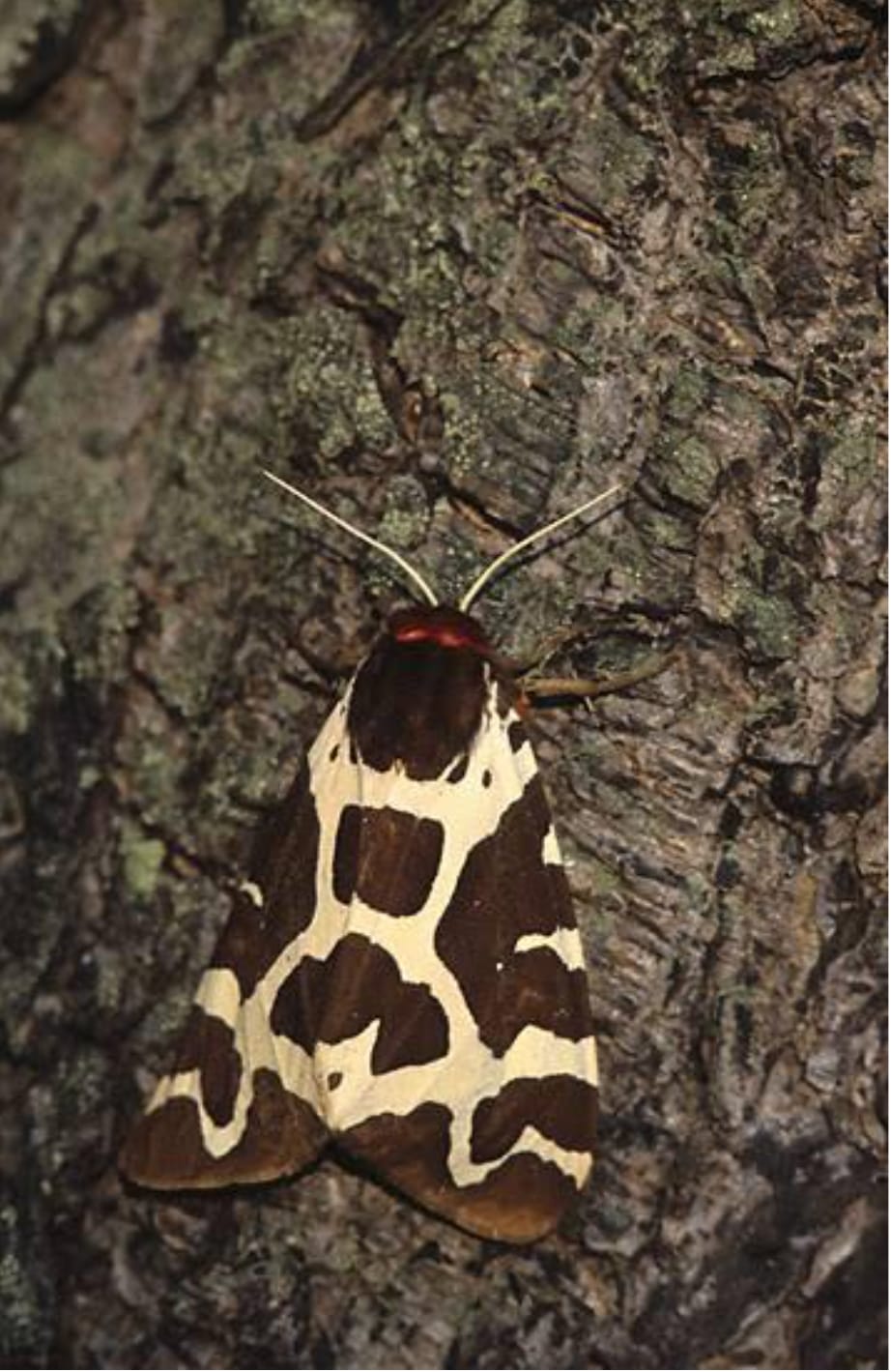
Arunan opened the discussion by asking how a caterpillar ends up on a bare concrete surface at all. Vatshla offered an explanation later. In the late monsoon months, she noted, mature caterpillars leave their host plants and wander across open ground, paths, doorways and walls in search of a safe place to pupate. She also suggested that the caterpillar might be a tiger moth larva of the family Erebidae, possibly a Spilosoma species such as the Bihar hairy caterpillar, and added that such caterpillars feed on leaves, soft stems and green branches. Niharika’s photograph carried the notes “wild weeds” and “mulberry” as likely food plants. She also shared the Wikipedia page for the garden tiger moth, together with a photograph of the adult moth, which has dark brown and cream wings and a reddish patch behind the head.
Sailekshmi brought in the Britannica entry on woolly bears. It describes them as the larvae of several tiger moth species and mentions the banded woolly bear of the Isabella tiger moth, along with the folk belief that the width of its black bands predicts the severity of winter. Arunan also shared a Cleveland Clinic article on caterpillar rashes, which reminded everyone that some hairy caterpillars can irritate human skin and should not be handled casually.
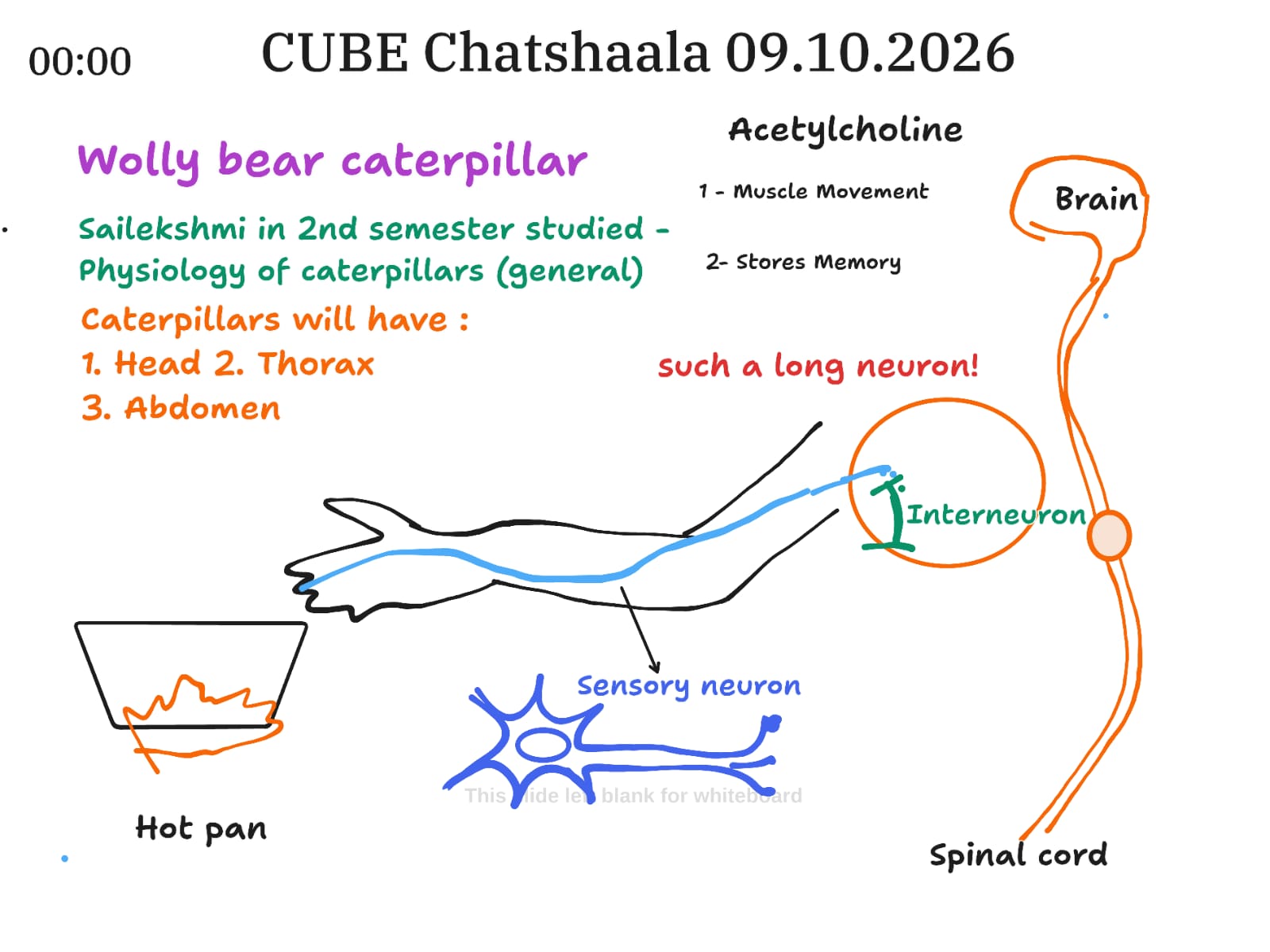
The second half of the evening turned to physiology. The whiteboard recorded that Sailekshmi had studied the general physiology of caterpillars in her second semester, and it set out the basic body plan of head, thorax, and abdomen. From there, the group followed a reflex pathway using the example of touching a hot pan. A sensory neuron picks up the stimulus, an interneuron relays the signal within the spinal cord, and the brain is connected above. Arunan contributed a note on acetylcholine as the first neurotransmitter ever discovered, acting as a chemical messenger in both the central and peripheral nervous systems. The whiteboard listed two roles for it: muscle movement and memory. Aarya remarked that she had never heard of a neuron as long as the one running from the fingertip to the spinal cord, and she supported this with two sources on sensory neuron types, which explain that such neurons are typically pseudounipolar, with one branch reaching the skin and the other entering the spinal cord. Aarya also suggested that Sailekshmi describe the structure and parts of a neuron to everyone, which set up the closing part of the session.
 Provocative Questions
-
The photograph shows an almost entirely dark caterpillar. What visible features would allow us to separate a true banded woolly bear from other hairy tiger moth larvae, and which of those features can we actually see in the photo?
-
Pyrrharctia isabella is described in the reference material as a species with a rusty band between black ends. If our caterpillar has no obvious band, what does that tell us about the identification?
-
Does the geographic range of a species belong in the first step of identifying it? What would we conclude if the named species is known mainly from another continent?
-
If the width of the bands has no dependable link to winter weather, why has this folk belief survived for so long, and what does that say about how people read patterns in nature?
-
Mature caterpillars wander across concrete before pupating. How might we test the idea that this wandering is a search for a pupation site, and not simply getting lost?
-
The hot pan example follows a reflex arc in a human. Would a caterpillar respond to a hot surface in the same way, and which parts of the drawing would need to change?
-
Acetylcholine is credited with both muscle movement and memory. Is a molecule that helps neurons communicate the same thing as a molecule that stores a memory?
-
The sensory neuron on the whiteboard is called remarkably long. What would a cell of that size need to stay alive and keep passing signals along its whole length?
-
Some caterpillar hairs can irritate the skin. What would a safe and ethical protocol for handling an unknown hairy caterpillar look like in a citizen science setting?
 What I Have Learned
The first lesson of the evening was that a name written on an observation card is a hypothesis, and the group treated it as one. Niharika said plainly that her identification was tentative, and that honesty is what made the discussion productive. Several people brought in competing possibilities, and each came with a source or a reason.
I also learned that the surface a creature is found on can say something about its life stage. A caterpillar on concrete in the late monsoon is not necessarily a lost one. It may be a mature larva leaving its food plants to find somewhere to pupate, and that gives a plain explanation for what looked like an odd place to find it.
On the physiology side, the reflex arc drawn on the whiteboard made the path of a signal easy to follow, from stimulus to sensory neuron, to interneuron, to brain, and back to the muscle. Seeing it drawn beside a caterpillar also showed me how easily a human diagram can be laid over a different animal without anyone noticing. Finally, the Cleveland Clinic article was a useful reminder that field observation carries real health risks. A fluffy caterpillar is not always safe to pick up.
 TINKE Moments (This I Never Knew Earlier)
-
A woolly bear is not a single species. Britannica describes the term as covering the caterpillars of several tiger moth species, with the banded woolly bear of the Isabella tiger moth being the best known. This I now know explicitly: the common name is a group label, so using it does not settle which species we are looking at.
-
A caterpillar crossing concrete in October can be explained by the timing of its life cycle. This I now know explicitly: late monsoon wandering is linked to the search for a place to pupate.
-
A sensory neuron really can run from the fingertip into the spinal cord. Aarya’s sources describe pseudounipolar sensory neurons with one branch in the skin and one entering the spinal cord. This I now know explicitly: the long neuron on the whiteboard is not an exaggeration, and its shape explains why it is so long.
-
Acetylcholine was the first neurotransmitter to be discovered and acts in both the central and peripheral nervous systems. This I now know explicitly: it is a messenger between cells, and its work is wider than a single function.
-
The winter prediction from bandwidth is a purported ability, which is the word Britannica itself uses. This I now know explicitly: a belief repeated widely is not the same as an established finding.
 Gaps and Misconceptions
Gap 1: The identification was never settled. The card names Pyrrharctia isabella, while the chat also suggested a Spilosoma tiger moth larva, and the adult moth photograph points toward the garden tiger moth. These are different species. As far as I know, the Isabella tiger moth is a North American species, so it is an unlikely match for a caterpillar found in India. The photo also shows a nearly uniformly dark body without a clear rusty band. A clearer close-up, a record of the exact location, and a check against regional field guides or an Indian biodiversity platform would help narrow it down. Rearing the larva to the adult moth would be the most certain method.
Gap 2: The banded woolly bear is tied to the winter folklore, but nobody in the session questioned the claim. It should be treated as folklore, since the source itself says only that the bands are purported to predict the winter.
Misconception 1: The whiteboard describes acetylcholine as something that stores memory. Acetylcholine is involved in learning and attention, but memories are held in lasting changes in the connections between neurons, not in the neurotransmitter itself. A more accurate wording would be that it supports the communication that learning depends on.
Misconception 2: The reflex diagram combines a caterpillar with human anatomy. A caterpillar has no spinal cord. Its nervous system is a brain connected to a chain of segmental ganglia along a ventral nerve cord, so a reflex can be handled locally in one segment, and the sensory cell would be much shorter than the fingertip-to-spinal-cord neuron discussed. In insects, the neurotransmitter at the junction with muscle is generally glutamate, with acetylcholine acting mainly between neurons in the central nervous system. The hot pan drawing is a good teaching model for vertebrates, but it should be labelled as such.
Misconception 3: The evening treated “woolly bear” and “tiger moth larva” as one and the same. Many tiger moth caterpillars are hairy and dark, and hair alone is a weak basis for identification. It is also worth stating that the Wikipedia and Britannica entries, while helpful, are general references and cannot confirm a specimen photographed in a particular place.
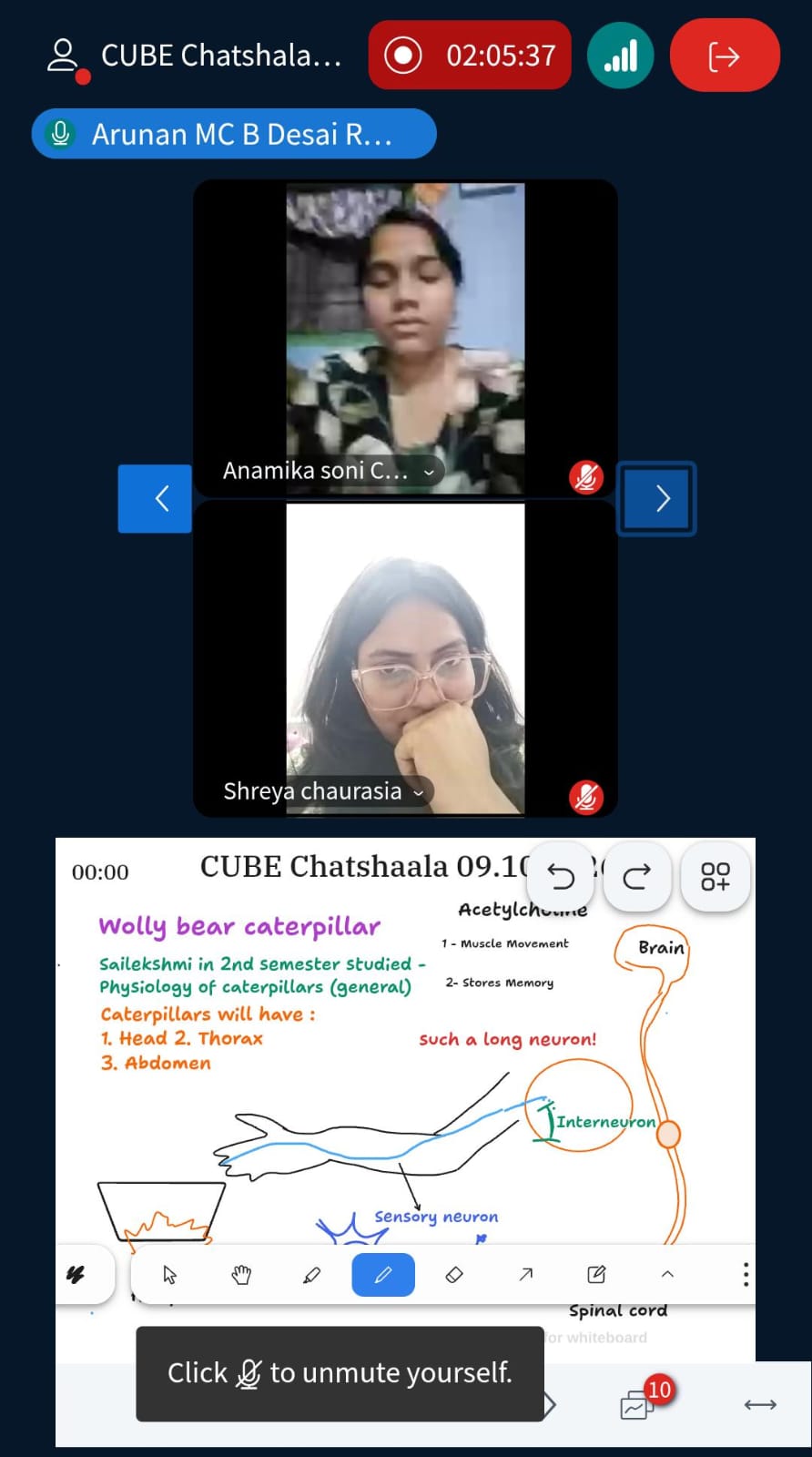
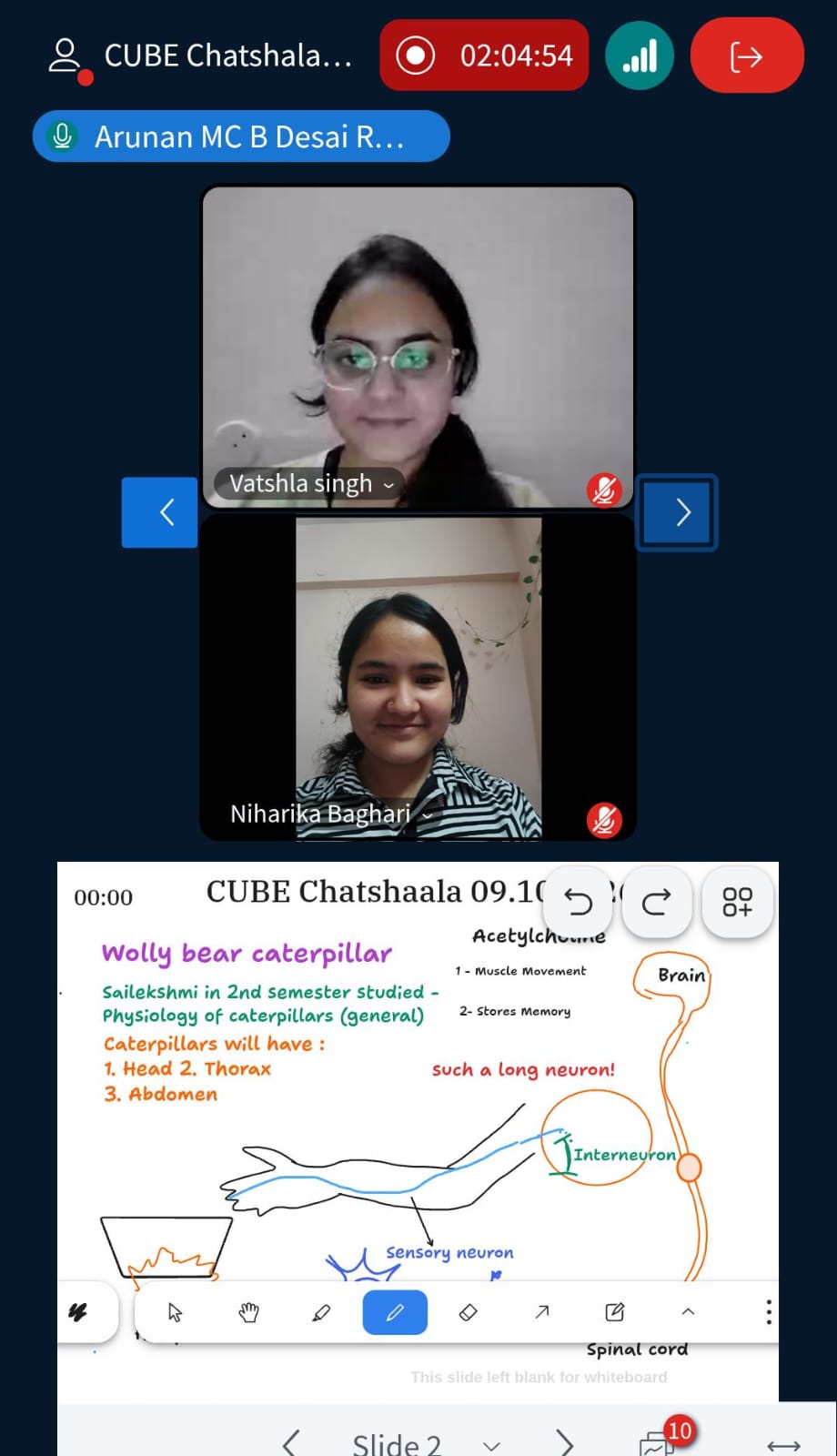
 Photographs during ChatShaala

 Reference