 CUBE ChatShaala Summary – 31/08/2025
Theme: Climate Change vs Weather Change – Cough and Sneeze Data Collection
Yesterday’s ChatShaala revolved around an important citizen science activity: recording cough and sneeze data from different homes across India to explore how climate and weather patterns may be influencing health.
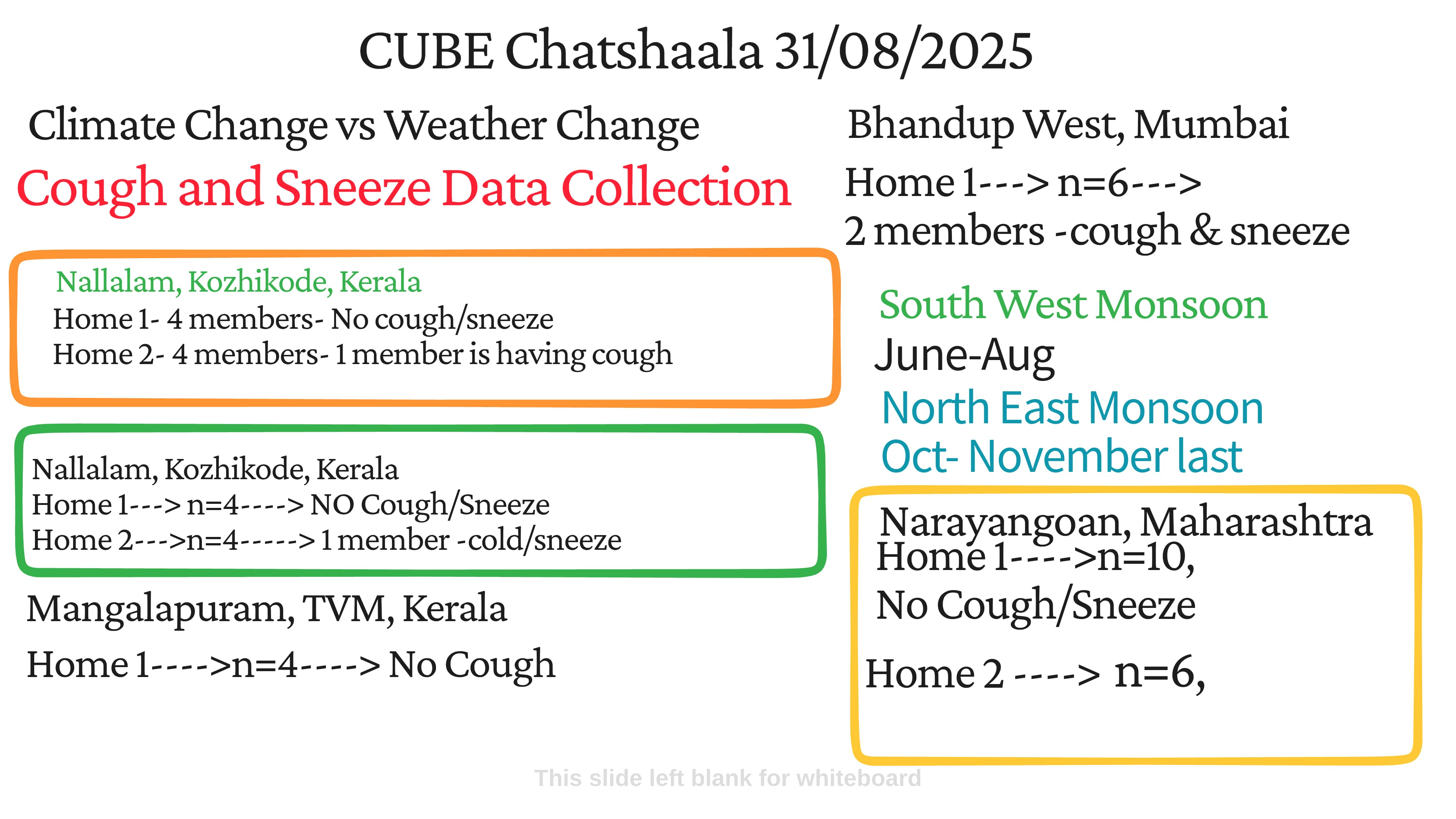
 Key Observations from Data Collection
-
Nallalam, Kozhikode (Kerala):
- Home 1 (n=4): No cough/sneeze.
- Home 2 (n=4): 1 member had cough/sneeze.
-
Mangalapuram, Thiruvananthapuram (Kerala):
- Home 1 (n=4): No cough/sneeze.
-
Bhandup West, Mumbai (Maharashtra):
- Home 1 (n=6): 2 members with cough & sneeze.
-
Narayangaon, Maharashtra:
- Home 1 (n=10): No cough/sneeze.
- Home 2 (n=6): No cough/sneeze reported.
 Context of Monsoons
- South-West Monsoon: June–August.
- North-East Monsoon: October–end of November.
By comparing monsoon phases with cough/sneeze incidence, participants are trying to tease apart:
 Is it weather change (short-term conditions) causing illness?
Or is it part of a larger climate change pattern?
 Provocative Questions for the Community
-
Why do some homes in the same locality report cough/sneeze while others don’t?
-
Could microclimate within houses (ventilation, dampness, exposure to rain) play a role?
-
Are we too quick to link health changes to “climate change” instead of carefully analyzing weather variability?
-
What if our local observations across India could build a nationwide health-weather map?
 What I Learned
From this ChatShaala, I realized that:
-
Data collection at the household level can reveal patterns often missed by large-scale reports.
-
Health conditions like cough and cold are multi-factorial — not only linked to climate but also to lifestyle, immunity, and living conditions.
-
Citizen science is a powerful tool to bridge the gap between local experiences and global questions.
 TINKE Moments
-
Seasonal illnesses might not be “climate change” but “weather change.”
-
Does rainfall intensity or humidity directly influence cough/sneeze prevalence?
-
Start correlating cough/sneeze reports with daily temperature/rainfall data.
-
Household-level surveys build a new dataset linking health + weather.
-
Community-driven tracking is more relatable and trustworthy.
 Gaps & Misconceptions Identified
-
Confusion between “climate” and “weather”: Many tend to use them interchangeably without realizing the difference in scale.
-
Limited sample size: Some homes had small family sizes; larger datasets are needed for stronger conclusions.
-
Overlooking variables: Factors like age, diet, and pre-existing conditions were not included in current surveys.
-
Assumption bias: Linking every cough/sneeze automatically to weather/climate without other checks.
 Reference
-
What’s the difference between climate and weather? | National Oceanic and Atmospheric Administration
@Theertha @Arunan @Ayana_Sudheer @SN1261 @magpie @Himanshu and others.