 CUBE ChatShaala Summary – 08 August 2025
Meeting Highlights
- Field Observation – Monsoon Fast Plant Discovery
-
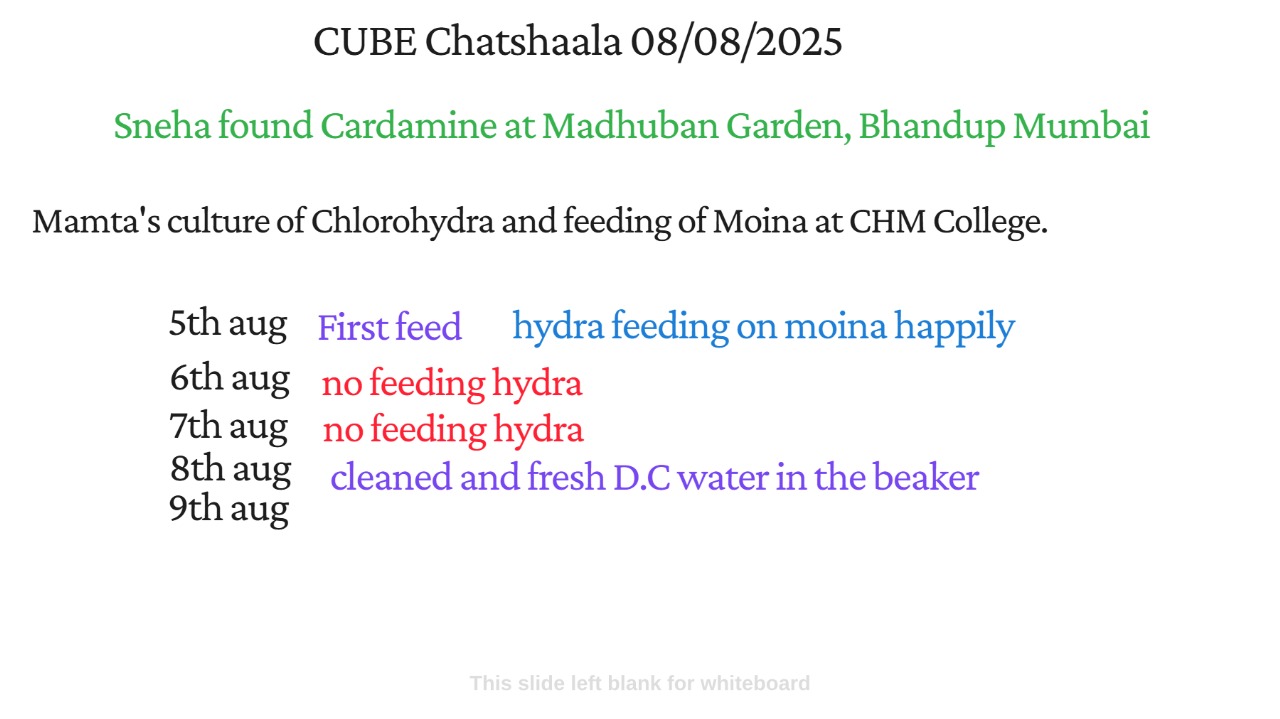
Observation by Sneha: Cardamine found at Madhuban Garden, Bhandup, Mumbai.
-
This adds to the ongoing monsoon biodiversity mapping project, particularly focusing on the distribution of fast-growing species like Cardamine during the rainy season.
-
The find ties into previous discussions on Cardamine leaf architecture and its adaptability in seasonal habitats (Reference).
- Laboratory Update – CHM College
-
Cubists by : Mamta.
-
Focus: Maintenance and feeding schedule of Chlorohydra using Moina as a live food source.
-
Feeding Timeline:
-
5th Aug: First feeding; Hydra observed feeding actively on Moina.
-
6th & 7th Aug: No feeding provided.
-
8th Aug: Culture beaker cleaned and replenished with fresh dechlorinated (D.C.) water.
-
9th Aug: Observation day to monitor Hydra health post-cleaning.
-
- Cross-Link Between Field & Lab Work
- The meeting emphasized how field-based plant observations (e.g., Cardamine in monsoon gardens) and lab-based aquatic model systems (Chlorohydra in controlled beakers) can complement each other in understanding adaptability and survival strategies.
TINKE Moments (Today I Never Knew Earlier ) 
-
Cardamine’s leaf patterns may reflect evolutionary strategies for optimizing water capture and light use during short monsoon growing windows.
-
Feeding frequency significantly influences Hydra’s activity levels and visible health—missing feed days can reveal resilience limits.
-
Dechlorinated water is critical in aquatic model maintenance, as chlorine residues can be fatal to sensitive organisms like Hydra.
-
A small beaker culture can mirror larger ecological principles—nutrient input, environmental maintenance, and organismal responses.
Provocative Question for the Community 
“If Cardamine thrives in natural rains without intervention, while Hydra requires precise care in a lab, what can this teach us about the spectrum of species’ environmental dependencies?”
Could similar resilience studies be designed where Cardamine is grown under controlled water regimes, paralleling Hydra’s feeding schedule experiments?
What I Learned Today 
Today’s ChatShaala illustrated the deep connection between field ecology and lab-based experimental biology. Both require careful observation, record-keeping, and maintenance practices—but the degree of care varies depending on the organism and environment. This dual perspective enriches our ability to design comparative studies on adaptability, survival, and resource use.
 Reference