 CUBE ChatShaala – 03/09/2025
 Meeting Summary
Today’s CUBE ChatShaala sparked a deep and lively discussion around allergies, sinusitis, pollen, and dust. The central question was: “Should there be an organism to cause allergy-type diseases?” Unlike infections caused by microbes, allergies arise when the immune system misidentifies harmless particles (like dust or pollen) as threats.
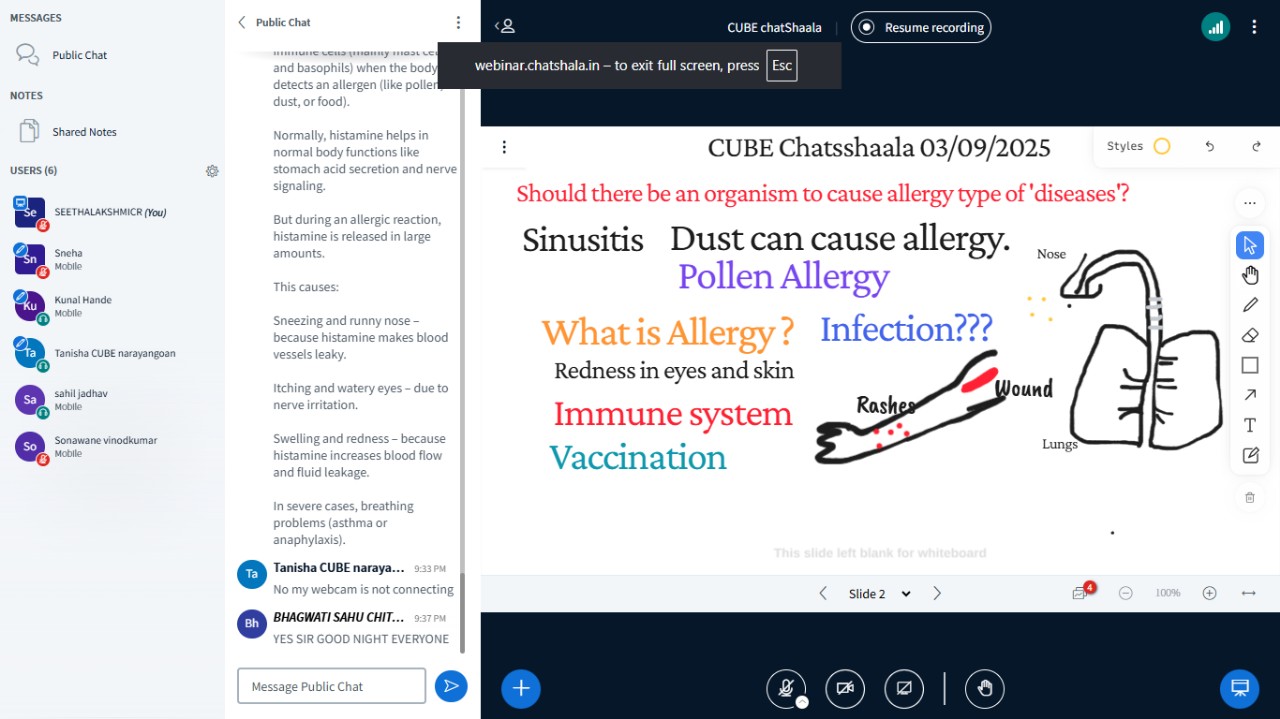
Participants explored:
-
Triggers of allergy: Dust, pollen, and environmental particles.
-
Body response: Histamine release leading to sneezing, runny nose, itching eyes, rashes, redness, and even breathing difficulties.
-
Overlap with diseases: The blurred line between infection, allergy, and immune response.
-
Solutions: Possible role of vaccination, immune system strengthening, and preventive care.
The discussion was enriched with visual notes on sinusitis, immune reactions, and allergy symptoms like rashes and lung/nose irritation.
 TINKE Moments (Things I Never Knew Earlier )
-
Allergies don’t always need an organism like bacteria or virus—dust and pollen themselves can trigger strong reactions.
-
Histamine, while part of normal body functions, becomes harmful when released in excess.
-
Allergies reveal how our immune system can sometimes act too strongly against harmless substances.
 Gaps and Misconceptions
-
Many still confuse allergy with infection, assuming an organism must always be present.
-
Some think allergy is a “disease” rather than a misfiring of the immune system.
-
The role of vaccination in allergies remains a point of uncertainty—can we train the body against allergens as we do with pathogens?
 Provocative Questions to Inspire All
-
If dust and pollen can trigger severe reactions, are allergies just our immune system’s overreaction or a hidden disease?
-
Can allergies ever be considered “infections,” or are they a separate class altogether?
-
Could vaccination against allergies become a future reality?
-
Are allergies telling us something deeper about how humans interact with their environment?
 What I Learned
Allergies are not simply small irritations; they reveal the sensitivity and complexity of the immune system. They also challenge the conventional idea that diseases always need organisms. This shift in perspective opens up new ways of thinking about health, prevention, and the invisible relationship between humans and their environment.
 Reference
@Arunan @sakshiconsultant2002 @SN1261 @2020ugchsncnseethala @Kashyap @sonawane and others.