 CUBE ChatShaala Summary – 03/10/2025
Today’s ChatShaala discussion revolved around curd formation experiments and the role of lactic acid bacteria in this everyday biological process.
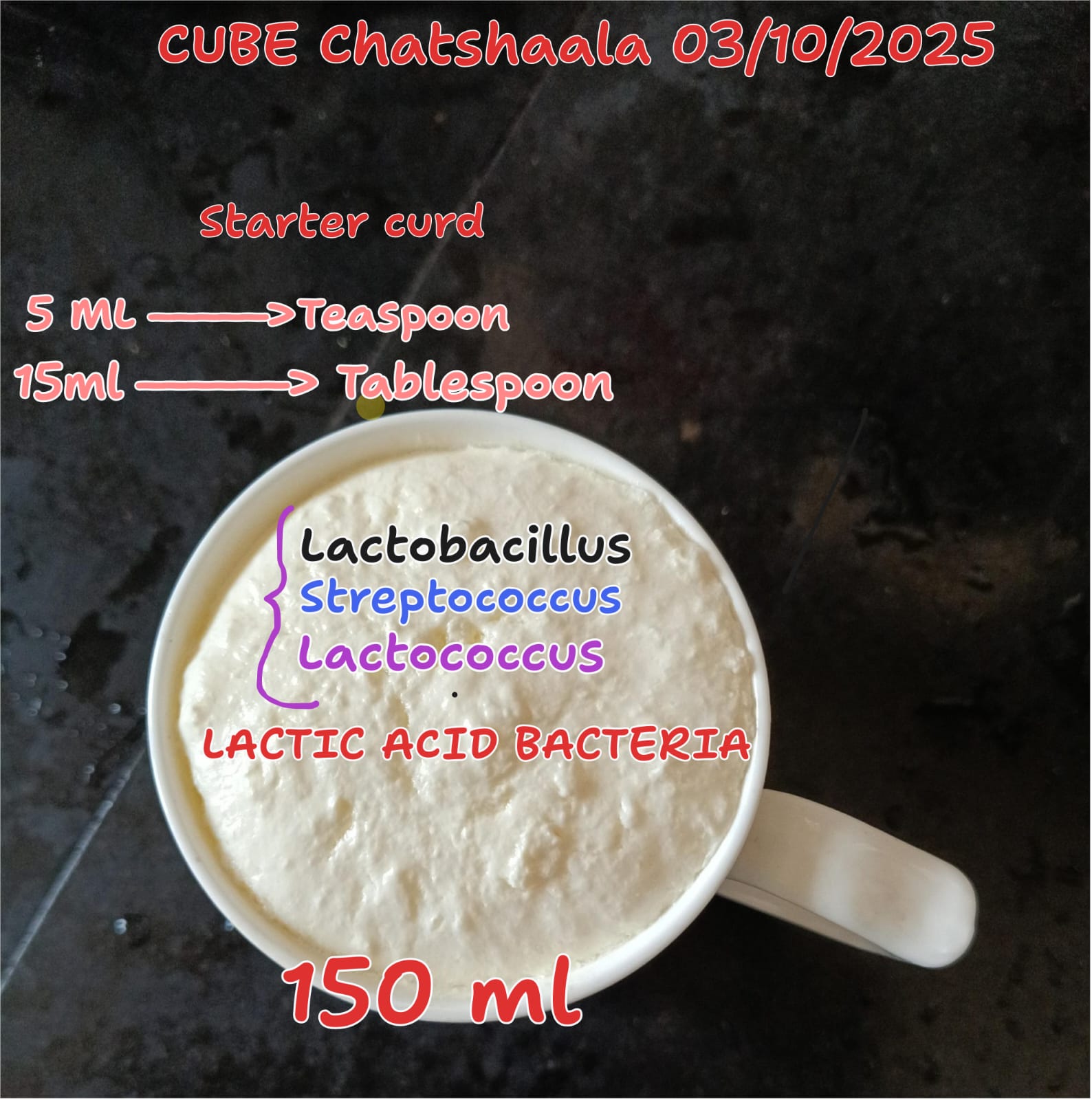

 Key Points Discussed
-
Starter Curd and Proportions:
- 5 ml (teaspoon) and 15 ml (tablespoon) amounts of starter curd were compared when mixed with 150 ml of milk.
- This set-up helps test whether the quantity of starter culture influences the speed and quality of curd setting.
-
Microbial Players:
- The main lactic acid bacteria involved are:
- Lactobacillus
- Streptococcus
- Lactococcus
- The main lactic acid bacteria involved are:
These bacteria ferment lactose into lactic acid, lowering pH and causing milk proteins to coagulate into curd.
- Experimental Thinking:
- Why does the amount of starter curd matter?
- Is it the number of bacteria introduced that speeds up the process, or are other factors (like temperature and milk quality) equally important?
 Provocative Questions for the Community
-
Curd Chemistry: If the same 150 ml of milk is used, will 5 ml and 15 ml starter curd give the same taste and texture after setting? Why or why not?
-
Microbial Competition: Could increasing the starter curd beyond a point actually reduce quality due to over-acidification?
-
Everyday Science: Do families in different parts of India (or the world) unknowingly follow different scientific protocols while setting curd?
 What I Learned Today
I realized that even a very common home practice like making curd is a controlled microbial experiment happening in every kitchen daily. Measuring spoonfuls of starter curd gave a quantitative approach to what is usually done by intuition.
 TINKE Moments (This I Never Knew Earlier)
-
A tablespoon of starter curd = 15 ml, a teaspoon = 5 ml. Such simple conversions can turn casual observations into measurable data.
-
Multiple bacterial species (Lactobacillus, Streptococcus, Lactococcus) work together in curd formation. I had assumed it was just Lactobacillus.
 Gaps and Misconceptions Identified
-
Some participants thought that more starter always means better curd. But over-inoculation can lead to sour, watery curd.
-
Confusion remains about whether the speed of curdling depends mainly on starter volume or environmental temperature.
-
A few were unaware that different bacterial species contribute to flavor diversity in curd.
 Reference
-
Lactic acid bacteria as starter cultures: An update in their metabolism and genetics - PMC
-
https://www.mdpi.com/1420-3049/28/5/2123?utm_source=chatgpt.com
-
https://www.journalofdairyscience.org/article/S0022-0302(17)31173-6/fulltext?utm_source=chatgpt.com
 Photographs during Chatshaala




@Arunan @Soumya_99 @sakshiconsultant2002 @SN1261 @magpie @Ayana_Sudheer @Chitralekha and others.