 CUBE ChatShaala — Discussion summary
20 April 2026 | Topic: Nail Growth Rate
Today’s ChatShaala is centred on an ongoing citizen-science experiment that members of the CUBE network have been running to measure and understand the rate at which fingernails grow. The session opened with a review of a nail-marking photograph shared by a 20-year-old female participant. The nail had been marked on 09/04/2026, and the follow-up photograph was taken eleven days later on 20/04/2026. Annotations on the image clearly identified the distal end (the free tip of the nail), the proximal end of the nail mark, and the proximal end of the growing nail, with the palm-side and shoulder of the nail also labelled to orient the viewer anatomically.
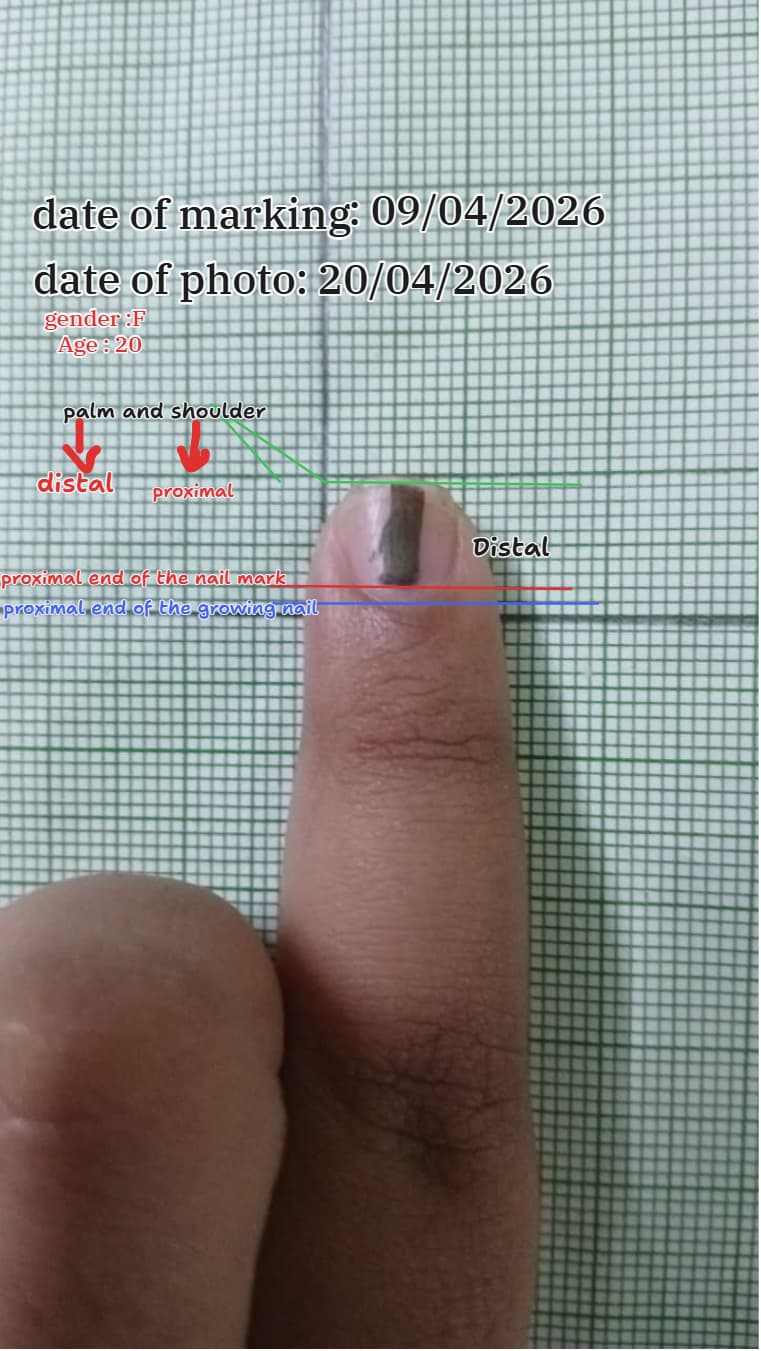
A short but important conceptual grounding was shared during the session: the proximal end of the nail — sitting beneath the skin at the base — contains the nail matrix, where new keratinocytes are continuously produced and pushed forward. This continuous forward movement is what we measure as nail growth. The distal free edge, by contrast, is composed of older, fully keratinised cells that have already been pushed out of the matrix. Understanding this anatomy is essential to correctly interpreting the measurements being taken by participants.
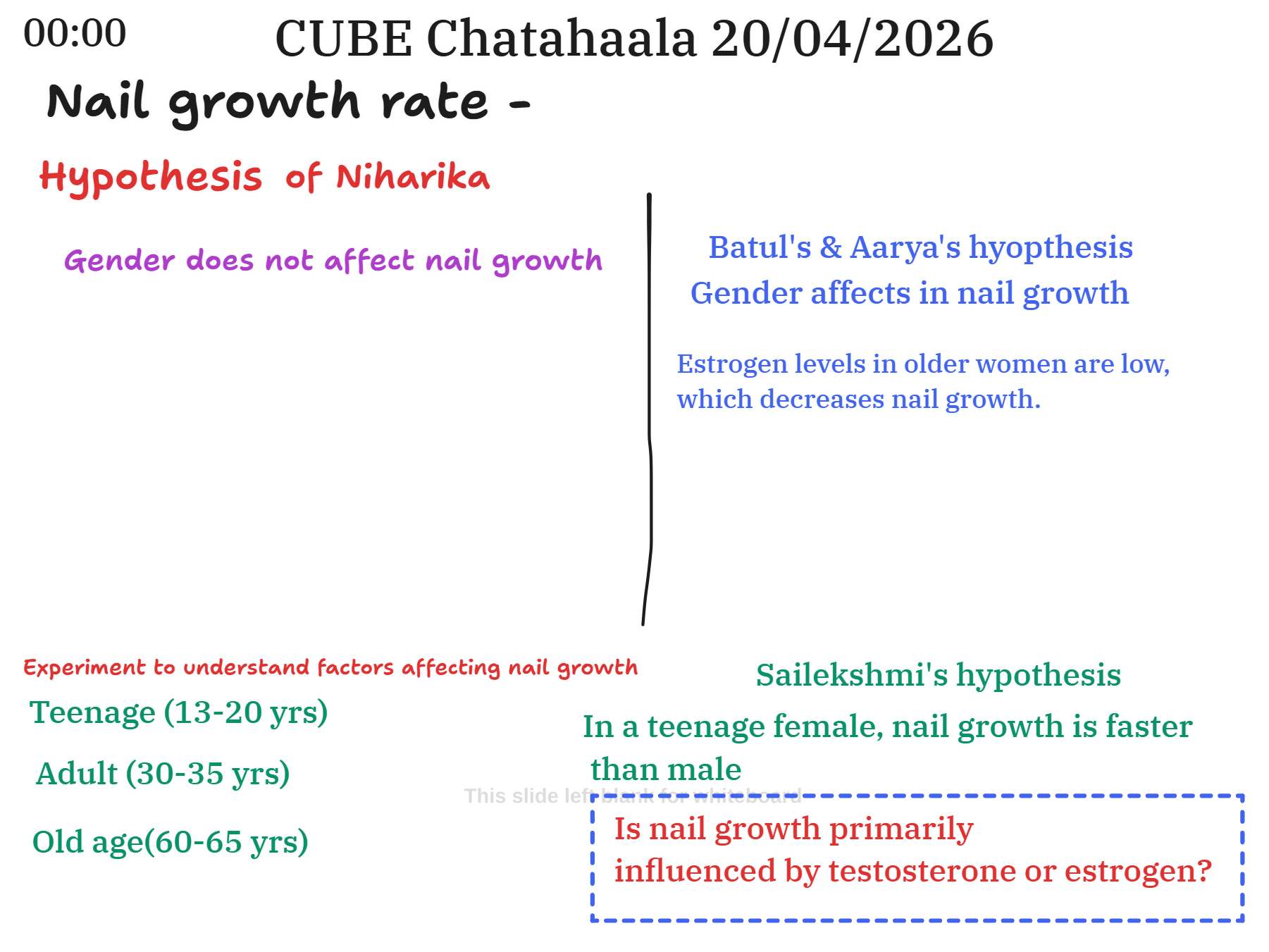
The session then shifted to debating a central biological question: Does gender influence the rate of nail growth? This prompted lively discussion, and three distinct hypotheses emerged, which the facilitator recorded on the whiteboard.
Niharika’s hypothesis
Gender does not affect nail growth — the rate is determined by other physiological or environmental factors, making gender an irrelevant variable.
Batul & Aarya’s hypothesis
Gender does affect nail growth. Specifically, lower estrogen levels in older women result in a measurable decrease in nail growth rate.
Sailekshmi’s hypothesis
In the teenage age group, females show faster nail growth than males — suggesting that hormonal changes during puberty, particularly elevated estrogen, may accelerate growth in young women.
These three hypotheses naturally converged into a central open question, highlighted on the whiteboard in a dashed box: Is nail growth primarily influenced by testosterone or estrogen? This remains the animating scientific question for future data collection.
To structure the investigation, the group agreed on an experiment design that would compare nail growth across three age brackets: Teenage (13–20 years), Adult (30–35 years), and Old age (60–65 years). Comparing these cohorts — and including both male and female participants within each — would allow the group to disentangle the effects of age from those of hormonal variation across gender lines.
The session wrapped up with an acknowledgement that the data collected so far, while promising, is limited in sample size. Participants were encouraged to continue documenting their nail-marking observations carefully and to recruit peers from diverse age groups to strengthen the dataset.
1 slide - Observation snapshot (20 April 2026)
| Parameter | Detail |
|---|---|
| Date of marking | 09/04/2026 |
| Date of photo | 20/04/2026 |
| Observation interval | 11 days |
| Participant gender | Female |
| Participant age | 20 years |
| Anatomical landmarks marked | Distal end, proximal end of nail mark, proximal end of growing nail |
 Provocative questions
-
If estrogen promotes faster nail growth and testosterone does the same (as some literature suggests), why might nail growth rates in older men — who also experience declining testosterone — not mirror the decline seen in post-menopausal women?
-
Sailekshmi’s hypothesis suggests that teenage females grow nails faster than teenage males. But would the same relationship hold across all fingers, or might dominant-hand fingers on males (due to increased blood flow from use) offset hormonal differences?
-
Since the nail matrix is the sole site of nail production, could there be measurable differences in matrix size or activity between males and females of the same age? How would one even measure that without imaging technology?
-
Niharika proposes that gender is irrelevant to nail growth. What confounding variables — nutrition, stress, sleep, dominant hand use, climate — would need to be controlled before her null hypothesis could be fairly tested?
-
The experiment groups participants into three age cohorts (13–20, 30–35, 60–65). Are there important hormonal transitions being missed by skipping the 20–30 and 35–60 ranges, particularly the perimenopausal window in women?
-
This session used a single photograph taken 11 days after marking. How might measurement accuracy improve if participants photographed their nails against graph paper at every 7-day interval instead?
-
Could an individual’s nail growth rate serve as a non-invasive proxy for their hormonal health — for instance, helping detect early signs of thyroid imbalance or estrogen deficiency in adolescent girls?
 What I have learned
Nail growth originates entirely from the nail matrix at the proximal end. The visible distal tip is simply older material that has been pushed forward — it no longer contributes to growth. This anatomical clarity is the foundation for correctly designing and reading any nail growth experiment.
The question of whether gender influences nail growth is more complex than it first appears. It is not just about male vs. female — it is really about how hormone profiles (estrogen and testosterone levels) change across a person’s lifetime and how those changes affect cellular activity in the nail matrix.
Sailekshmi’s hypothesis is particularly interesting because it introduces an age-gender interaction effect: the claim is not that females always grow nails faster, but that specifically during the teenage years, they do. This kind of nuanced, conditional hypothesis is scientifically stronger than a blanket claim.
Citizen science demands methodological discipline. Even a simple experiment like nail marking requires agreed-upon protocols: consistent lighting in photographs, graph-paper backgrounds for scale, standardised measurement points, and uniform intervals between photos. Without these, comparing data across participants becomes unreliable.
Competing hypotheses in the same group are not a problem — they are the engine of inquiry. The fact that Niharika, Batu,d Aarya, and Sailekshmi hold different positions is what makes this investigation scientifically alive. Good data will eventually adjudicate between them.
 TINKE moments (This I Never Knew Earlier)
TINKE 1 — Proximal vs. distal confusion
Several participants initially struggled to identify which end of the nail is the “growing” end. There is an intuitive but incorrect assumption that the visible tip (distal end) is where growth happens. Realising that growth is entirely driven by the hidden proximal matrix — beneath the skin — was a genuine conceptual shift for many in the group.
TINKE 2 — Hormones as a dynamic variable, not a fixed category
Participants began by framing the question as “male vs. female,” but the discussion revealed that the real variable is hormone level, which changes dramatically within a single gender across age. A teenage girl and a 65-year-old woman are both female, but their estrogen profiles are vastly different. This reframing from “gender” to “hormone level across age” was a significant insight.
TINKE 3 — Testosterone also influences nail growth in women
The whiteboard question about testosterone vs. estrogen caught several participants off guard. The assumption was that estrogen is “the female hormone” relevant here. But testosterone is present in women too, and declining testosterone in older women has also been linked to slower nail and hair growth. This added an unexpected layer to an apparently simple binary question.
TINKE 4 — Sample size awareness
At least one participant was surprised to realise how few data points the group currently has. A single photograph from a single 20-year-old female, while carefully annotated, cannot support or refute any of the three hypotheses on the board. The moment of recognising the gap between “we have data” and “we have enough data to conclude” was an important methodological awakening.
 Gaps and misconceptions
Gap — No male participant data yet
All current nail-marking data comes from a female participant. Without at least matched male data from the same age cohort, the gender-comparison hypothesis cannot be tested at all. Recruiting male participants — particularly in the 13–20 age bracket to match Sailekshmi’s hypothesis — should be the immediate next step.
Gap — No standardised measurement protocol
The session did not establish a shared, written protocol for how to measure the distance between the original mark and the current nail-tip position. Different participants may be measuring from different reference points, introducing systematic error. A clear, illustrated protocol document should be created and circulated before the next data collection round.
Misconception — “Faster nail growth = healthier nails.”
There was an implicit assumption in parts of the discussion that a higher nail growth rate is inherently desirable or a sign of health. In reality, abnormally fast nail growth can be associated with conditions like hyperthyroidism or certain medications. Growth rate is a biological data point, not a health score.
Misconception — Treating gender as a binary, fixed biological constant
The experiment design currently uses a simple male/female split. This overlooks the fact that hormone levels — the actual proposed mechanism — vary enormously within each gender category based on age, health status, and individual biology. The experiment would gain rigour by recording actual age and ideally noting any known hormonal conditions, rather than relying solely on gender as a proxy variable.
Gap — Literature not yet integrated into hypothesis formation
Relevant peer-reviewed sources (including NIH resources on nail anatomy and studies linking hormonal imbalances to nail health) were referenced by the session organiser, but do not yet appear to have been read and discussed by all participants. Grounding the hypotheses in published findings before the next session would sharpen the predictions and help the group avoid testing questions that have already been answered.
 Photographs during Chatshaala
 Referance