CUBE ChatShaala Summary – 30 October 2025
Topic: Sailekshmi’s Zoology Practical Exam Discussion
Theme: From Bones to Biology — Connecting Frog Osteology, Vertebrae, and Plant Regeneration
 Session Overview
Today’s ChatShaala revolved around Zoology Practical topics—particularly Osteology of Frog, Typical Vertebra, and Ninth Vertebra, integrated with insights into plant tissue culture and hormones. The session beautifully blended animal and plant systems, showing how comparative biology deepens understanding across life forms.
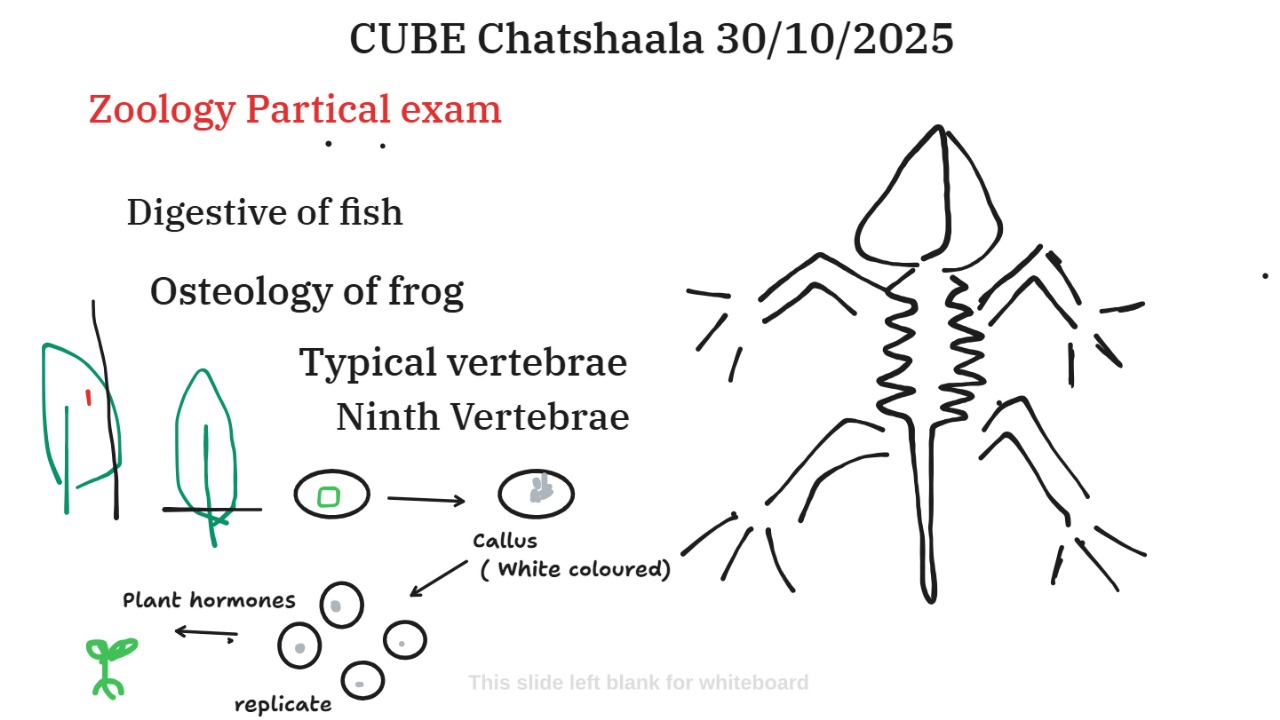

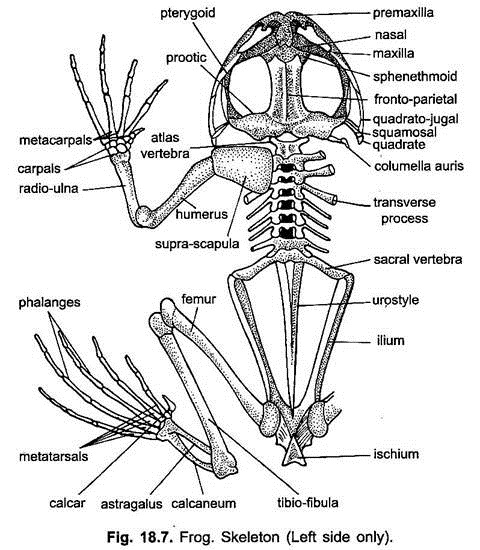
Participants examined the frog skeleton diagram in detail—identifying bones such as urostyle, ilium, tibio-fibula, scapula, and phalanges. The focus then shifted to understanding how the ninth vertebra differs from typical vertebrae in structure and function, offering evolutionary significance in locomotion and jumping.
The conversation also touched on the digestive system of fish, connecting form and function — how structural adaptations reflect their aquatic lifestyle.
On the plant side, a fascinating discussion on callus formation and plant hormones brought a cellular perspective to growth and regeneration, linking developmental biology with lab observation skills.
 Key Learnings
-
The urostyle in frogs represents the fusion of vertebrae, aiding in powerful jumps.
-
Typical vertebra shows distinct centrum, neural arch, and spine, while the ninth vertebra connects directly with the urostyle.
-
Comparative anatomy helps in visualizing evolutionary modifications.
-
In plants, callus formation is triggered by plant hormones like auxins and cytokinins, reflecting how life adapts and regenerates across kingdoms.
-
The integration of zoology and botany topics during one session reflects the spirit of interdisciplinary inquiry—a CUBE hallmark.
 T.I.N.K.E. Moments (This I Never Knew Earlier)
-
The frog’s urostyle plays a critical role similar to the tailbone in humans, a vestige of evolutionary history.
-
Osteology is not just about bones—it reveals the lifestyle, habitat, and movement patterns of animals.
-
The white callus seen in plant tissue culture is not just “undifferentiated cells,” but a gateway to regeneration when exposed to the right hormonal balance.
-
Typical vertebrae comparison between frog and fish vertebrae reveals both diversity and unity of structure.
 Gaps and Misconceptions Identified
-
Some confusion existed between urostyle and vertebral column extension—clarified as the posterior fusion of vertebrae unique to frogs.
-
Misunderstanding between ilium (hip bone) and ischium (posterior pelvic bone) was cleared through skeletal labeling.
-
Many thought callus is formed without hormones—today’s session highlighted the necessity of plant hormones (auxins and cytokinins) in its initiation.
 Reflection: What I Learned
The skeletal structure of a frog is not just an arrangement of bones—it’s a story of movement, adaptation, and evolution. Similarly, the plant callus reminds us that regeneration is a universal principle of life.
 Provocative Questions for the Community
-
 If the urostyle helps a frog jump, what would happen if it were absent? Could the frog still move efficiently?
 -
 Why do animal and plant cells respond differently to injury—one regenerates callus, the other forms scar tissue?
 -
 Can understanding vertebral fusion in frogs inspire better prosthetic or orthopedic designs in humans?
 -
If hormones can make a plant regenerate, could similar biochemical triggers exist in animals for organ repair?
 **Reference **
- https://www.notesonzoology.com/wp-content/uploads/2017/07/clip_image002_thumb-98.jpg
- https://cdn.vectorstock.com/i/preview-1x/21/35/leaf-anatomy-vector-1612135.jpg
- Anatomy - Wikipedia
 Photographs during Chatshaala