 CUBE Chatshaala - Discussion Summary
Today’s session opened with Sailekshmi’s field observation on sprouting behaviour in the potato tuber (Solanum tuberosum), drawn from tubers she has been tracking at Tumrhi, Bageshwar, Uttarakhand. The central data point she brought to the group was straightforward but rich with implications: out of five potatoes under observation, two had matured and broken dormancy, showing visible sprouts, while the remaining three stayed immature and dormant. This 2-out-of-5 ratio became the anchor for a broader conversation about what dormancy actually means at a physiological level, and why some tubers “wake up” earlier than others even under seemingly identical storage conditions.
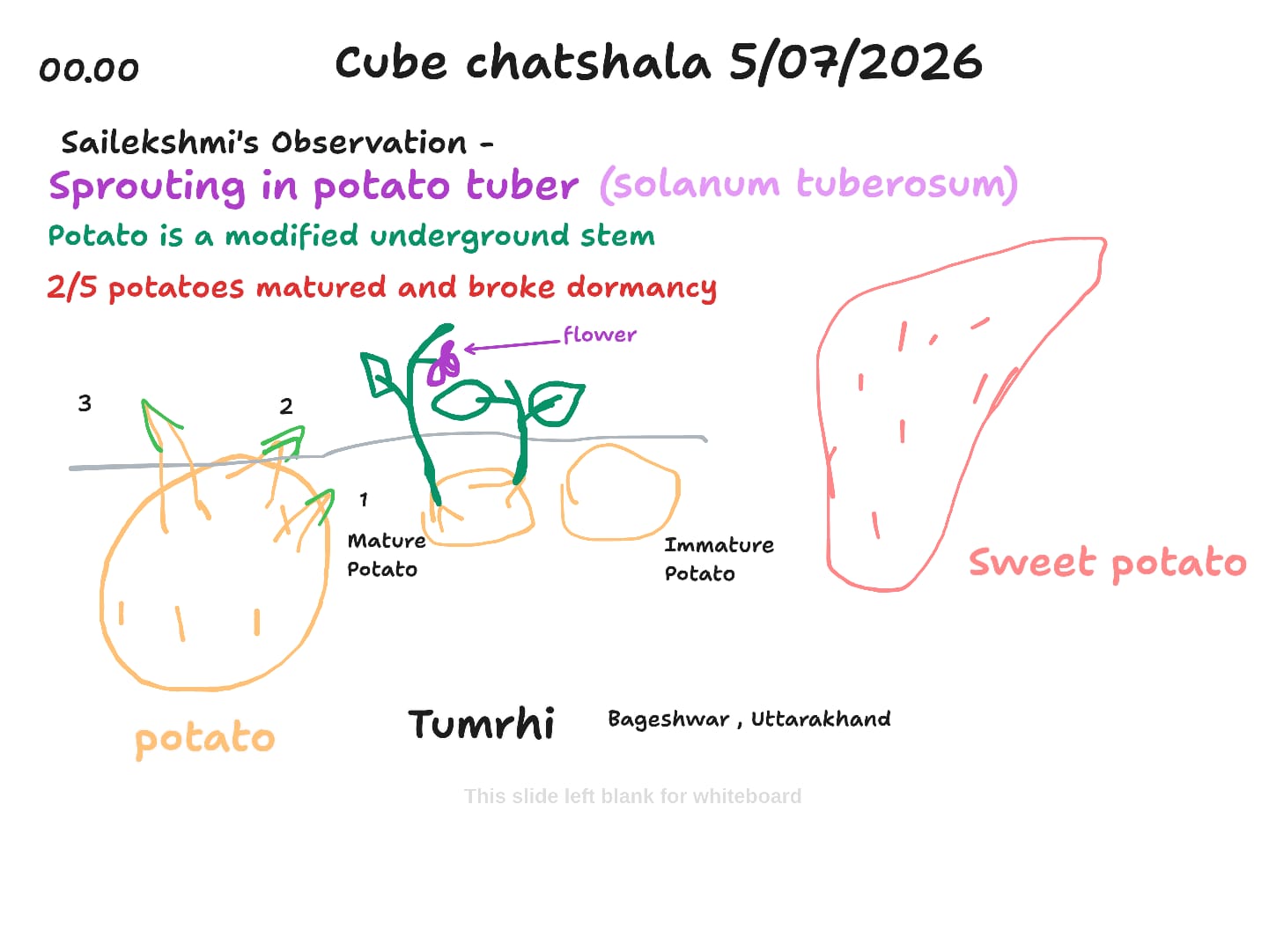
The participants spent time establishing a foundational point that often gets glossed over in casual understanding of potatoes: the potato is not a root. It is a modified underground stem, technically called a tuber, and this distinction matters because it explains why potatoes sprout the way they do. Stems carry nodes and axillary buds, and it is precisely these buds, visible on the tuber’s surface as “eyes,” that give rise to sprouts once dormancy lifts. The whiteboard sketch showed this clearly, with the mature potato (labelled 1) sending up a shoot bearing leaves and even a small purple flower. In contrast, an adjacent immature potato remained smooth and inactive underground.
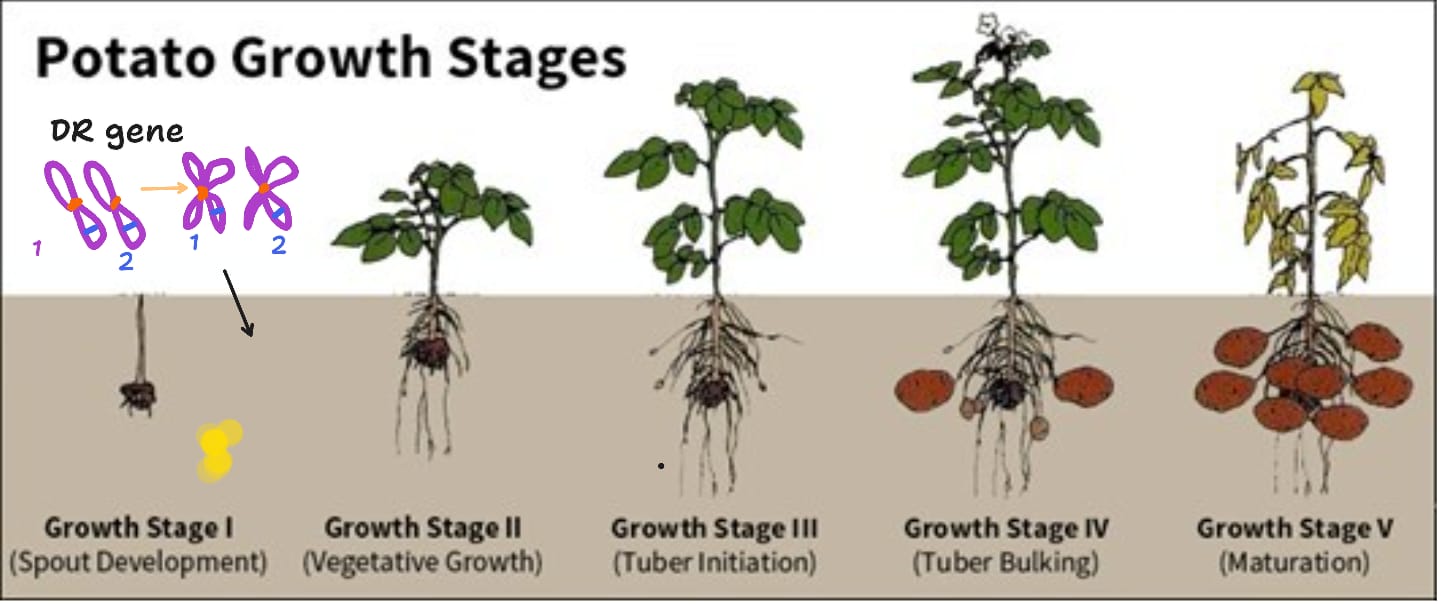
The discussion then moved to the five-stage growth model of potato development, referencing the second image shared during the session. The stages were laid out as Spout Development, Vegetative Growth, Tuber Initiation, Tuber Bulking, and Maturation. Members connected Sailekshmi’s real-world sample directly to Stage I, Spout Development, where a dormant seed tuber begins pushing out a shoot in response to internal hormonal cues. This is the phase in which sprouts that may already be latent on the tuber begin to develop further, while new roots simultaneously start forming below, a process that typically unfolds over roughly two to three weeks depending on soil temperature, seed physiological age, and variety.
A particularly engaging thread emerged around the DR gene diagram in the second image, showing two chromosome pairs labelled 1 and 2 undergoing what appeared to be a structural rearrangement before dormancy release. The group did not resolve exactly which molecular pathway was being depicted, but the conversation usefully opened up the idea that dormancy is not simply the absence of activity; it is an actively maintained physiological state, regulated by shifting hormone balances, particularly among gibberellins, cytokinins, and jasmonic acid, and gated by gene expression changes within the tuber’s meristem tissue. Several members noted parallels here to seed dormancy in general, reinforcing a cross-cutting theme in ChatShaala’s biology track.
The session closed with a comparative note on sweet potato (illustrated separately on the whiteboard). The group clarified, importantly, that sweet potato is botanically distinct from potato: it is not a modified stem but rather a swollen storage root, an enlarged lateral root of the plant. Unlike potato, sweet potato is typically propagated through vine cuttings rather than through eyes or buds, and its roots generally mature within about four months of planting, with some fast-maturing varieties ready in as little as two months. This distinction between “stem tuber” and “storage root” became one of the more productive clarifications of the day, since the two are frequently and mistakenly grouped as “the same kind of vegetable.”
 Provocative Questions
-
If dormancy is an actively maintained state rather than passive inactivity, what specific internal signal do we think tipped these two potatoes out of dormancy while the other three stayed suppressed? Could it be temperature exposure, moisture, physical damage, or something purely genetic?
-
The whiteboard shows a flower forming on the mature potato’s shoot. Given that potato is usually propagated vegetatively through tubers rather than seed, what evolutionary purpose does flowering still serve for the plant?
-
Since potato is a modified stem and sweet potato is a modified root, do their sprouting mechanisms operate through comparable hormonal pathways, or are we looking at two fundamentally different developmental scripts that happen to produce a similar-looking harvest?
-
If two out of five potatoes broke dormancy under the same storage conditions, what does that tell us about genetic uniformity, or lack of it, within a single batch of seed tubers?
-
Could the DR gene rearrangement observed in the reference diagram be a controllable variable, meaning could tuber dormancy potentially be manipulated on demand by farmers rather than left to chance environmental cues?
 What I Have Learned
This session reshaped how I think about something as ordinary as a potato sitting in a kitchen basket. I had always treated sprouting as a kind of decay, a sign the potato had “gone off,” rather than recognising it as the visible endpoint of a tightly regulated developmental programme. Learning that the potato is technically a stem, not a root, was the detail that reorganised everything else for me. Once that clicks, the eyes on a potato stop being a cosmetic feature and start making sense as genuine stem nodes, each one carrying the potential for an entire new shoot system.
I also came away with a sharper appreciation for how much biology is happening beneath a seemingly binary outcome. Sailekshmi’s 2-out-of-5 observation could easily be summarised as “some sprouted, some didn’t,” but sitting with the five-stage growth model made clear that this outcome is the product of an intricate hormonal negotiation, one that science is still actively working to fully characterise. That, to me, is the real value of citizen observation of this kind: it grounds abstract growth-stage diagrams in a living, countable, personally tracked dataset.
Finally, the sweet potato clarification was a useful corrective to a mislabelling I have probably carried for years. Recognising that sweet potato is a root and potato is a stem, and that they therefore sprout, propagate, and develop through entirely different structural logic, is exactly the kind of “obvious once explained” insight that ChatShaala consistently delivers.
 TINKE Moments (This I Never Earlier)
TINKE 1: The potato is a stem, not a root.
Before this session, many participants (myself included) held an implicit, unexamined assumption that a potato was some kind of root vegetable. The whiteboard discussion made explicit that a potato is a modified underground stem, and that its “eyes” are stem buds rather than any root-derived structure. This reframes the entire sprouting process as classic stem-bud outgrowth rather than root regeneration, a distinction that had previously remained unstated in the group’s working vocabulary.
** TINKER 2: Dormancy is regulated, not passive.**
There was an implicit assumption running through earlier conversations that a “resting” tuber is simply inert. Today’s session made explicit that dormancy is an actively maintained hormonal and genetic state, governed by shifting balances of growth-promoting and growth-inhibiting signals within the tuber. The tuber isn’t waiting for the outside world to hand it a green light; it is running an internal, ongoing process, and dormancy release is the outcome of that process tipping in a particular direction.
TINKE 3: Potato and sweet potato are structurally unrelated.
Perhaps the most immediately useful TINKE moment of the day: what many had implicitly filed away as “two similar tuber vegetables” are, in fact, botanically distinct organs entirely, one a stem, the other a root, propagated differently, maturing on different timelines, and following different sprouting biology. This had never been surfaced as an explicit point of confusion before today.
 Gaps and Misconceptions
-
Unresolved mechanism behind the DR gene diagram: The session referenced a chromosome-level illustration linked to dormancy release, but the group did not have a clear, agreed-upon explanation of exactly what molecular event this diagram represents or how it connects mechanistically to the hormonal pathways discussed. This remains an open thread for a future session, ideally with a dedicated reference pulled from a peer-reviewed source on tuber dormancy genetics.
-
No controlled variable recorded for the 2-of-5 sprouting outcome: Sailekshmi’s observation is a valuable real-world data point, but the session did not capture information on storage temperature, light exposure, or handling history for the five tubers. Without that context, it is difficult to say with confidence whether the sprouting split reflects genuine genetic variability between tubers or simply uncontrolled environmental differences.
-
Common misconception flagged and corrected: The recurring habit of mentally grouping potato and sweet potato as “the same category of vegetable” was identified as a widespread misconception. The session corrected this, but it is worth reinforcing in future write-ups since the confusion is common even outside this group.
-
Flowering purpose left unexplored: The appearance of a flower on the mature potato’s shoot was noted on the whiteboard but not discussed in depth. Since potato cultivation today relies almost entirely on vegetative propagation via tubers, the ecological or breeding-related role of potato flowering remains a gap worth returning to, particularly for members interested in breeding or seed-saving applications.
 Photographs during Chatshaala


 Referance