 CUBE ChatShaala – Meeting Summary
Date: 05 January 2026
Theme: Plant reproductive biology, research culture, and scientific questioning
Overview
The CUBE ChatShaala session on 05 January 2026 was a deeply exploratory and concept-driven discussion that combined classical botanical morphology with contemporary research perspectives. The session successfully blended observation, questioning, and interpretation—highlighting the scientific thinking encouraged within the CUBE ecosystem.
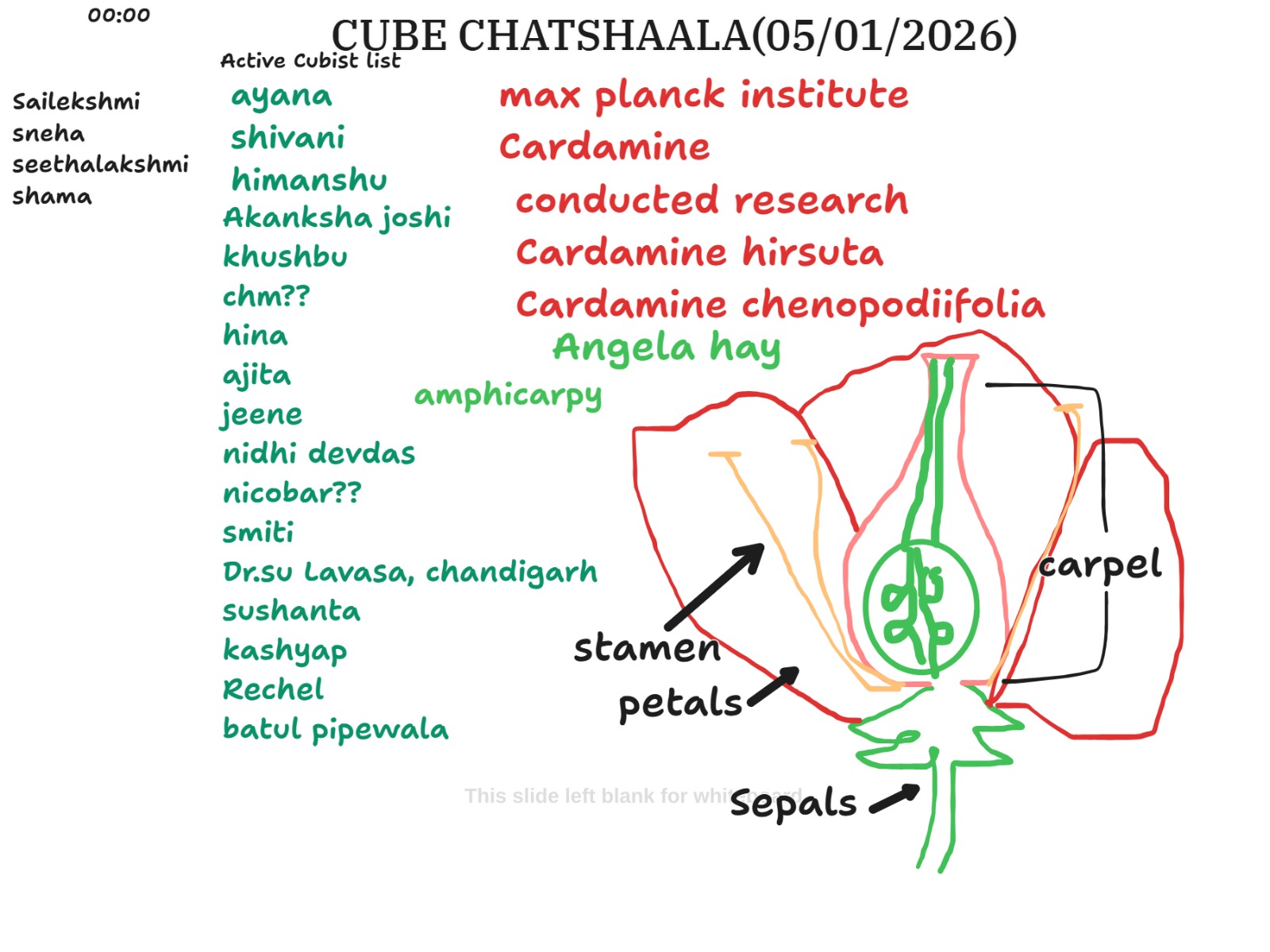
The discussion opened with active participation from Cubists across institutions, setting a collaborative tone. A key focus was placed on Cardamine, a model plant system widely studied for its reproductive strategies. Reference was made to research work associated with the Max Planck Institutes (Germany), particularly studies linked to Angela Hay, highlighting how developmental biology bridges morphology with evolutionary adaptation.
Whiteboard Discussion Highlights
The whiteboard became central to unpacking complexity through simplicity.
-
Floral Structure Revisited
A hand-drawn floral diagram was used to revisit foundational structures:- Sepals as protective organs
- Petals as attractants
- Stamens as male reproductive units
- Carpel as the female reproductive organ (ovary, style, stigma)
The act of drawing rather than displaying a prepared slide encouraged slow thinking and collective correction, reinforcing structure–function relationships.
-
Carpel as a Concept, Not Just a Part
The carpel was discussed not merely as an anatomical label but as an evolutionary innovation. Reference to authoritative descriptions (e.g., encyclopedic definitions) helped ground the discussion while opening space for deeper questions about origin and modification. -
Amphicarpy in Cardamine
The concept of amphicarpy—production of two distinct types of flowers/fruits—emerged as a key learning point. The group explored how Cardamine hirsuta and Cardamine chenopodiifolia exemplify adaptive strategies that balance dispersal and survival. -
Research Culture and Publication Context
The discussion briefly contextualized how such plant studies reach global audiences through prestigious platforms such as PNAS (Proceedings of the National Academy of Sciences). The rigor, peer review, and multidisciplinary scope of such journals were highlighted to emphasize why careful observation and precise language matter.
 What I Learned Today
-
Drawing biological structures by hand reveals gaps that slides often hide.
-
The carpel is not just a textbook term but a gateway to understanding angiosperm success.
-
Amphicarpy reflects ecological intelligence rather than biological redundancy.
-
Institutions like the Max Planck Society prioritize curiosity-driven research that starts with deceptively simple questions.
-
Publishing in journals like PNAS demands clarity of thought long before clarity of results.
TINKE Moments (This I Never Knew Earlier)
-
I had not previously connected flower architecture directly with life-history strategies.
-
Amphicarpy challenged my assumption that plants always optimize for maximum dispersal.
-
The same plant can “decide” differently depending on environmental certainty.
-
Scientific drawings are not illustrations—they are thinking tools.
 Gaps and Misconceptions
-
Misconception: All flowers serve the same reproductive purpose.
Correction: Structural variation reflects adaptive strategies. -
Misconception: Research begins in laboratories.
Correction: It often begins with careful field observation and simple sketches. -
Gap: Limited clarity on how gene regulation translates into visible floral diversity.
-
Gap: Overreliance on memorized definitions rather than functional reasoning.
 Provocative Queries for the inspiration
-
If one plant can produce two types of flowers, is it responding—or anticipating?
-
Why would a plant choose to drop seeds nearby instead of dispersing them widely?
-
Do diagrams reveal what words conceal?
-
Why are scientists around the world obsessed with Cardamine?
-
Is it data, or is it the question behind the data?
 Closing Reflection
Today’s ChatShaala reaffirmed that learning science is not about collecting answers but about sharpening questions. The whiteboard reminded us that complexity often emerges from simple lines—drawn slowly, argued collectively, and revised honestly. This session did not end with conclusions; it ended with curiosity, which is precisely where good science begins.
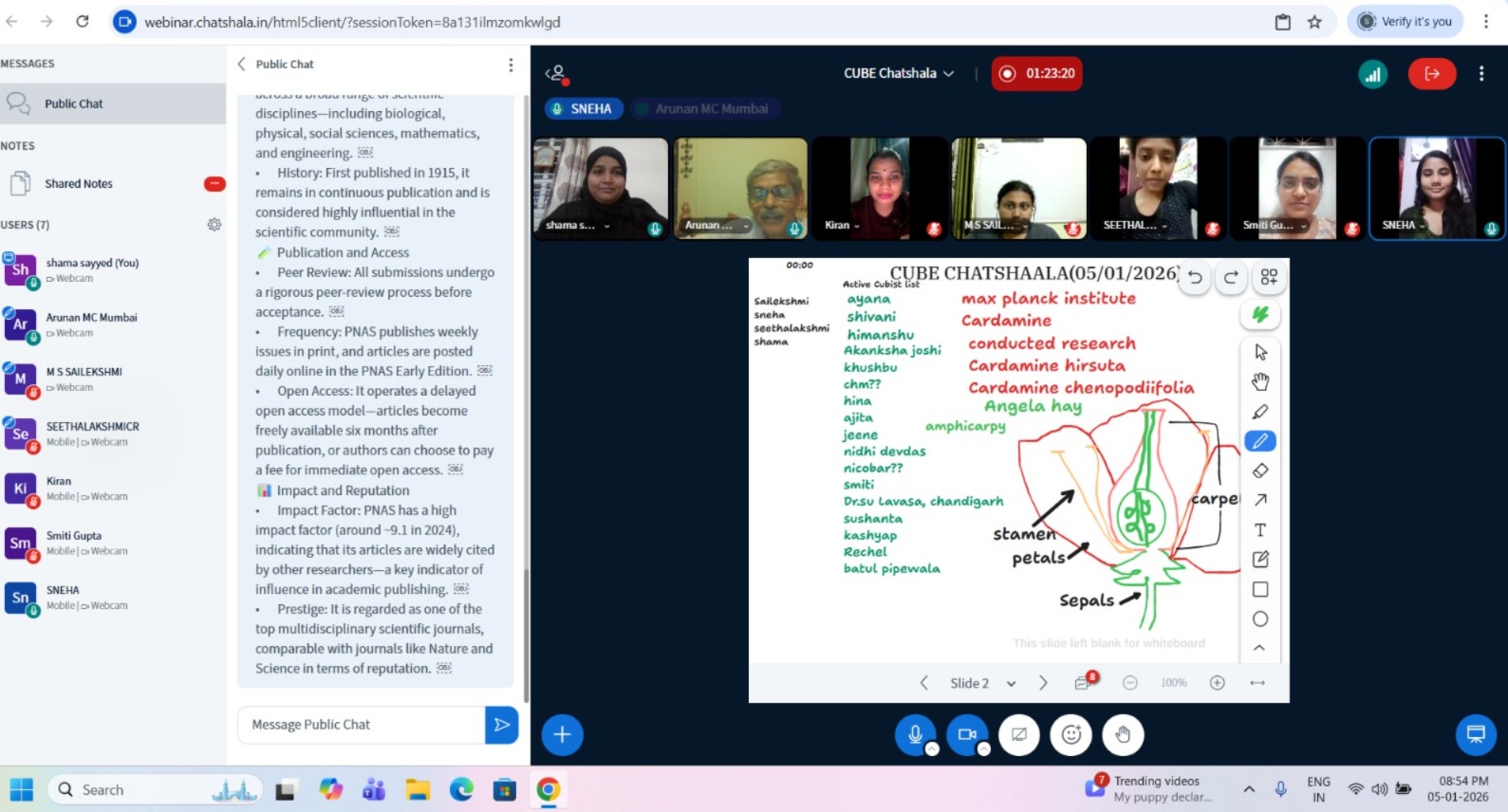
 Photographs during Chatshaala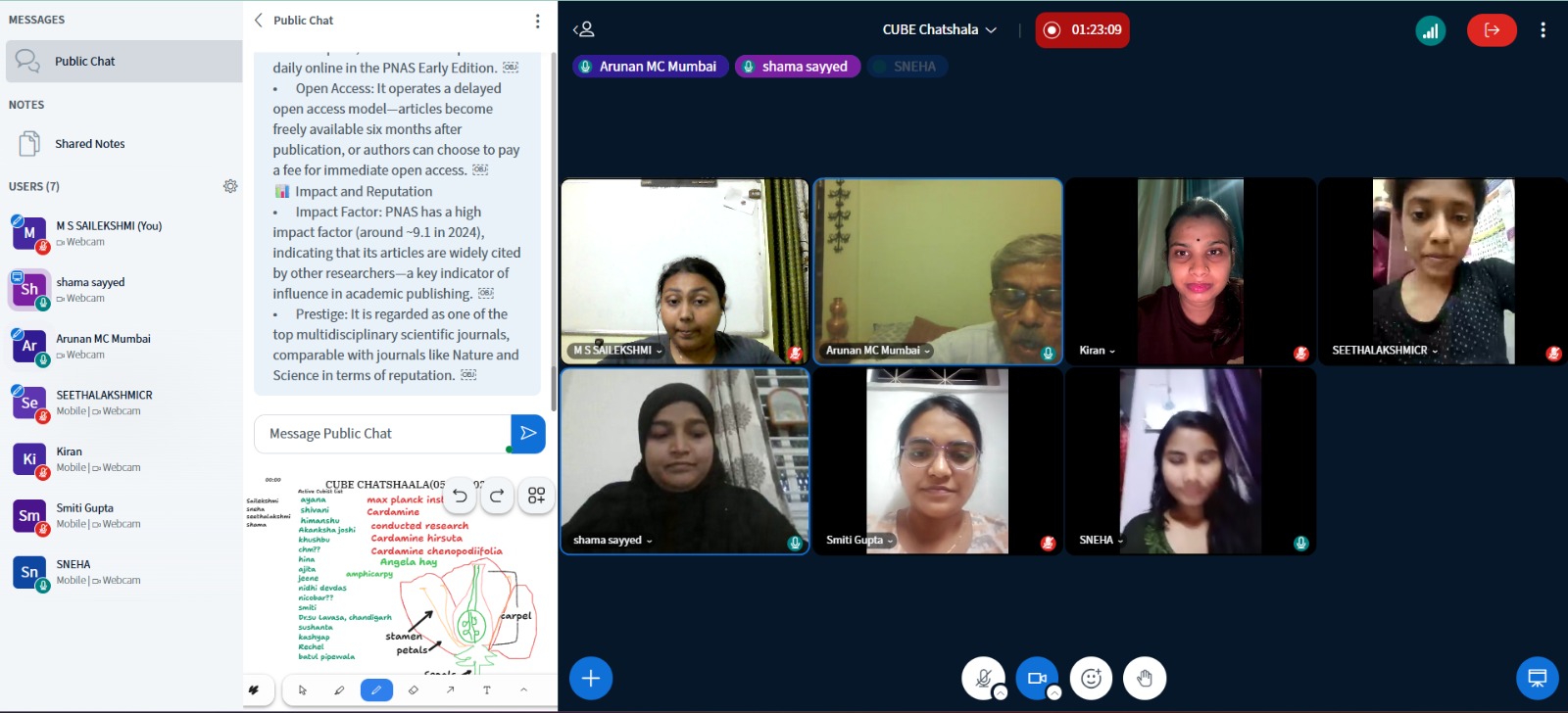
 Reference