 CUBE ChatShaala Summary – 09 December 2025
Topic: Exploring Chlorohydra, Model Systems & Reproduction in Hydra
Today’s ChatShaala brought together observations and hypotheses centered on Hydra, Chlorohydra, Chlorella, and the use of model organisms such as Moina macrocopa JSK1. Participants shared field experiences from the NES Ratnam Workshop (Bhandup, Mumbai) and built collective understanding around symbiosis, survival strategies, and reproductive modes.
 Meeting Summary
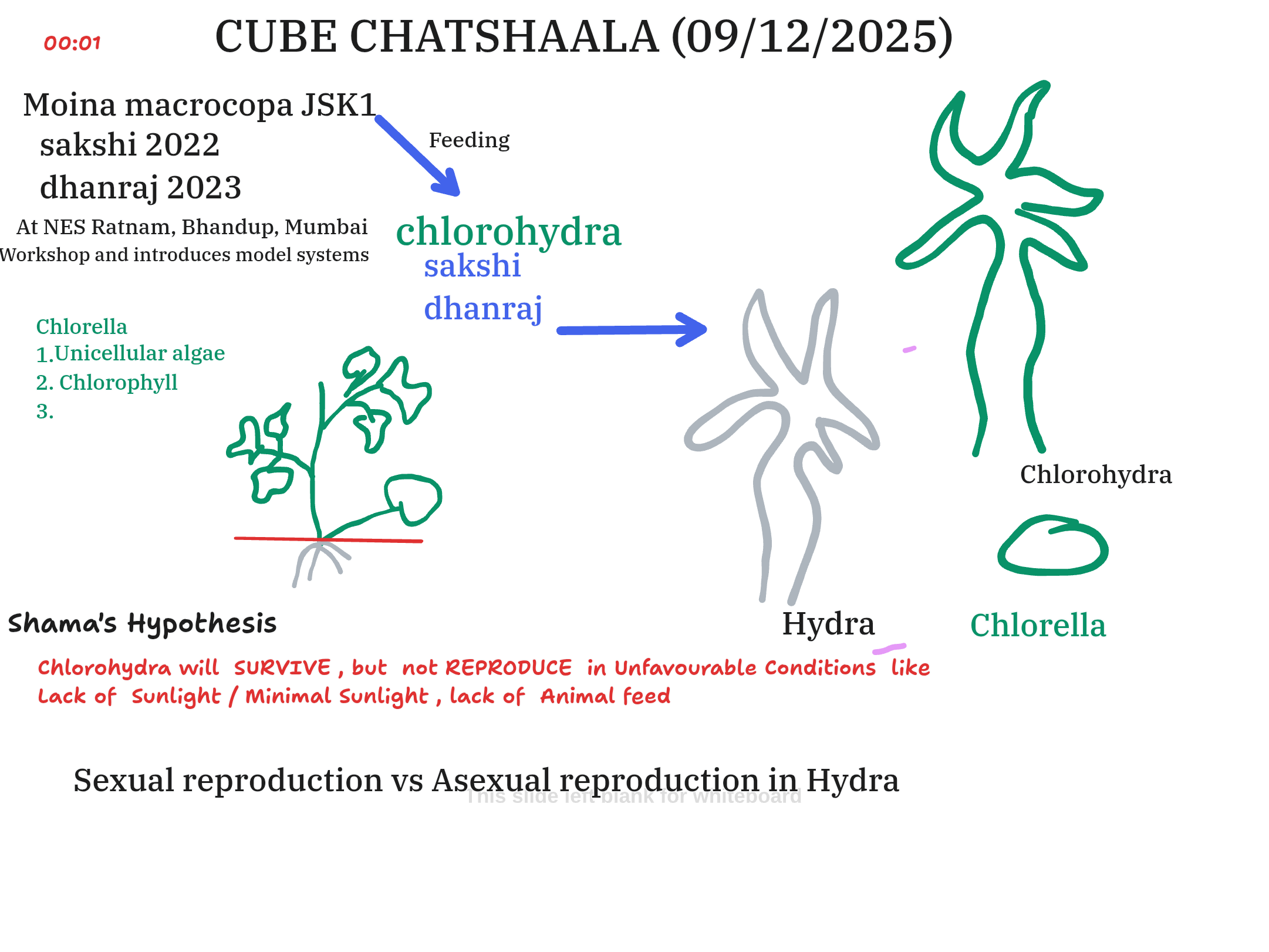
The discussion began with a recap of Moina macrocopa cultures initiated by Sakshi (2022) and Dhanraj (2023). This set the stage for a deeper examination of Hydra and its symbiotic variant, Chlorohydra. The whiteboard highlighted how Chlorella, a unicellular alga containing chlorophyll, supports Chlorohydra through photosynthesis, providing an alternative energy source.
Visual sketches illustrated:
- Free-living Hydra
- Hydra hosting Chlorella to form Chlorohydra
- Feeding interactions and the advantages conferred by symbiosis
Sailekshmi Question
Why is chlorohydra feeding with moina, even though chlorella is present?
Sneha correlated with the help of the cardamine plant as it produces food through photosynthesis by absorbing minerals from the soil and using sunlight as solar energy, with the green pigment chlorophyll.
Shama presented a hypothesis proposing that Chlorohydra can survive but may not reproduce under unfavourable conditions (minimal sunlight, absence of animal prey). Participants reflected on how sunlight and food availability jointly affect the balance between survival and reproduction.
The session concluded with a discussion on sexual vs asexual reproduction in Hydra, noting that budding predominates in nutrient-rich conditions, while sexual reproduction often appears during environmental stress.
 What I Learned Today
-
Symbiosis between Hydra and Chlorella increases survival during low-food conditions but might compromise reproduction.
-
Sunlight is a critical variable—not only for photosynthetic partners, but also for triggering physiological responses in Hydra.
-
Model organisms like Hydra and Moina reveal surprisingly deep biological principles using simple tools.
-
Reproductive modes in Hydra act as indicators of environmental stress or stability.
 TINKE Moments (Things I Never Knew Earlier)
-
Chlorohydra can act almost like a “solar-powered” animal due to Chlorella living inside its tissues.
-
The shift from asexual to sexual reproduction in Hydra can be a direct outcome of environmental constraints.
-
A unicellular alga can significantly alter the behaviour and biology of an animal host.
-
Simple field organisms perfectly mirror complex ecological relationships seen across ecosystems.
 Gaps & Misconceptions Identified
-
Misconception: Chlorohydra will always reproduce better because it has photosynthetic partners.
Clarification: Energy from Chlorella supports survival, but reproduction requires additional resources, especially rich animal protein. -
Gap: Lack of clarity on how much sunlight is “minimal” or sufficient for Chlorohydra survival.
→ Calls for controlled experiments with light gradients. -
Misconception: Hydra stops feeding when it becomes Chlorohydra.
Clarification: Chlorohydra still requires animal prey; photosynthesis only supplements, not replaces, feeding. -
Gap: No quantification yet of how many Chlorella cells Hydra can host and how this varies with environmental stress.
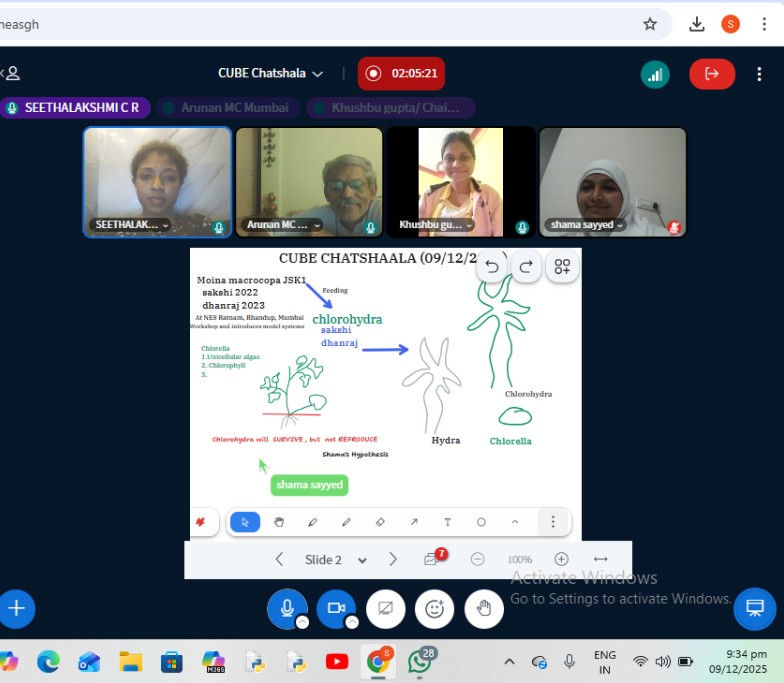
 Photographs during Chatshaala

 Provocative Questions to Inspire the Community
-
If Hydra becomes Chlorohydra for survival, does that make it more plant-like or more resilient as an animal?
-
What environmental cue decides whether Hydra will bud or reproduce sexually?
-
Could Chlorohydra survive longer starvation than normal Hydra? How would we test this?
-
What happens if we gradually remove sunlight from Chlorohydra—does it lose its algae or adapt?
-
Is Chlorohydra an evolutionary advantage or a temporary compromise?
 Reference