CUBE ChatShaala — Discussion Summary
Date: 25 April 2026
Today’s session opened with a classroom-style investigation into something as seemingly routine as fingernail growth, before pivoting, in a genuinely exciting way, to the molecular world of antibiotic resistance. Both threads were driven by student curiosity and real data rather than textbook dictation, which is the hallmark of CUBE’s collaborative inquiry approach.
Part One: Nail Growth Rate as a Biological Variable
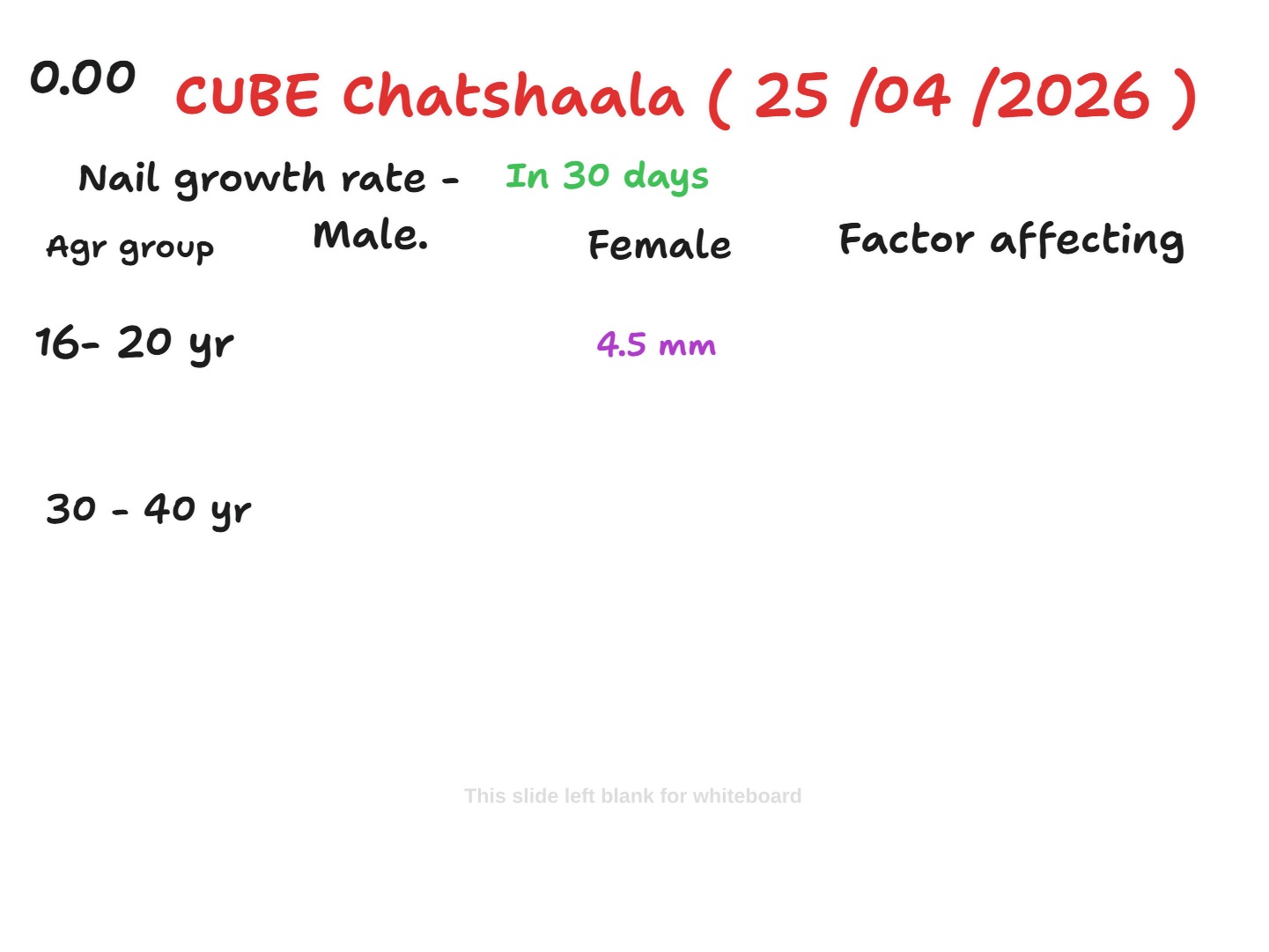
The first whiteboard (recorded at 0:00) set up a structured data table to explore how nail growth rate varies across age groups and sexes. The central question posed was: how many millimetres do nails grow in 30 days? The table organised data by age group (16–20 years and 30–40 years), with separate columns for Male, Female, and Factors Affecting growth.
The only data point clearly entered was 4.5 mm for females in the 16–20 age group. The male column and the 30–40 age group rows remained unfilled, indicating that the group had either not yet gathered data for those categories or was actively inviting participants to contribute their measurements. This framing turns the exercise into a live citizen-science experiment — a defining feature of CUBE’s methodology. The session treated the body itself as a laboratory, with each participant potentially a data source.
Part Two: Antibiotic Resistance — From Penicillin to Beta-Lactamase
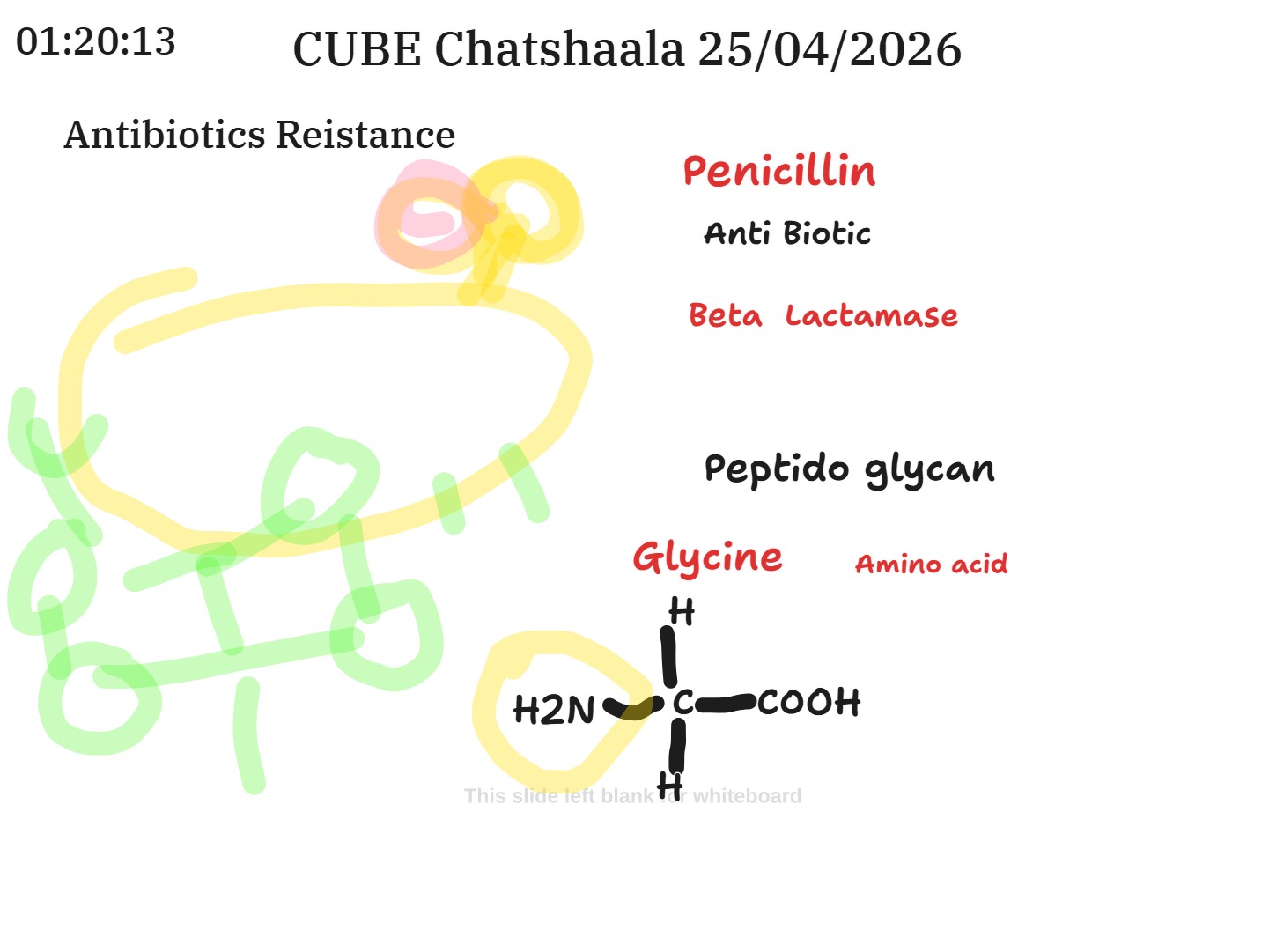
By the 1-hour 20-minute mark (as shown on the second whiteboard), the conversation had moved into significantly deeper biochemical territory. The topic was antibiotic resistance, centred on Penicillin as the anchor example.
The diagram on the board drew out the structural formula of Glycine (H₂N–C(H)–COOH), identifying it explicitly as an amino acid and connecting it to Peptidoglycan—the polymer mesh that forms the structural backbone of bacterial cell walls. The visual showed two sketched shapes: one representing the bacterial cell and another, presumably illustrating how Penicillin acts on the peptidoglycan layer.
The conceptual arc the group was tracing was this: Penicillin works by mimicking the D-Ala-D-Ala terminal sequence of the peptidoglycan precursor. It binds competitively to transpeptidase enzymes (Penicillin-Binding Proteins, or PBPs), blocking the cross-linking of peptidoglycan strands. Without this cross-linking, the bacterial cell wall becomes structurally unsound, rupturing under osmotic pressure.
The resistance mechanism discussed was the production of Beta-Lactamase — an enzyme that bacteria synthesise to break the beta-lactam ring in penicillin, thereby neutralising the drug before it can reach its target. This was illustrated on the whiteboard, with the term “Beta Lactamase” written prominently alongside “Penicillin” and “Antibiotic.”
The supplementary notes enriched this with four broader resistance mechanisms: enzymatic inactivation (as above), modification of target sites, reduced membrane permeability through loss of porin channels, and active efflux pumps. The genetic basis — including spontaneous mutation and horizontal gene transfer via conjugation, transformation, transduction, and transposons — was also discussed.
 Provocative Questions
-
We recorded 4.5 mm nail growth in females aged 16–20 over 30 days. What do we predict for males in the same age group, and what biological reasoning would we use to justify that prediction before collecting any data?
-
Nails are made of keratin, a protein assembled from amino acids. Glycine was highlighted today as a component of peptidoglycan in bacteria. Does the presence of glycine in both keratin and peptidoglycan tell us something meaningful about evolutionary biochemistry, or is it simply a coincidence of chemistry?
-
Beta-Lactamase breaks the beta-lactam ring and inactivates Penicillin. But bacteria also resist antibiotics by mutating their Penicillin-Binding Proteins (PBPs). These are two entirely different strategies arriving at the same outcome. What does this convergence of resistance mechanisms tell us about the selective pressure antibiotics exert?
-
The whiteboard showed the structure of Glycine — the simplest amino acid, with no R-group side chain. Why would Glycine be particularly important in the rigid structure of bacterial peptidoglycan? What would happen structurally if a larger amino acid were substituted at that position?
-
Horizontal gene transfer allows bacteria to share resistance genes across species boundaries. If a non-pathogenic soil bacterium carries a beta-lactamase gene and transfers it to a pathogenic strain, what does that imply about how we should think about antibiotic use in agriculture and the environment — not just in hospitals?
-
We are measuring nail growth in humans as a proxy for cell division rates. Could nail growth rate serve as a biomarker for broader metabolic health, nutritional status, or hormonal activity? How would you design a controlled study to test this?
-
The data table left the 30–40 age group entirely blank. Based on what we know about cellular ageing and reduced metabolic rate in older tissues, what would your hypothesis be for nail growth in that cohort compared to the 16–20 group?
 What I Have Learned
This session reminded me that the most ordinary biological phenomena — something as unremarkable as a growing fingernail — can become a gateway into deep questions about cellular biology, molecular genetics, and even public health policy if you ask the right questions.
The nail growth exercise showed me that collecting real, first-person biological data is not just pedagogically engaging; it is scientifically meaningful. When we measure ourselves as a cohort and compare across age and sex, we are generating genuinely novel data that no textbook captures.
The shift to antibiotic resistance revealed how one molecule — Penicillin — connects structural biochemistry (the beta-lactam ring), cell biology (peptidoglycan cross-linking), evolutionary biology (resistance arising under selection pressure), and global health (the antibiotic resistance crisis). The enzyme Beta-Lactamase is not just a curiosity; it represents one of the most consequential biochemical adaptations in the history of medicine.
I also learned to appreciate the structural logic of Glycine. Its simplicity — a bare carbon with two hydrogens, an amino group, and a carboxyl group — makes it the least sterically demanding amino acid, which is precisely why it fits into the tight geometry of peptidoglycan’s cross-linked mesh. Biology often finds elegant solutions in simplicity.
Perhaps most importantly, I was reminded that resistance mechanisms are plural and redundant. Bacteria do not bet on a single strategy. They inactivate the drug, hide from it, pump it out, and restructure the target it binds to. Understanding this multiplicity is essential to designing better antibiotics and combination therapies.
 TINKE Moments (This I Never Knew Earlier)
TINKE 1 — The Missing Male Data
The nail growth table had no data entered for males in either age group, and no data at all for the 30–40 cohort. This is not a failure of the session — it is a live TINKE moment. The group has not yet established whether nail growth rate differs between males and females in the same age band, or whether it declines with age as expected. These are open empirical questions. Until the data is gathered, any claim about sex-based or age-based differences is speculative.
TINKE 2 — What Exactly Are the “Factors Affecting” Nail Growth?
The whiteboard included a column labelled “Factor Affecting” but left it entirely blank. This is a significant gap. Nutrition (biotin, zinc, protein intake), hormonal status (thyroid hormones, androgens), season (nails reportedly grow faster in summer), dominant versus non-dominant hand — all of these are known or hypothesised influences. The group has not yet operationalised which factors it intends to track, which means the data collected so far may not be fully comparable across participants.
TINKE 3 — The Jump from Glycine to Peptidoglycan
The whiteboard placed Glycine’s structural formula alongside Peptidoglycan without fully tracing the biochemical steps connecting them. Glycine is one of the five amino acids in the pentapeptide side chain of peptidoglycan (specifically the third residue in some bacterial species), but this connection was not explicitly spelled out. Participants who do not already know this pathway may have experienced the connection as unexplained. This is a teaching gap worth revisiting.
TINKE 4 — Beta-Lactamase Mechanism Not Drawn Out
The whiteboard named Beta-Lactamase as the resistance mechanism but did not show the actual biochemical cleavage — the opening of the four-membered beta-lactam ring. Without showing the “before and after” of that ring opening, participants can understand that resistance happens without understanding how it happens at the molecular level. Drawing the intact penicillin structure alongside the cleavage participants can help understand. No Discussion of Resistance Beyond Enzymatic Inactivation**
The session, from the whiteboard evidence, focused primarily on Beta-Lactamase as the resistance mechanism. The three other major mechanisms — target site modification (mutated PBPs), reduced permeability (porin loss), and efflux pumps — were not represented visually or, apparently, discussed in depth. This is a meaningful omission because it could lead participants to believe that resistance to Penicillin is only about enzyme production, which would be an oversimplification.
 Gaps and Misconceptions
Gap 1 — Conflating Penicillin Resistance with Antibiotic Resistance Generally
Penicillin is an excellent anchor case, but it can inadvertently create the impression that all antibiotic resistance works via beta-lactamase. Different antibiotic classes are defeated by entirely different mechanismsmsms. Aminoglycosides are inactivated by modifying enzymes. Macrolides are blocked by ribosomal methylation (23S rRNA alteration). Fluoroquinolones are defeated by DNA gyrase mutations. Building a comprehensive mental model requires students to see resistance as a family of strategies, not a single trick.
Gap 2 — The Relationship Between Nail Growth and Cell Division
It was not made explicit in today’s session that nail growth is driven by keratinocyte proliferation in the nail matrix. If participants do not understand this, the measurement exercise remains purely phenomenological — they know how fast nails grow, but not why. Linking the measurement back to the underlying cell biology would deepen the inquiry considerably.
Potential Misconception — “Bacteria Develop Resistance”
A common and important misconception is that individual bacteria actively “develop” or “learn” resistance in response to an antibiotic. In reality, resistance arises through random mutation or gene acquisition that pre-exists antibiotic exposure; the antibiotic then selects for those resistant variants by eliminating the susceptible ones. If this distinction was not explicitly addressed in today’s session, it is worth foregrounding in the next one, as it changes how participants understand both evolution and the danger of incomplete antibiotic courses.
Potential Misconception — Glycine as Universally Present in Peptidoglycan
Glycine features prominently in the peptidoglycan of Staphylococcus aureus (as a pentaglycine bridge), but its role varies across bacterial species. Gram-negative bacteria have a thinner peptidoglycan layer with a different crosslinking arrangement. Presenting Glycine as “the amino acid of peptidoglycan” without this qualification could create an oversimplified picture that becomes an obstacle when students encounter Gram-negative bacterial cell biology.
 Photographs during ChatShaala