CUBE Chatshaala – Discussion Summary
Date: 28 June 2026
Today’s CUBE Chatshaala session was a lively and hands-on gathering where participants shared their ongoing home lab experiments centred on seed germination and root nodule development in leguminous plants. Three cubists Aarya, Manali, and Niharika presented their experimental setups and early observations, sparking a rich group discussion about the biology of seed imbibition, germination rates, and the formation of root nodules across different legume species.
Aarya’s HomeLab Research — Root Nodules Study of Green Gram
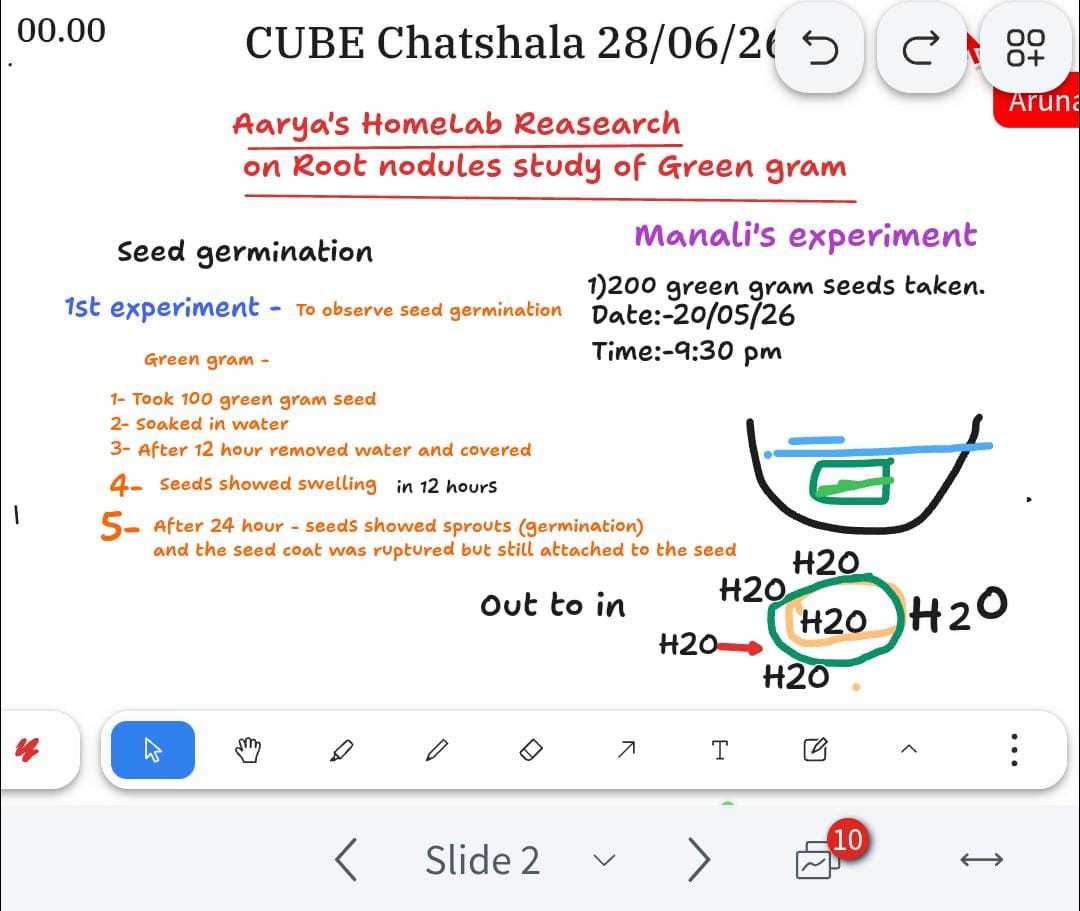
Aarya opened the session by presenting her home lab research focused on root nodule study in green gram (Vigna radiata). Her first experiment was designed to observe the process of seed germination. She took 100 green gram seeds, soaked them in water, and after 12 hours, removed the water and covered the seeds. Within those first 12 hours, the seeds visibly swelled a clear sign that water uptake (imbibition) had begun. By the 24-hour mark, the seeds had sprouted and shown germination: the seed coat had ruptured but remained attached to the seed.
A particularly interesting point Aarya illustrated on the whiteboard was the direction of water movement during imbibition water moves from outside the seed to inside, a fundamentally osmotic and physical process driven by the seed’s internal matric potential. This “out to in” movement of water was annotated with multiple H2O labels converging toward the seed, making the concept visually intuitive and discussion-worthy.
Manali’s Experiment — Germination Rate Study
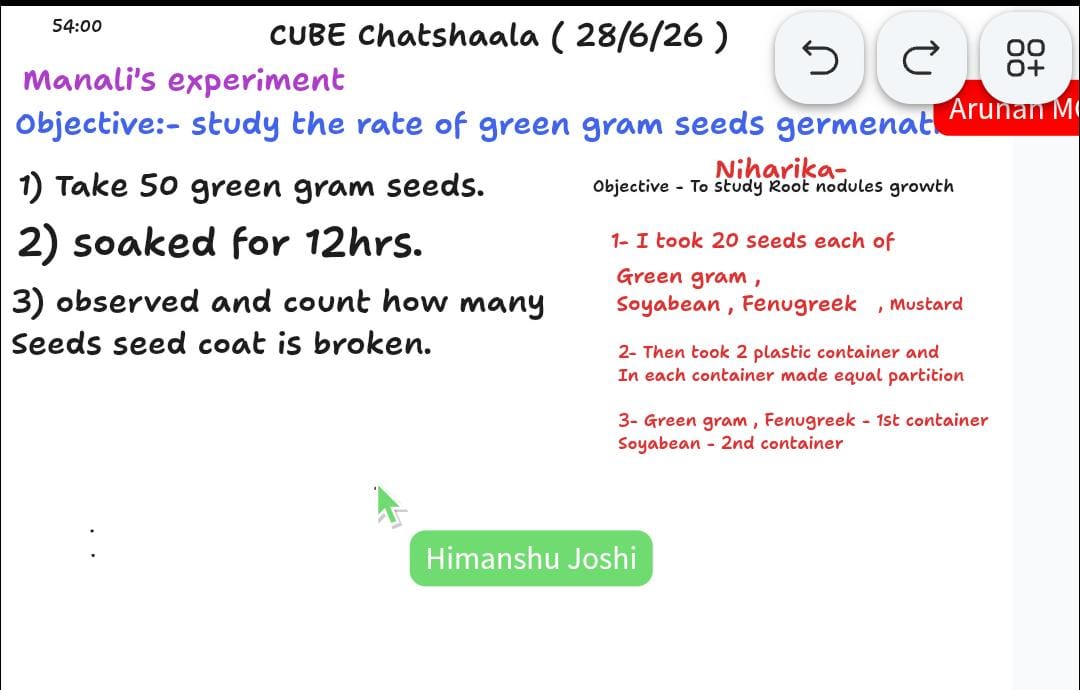
Manali’s experiment took a more quantitative approach. Her objective was to study the rate of green gram seed germination. She began with 200 seeds on 20th May 2026 at 9:30 PM, though the whiteboard also noted a separate set of 50 seeds for closer observation. Her protocol was straightforward: soak 50 green gram seeds for 12 hours, then observe and count how many seeds had their seed coat broken using this as a measurable indicator of germination onset.
This experiment introduced the group to the idea of using germination rate as a quantifiable metric rather than just a qualitative observation, which prompted discussion around what constitutes a reliable indicator of germination seed coat rupture, radicle emergence, or something else entirely.
Niharika’s Experiment — Comparative Root Nodule Growth Study
Niharika presented the most comparative experimental design of the session. Her objective was to study root nodule growth across multiple plant species. She selected 20 seeds each of green gram, soybean, fenugreek, and mustard, and placed them in two plastic containers with equal partitions. Container 1 held green gram and fenugreek; Container 2 held soybean. Mustard was included as a non-leguminous control.
This multi-species setup was significant because it allowed for a side-by-side comparison of nodule formation in confirmed legumes (green gram, soybean, fenugreek) against a non-legume (mustard), which is not known to form symbiotic associations with Rhizobium. The session noted that this design has strong potential to generate comparative data on nodulation across legume species and to confirm the absence of nodules in mustard.
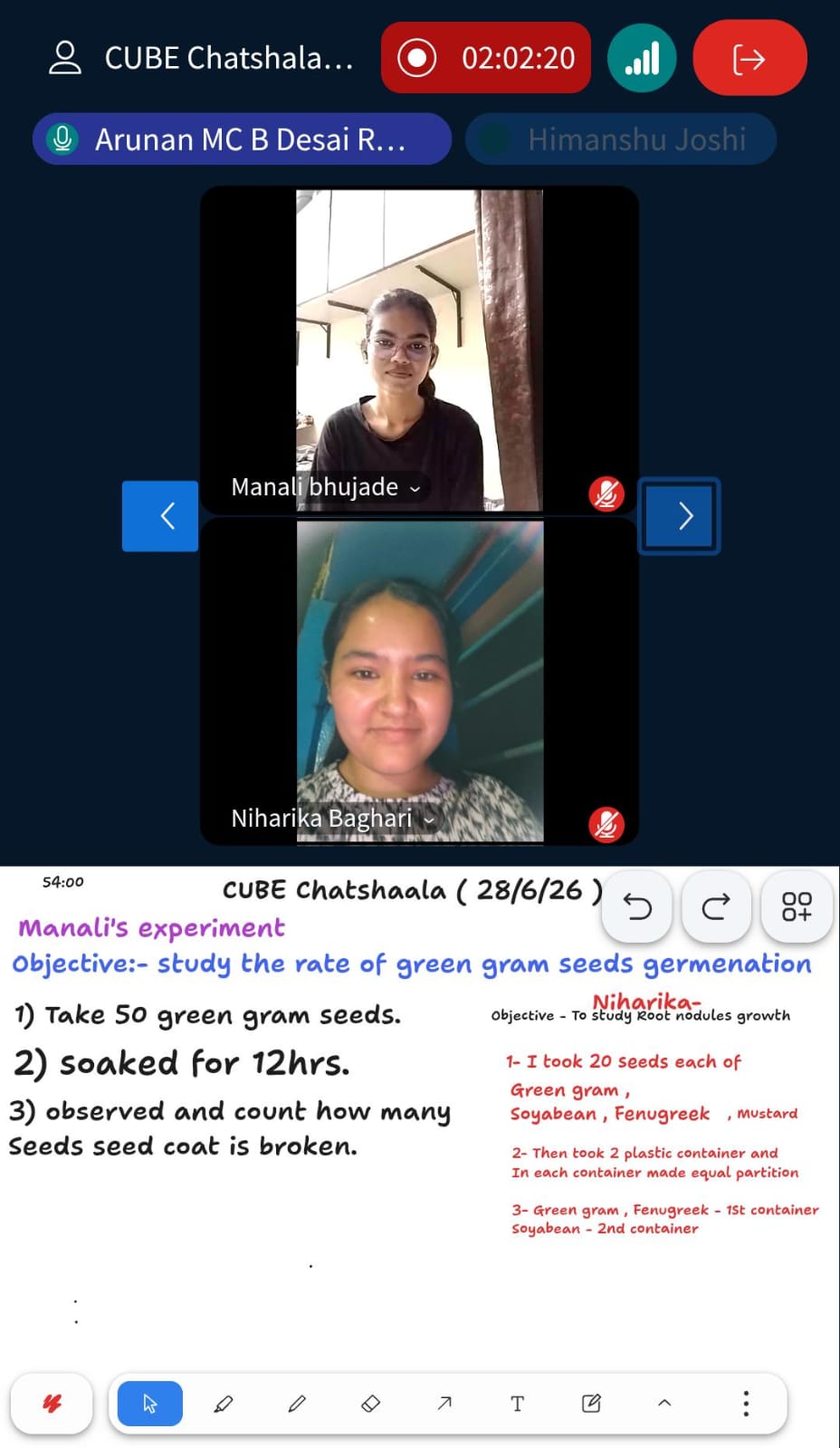
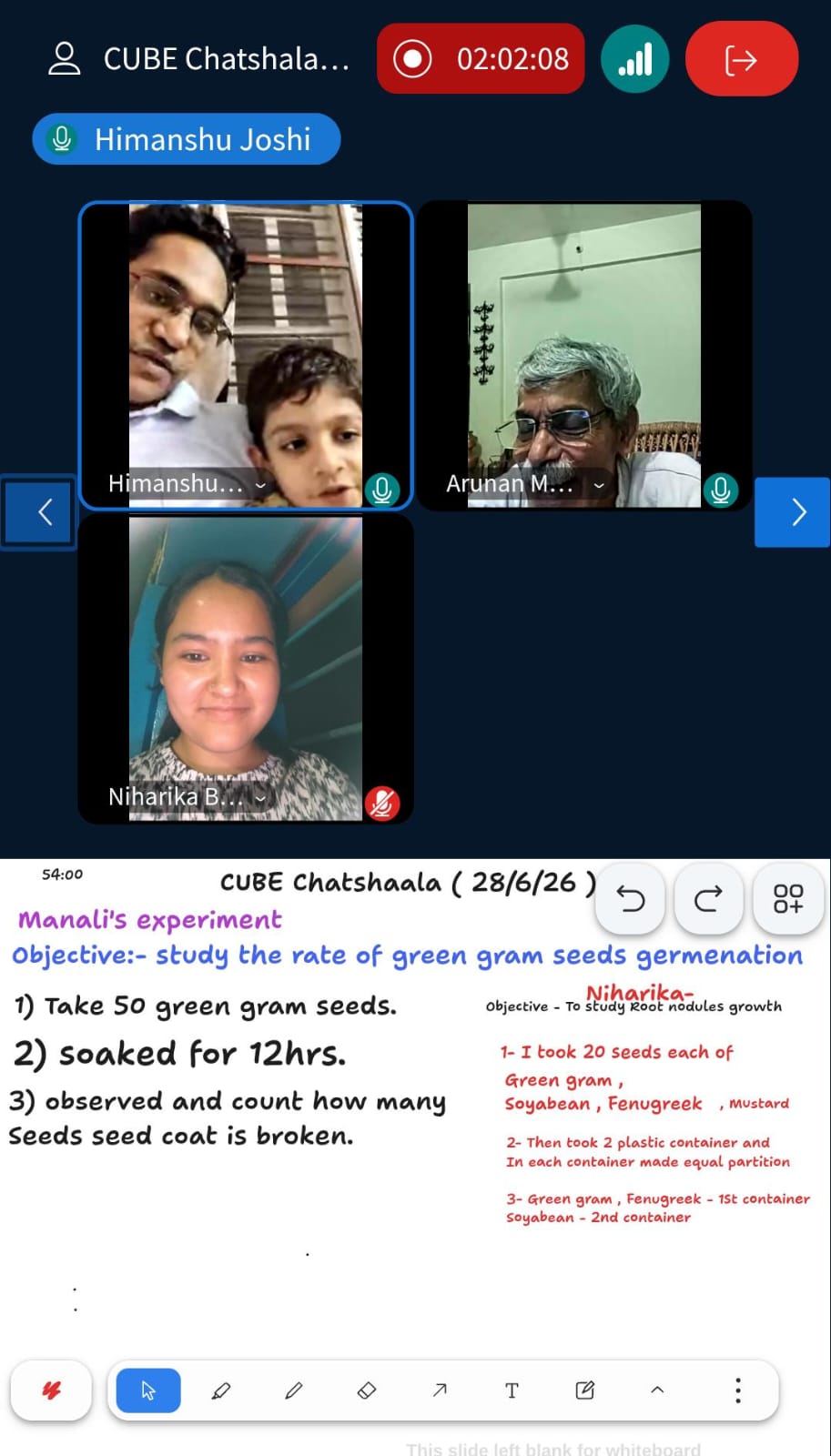
Himanshu Joshi was also present during the session and contributed to the discussion, as noted on the whiteboard.
 Provocative Questions
-
Aarya observed that the seed coat ruptured but remained attached to the seed after 24 hours of germination. What structural or biochemical changes in the seed coat allow it to rupture under the pressure of the emerging radicle, yet stay connected to the cotyledons?
-
Manali used seed coat breakage as her indicator of germination onset. But is seed coat rupture the same as germination? Could a seed show coat breakage without having undergone true germination and how would we distinguish between the two under home lab conditions?
-
Water movement during imbibition was described as moving from “outside to inside” the seed. What exactly drives this movement is it purely osmotic pressure, or does matric potential (the physical binding of water to seed components) play an equal or greater role?
-
Niharika included mustard in her root nodule study as a comparative species. Since mustard is a non-legume, what result would you predict for its root nodule count and if any structure resembling a nodule were to appear on mustard roots, how would you verify whether it is a true Rhizobium-induced nodule or something else?
-
All three experiments used green gram as a common species. Given that Aarya, Manali, and Niharika are all working with the same organism under possibly different home conditions (temperature, humidity, water quality), could we design a way to pool and compare their data meaningfully?
-
Niharika placed green gram and fenugreek together in Container 1 and soybean in Container 2. Could growing two different legume species in the same container affect their root development or compete for Rhizobium strains in the soil? Is Rhizobium species-specific in its nodulation?
-
Aarya noted that swelling of seeds was visible within 12 hours of soaking. Does the rate of swelling vary across different legume species, and could swelling rate be used as an early predictor of germination success?
 What I Have Learned
Today’s session reinforced how much meaningful science can emerge from home lab settings when experiments are designed with a clear objective and a simple, consistent protocol.
One of the most grounding reminders from this session was that germination is not a single event it is a process. Seed swelling, seed coat rupture, and radicle emergence are sequential markers, not synonyms. Manali’s choice to count seed coat breakage as her germination metric is practical under home lab conditions, but it invites us to think critically about what exactly we are measuring and what we might be missing.
Aarya’s visual explanation of water moving “outside to inside” during imbibition brought clarity to a concept that is often taken for granted. Seeds are dry systems with enormous potential to absorb water, and that uptake physically drives the mechanical pressure that eventually ruptures the seed coat. Seeing this drawn out as a diagram made it tangible.
Niharika’s comparative experiment was perhaps the most thought-provoking design presented. By including mustard a non-leguminous plant alongside confirmed legumes, she has set up a natural control that will make any differences in root nodule formation far more visible and compelling. This is exactly the kind of experimental thinking that CUBE encourages: don’t just observe one thing in isolation, compare it to something that should behave differently.
The session also underscored that Rhizobium research does not require a professional laboratory. A home setup with seeds, containers, soil, and careful daily observation is sufficient to begin documenting one of the most ecologically important plant-microbe relationships in the natural world.
 TINKE Moments (This I Never Knew Earlier)
TINKE 1: Seed swelling is not the same as germination.
Several participants had been using the terms interchangeably, but today’s discussion made it explicit: swelling is caused by imbibition (physical water uptake), while germination proper begins with the activation of the embryo and becomes externally visible through radicle emergence. Seed coat rupture falls somewhere in between it is a consequence of swelling pressure but does not by itself confirm that the embryo has activated.
TINKE 2: Water moves into seeds driven by matric and osmotic potential, not active transport.
Seeds do not “pull” water in through any biological pump. The movement is passive, driven by the difference in water potential between the dry seed interior and the surrounding water. This distinction matters because it means germination can begin even in seeds that have lost metabolic activity temporarily as long as water potential gradients exist.
TINKE 3: Mustard does not form Rhizobium-induced root nodules.
Niharika’s inclusion of mustard (a Brassica species) in her experiment is grounded in this fact. Rhizobium forms symbiotic nodules specifically with leguminous plants through a highly specific molecular signalling process. Mustard, not being a legume, lacks the receptor systems to initiate this symbiosis. Its presence in the experiment serves as a biological negative control.
TINKE 4: Different legumes may host different strains of Rhizobium.
This came up when considering whether green gram and soybean, if grown in proximity, might compete for the same Rhizobium populations. The reality is that Rhizobium-legume symbiosis is often strain-specific different legume genera can preferentially associate with specific Rhizobium species or strains, which has implications for mixed-container experiments like Niharika’s.
 Gaps and Misconceptions
Gap 1 — Absence of soil specification across experiments.
None of the three experiments specified the type of soil or growing medium being used. Since Rhizobium is a soil bacterium, the presence or absence of the right Rhizobium strains in the soil directly determines whether nodules will form at all. Without this information, it will be difficult to interpret differences in nodulation outcomes across the three experiments.
Gap 2 — No timeline for root nodule observation.
While Manali recorded the exact date and time of seed soaking and Aarya tracked 12-hour and 24-hour germination milestones, none of the experiments specified when they planned to first look for root nodules. Nodule formation typically begins a few days after root development and is not visible at the germination stage. Clarifying a nodule-observation timeline would strengthen all three study designs.
Gap 3 — Germination rate vs. germination percentage.
Manali’s stated objective was to “study the rate of green gram seed germination,” but her protocol — counting seeds with broken seed coats after a fixed time point actually measures germination percentage at that moment, not rate over time. Rate would require counting at multiple time intervals to capture how quickly germination progresses. This is a conceptual gap worth addressing.
Gap 4 — Mustard included but not framed as a control.
Niharika included mustard in her experiment but it was not explicitly labelled as a negative control in the whiteboard notes. Framing it explicitly as such would sharpen the experimental design and make it easier to explain the purpose of its inclusion to others reading the data.
Misconception — “More seeds = better experiment.”
Manali used 200 seeds in her broader setup and 50 seeds for close observation. While larger sample sizes are generally valuable, a common implicit assumption is that more seeds automatically improve reliability. What matters equally is consistency in conditions same container, same water source, same covering method, same room temperature because variability in conditions can undermine the value of a large sample size.
 Photographs during Chatshaala