 CUBE ChatShaala - Discussion Summary
Today’s session, held on 14th August 2026, brought the group into the world of tiny nematodes and the outsized role they play in biology. Sailekshmi, Niharika Baghari, Kiran mam, Akanksha Joshi, Kiran Varma (Elphinstone College), Aarya Takke, Nishant, Sonari, Divya, Komal Singh, and Manali Bhujade were all present, with the discussion led by Akanksha Joshi and anchored around a whiteboard study of C. elegans, and comparing to earthworms, same scale.
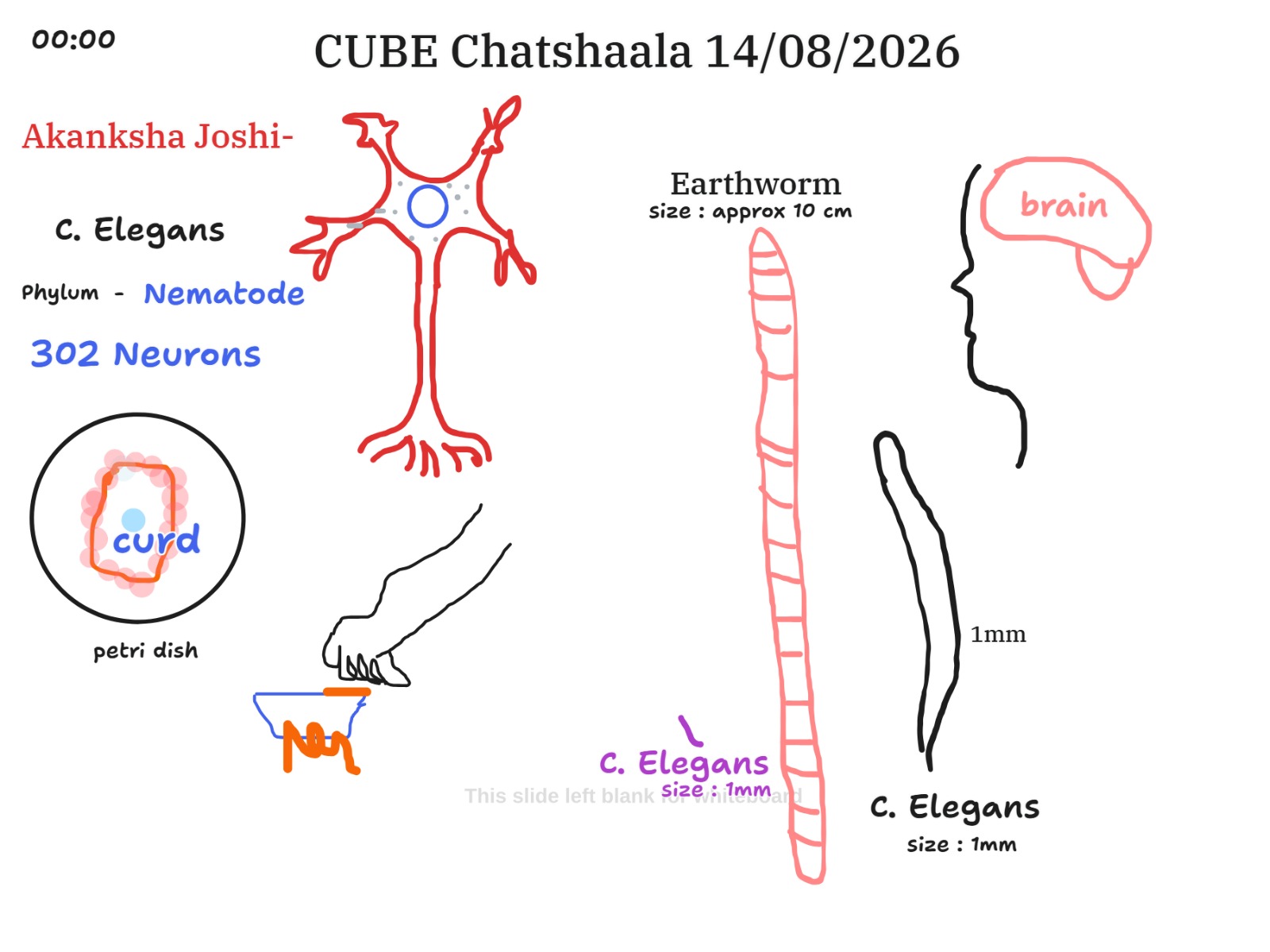
The session opened with the basics of Caenorhabditis elegans: a nematode belonging to the phylum Nematoda, roughly 1 millimetre in length, and carrying just 302 neurons in its entire nervous system. A hand-drawn neuron, complete with nucleus and branching processes, was used to show what a single one of those 302 cells actually looks like, connecting the abstract number back to real cellular structure. The group then walked through how these worms are cultured and observed in practice: a petri dish containing a curd-like bacterial lawn was sketched to represent the growth medium on which the worms feed, and a separate illustration showed a hand using a pick to transfer worms from the dish, a technique central to maintaining and isolating nematode cultures in the lab.
From there, the conversation moved outward in scale for comparison. An earthworm, drawn at roughly 10 centimetres, was placed alongside C. elegans at 1 millimetre to make the size difference vivid and immediate, a hundredfold jump in length between two organisms that both fall broadly under the “worm” label in everyday language despite belonging to entirely different phyla, Nematoda and Annelida, offering a third point of reference and setting up a natural comparison of nervous system complexity: 302 neurons in C. elegans versus the roughly 100 billion neurons packed into the human brain.
The reference material shared for the session pointed the group toward the MRC Laboratory of Molecular Biology’s public engagement resources on C. elegans, footage of live nematode behaviour, information on animal models used in research facilities, background on earthworm biology, and additional nematode-related video content. Drawing on these, the discussion kept circling back to a central theme: despite its extreme simplicity, C. elegans is one of the most powerful model organisms in modern biology, precisely because its small, fixed number of neurons can be mapped, studied, and manipulated in ways that would be practically impossible in a larger, more complex nervous system.
 Provocative Questions
-
C. elegans manages to sense touch, taste, smell, and even make decisions about food versus danger with only 302 neurons, while the human brain needs roughly 100 billion to do comparable and far more sophisticated things. What does this gap tell us about the relationship between neuron count and behavioural complexity, and is more always better?
-
Earthworms and C. Elegans are both commonly called “worms,” yet one is a nematode and the other an annelid, and they differ in size by roughly a hundredfold. What does this everyday confusion of terms reveal about how casual language can obscure real biological distinctions?
-
The petri dish setup, with its curd-like bacterial lawn, is designed specifically to keep C. elegans fed and observable. What features of this simple, inexpensive culture system explain why *C. Elegans became such a widely adopted laboratory organism in the first place?
-
If C. elegans has a completely mapped nervous system of only 302 neurons, why hasn’t that complete map alone been enough to fully explain or predict its behaviour?
-
Given the size difference between *C. Elegans and an earthworm, how might their very different scales shape the kinds of biological questions each organism is best suited to answer in a laboratory setting?
-
What does it mean, practically, for a citizen science group in India to attempt isolating C. elegans from local soil, when so much of the existing research literature and model organism infrastructure is built around lab-reared strains?
 What I Have Learned
This session was a useful reminder of how much scientific value can come from an organism most people would dismiss as “just a worm.” Seeing C. Elegans, the earthworm, and the human brain sketched together at their true relative scales made the size and complexity differences concrete in a way that reading the numbers in isolation never quite manages. A worm a millimetre long, invisible without a microscope, sits at the foundation of decades of neuroscience research, and that contrast alone reshaped how I think about the relationship between an organism’s size and its scientific importance.
I also came away with a sharper sense of why C. Elegans earned its place as a model organism. It isn’t simply that the worm is small or easy to grow in a petri dish on a bacterial lawn, though both of those things matter enormously for practical reasons. It’s that its nervous system, at only 302 neurons, is small enough to be completely mapped, connection by connection, something that remains far out of reach for any vertebrate. Working through the practical side of the session, the petri dish, the curd-like growth medium, and the picking technique, also grounded the discussion in the reality of what citizen scientists in the CUBE network are actually attempting when they try to isolate nematodes from Indian soil.
 TINKE Moments (This I Never Knew Earlier)
The first TINKE moment of the session centred on the sheer disparity in neuron count between C. elegans and the human brain. Many participants likely held a loose sense that simpler organisms have “fewer” neurons, but seeing the number 302 written down next to the human brain’s roughly 100 billion made the scale of that difference explicit and, frankly, startling. This is a classic TINKE moment: a fact that had perhaps been encountered before in passing but was never really allowed to register until it was placed directly alongside its human counterpart.
A second TINKE moment emerged from the size comparison between C. elegans and the earthworm. It is easy, in casual conversation, to lump all worm-like creatures together as roughly similar organisms. Drawing the earthworm at 10 centimetres beside C. Elegans at 1 millimetre made explicit that these two are separated not only by a hundredfold difference in length but by entirely different phyla, Nematoda and Annelida, with very different body plans and biology underneath the surface resemblance. Naming this distinction directly shifted the group’s understanding of what “worm” actually covers as a category.
A third TINKE moment arose around the practical culturing process itself. The petri dish, the curd-like bacterial lawn, and the picking tool are details that can easily be glossed over when C. Elegans is discussed purely as an abstract model organism in textbooks. Walking through how the worms are actually grown and handled in a lab setting made explicit just how much hands-on technique underlies the seemingly simple fact of “C. elegans is easy to culture.”
 Gaps and Misconceptions
One area that would benefit from further discussion is the precise biological distinction between the phylum Nematoda and the phylum Annelida, to which the earthworm belongs. The whiteboard placed both organisms side by side for scale, but the session did not go into the structural differences, such as the earthworm’s segmented body plan versus the unsegmented body of C. elegans, that underlie their very different classifications. This would be a valuable point to revisit in a future session.
There is also some ambiguity around what exactly is meant by the curd-like structure drawn inside the petri dish. It likely represents the bacterial lawn, typically E. coli, that C. Elegans feeds on in culture, but this was not stated explicitly on the whiteboard, and clarifying this connection between the drawing and the underlying microbiology would strengthen the write-up for readers encountering the topic for the first time.
Finally, while the session referenced the ongoing effort within the CUBE community to isolate C. Elegans from Indian soil, the specific outcomes or challenges of that effort were not discussed in depth during today’s meeting. A follow-up session drawing on the group’s actual isolation attempts, successes, and setbacks would help connect today’s conceptual discussion to the hands-on citizen science work already underway.
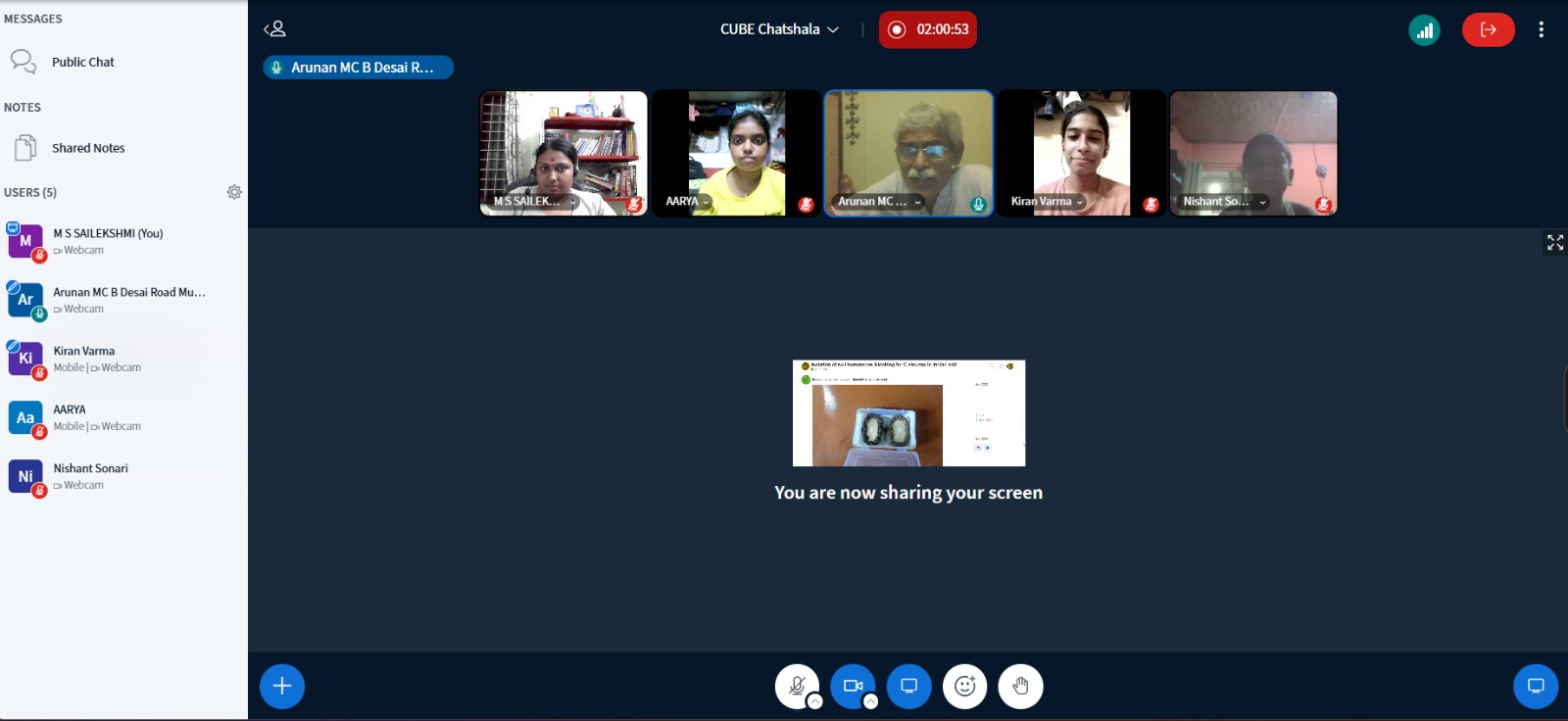
 Photographs during Chatshaala
 Referance
- Isolation of soil Nematodes &looking for C.elegans in Indian soil - #5 by Theertha
- Checking your browser - reCAPTCHA
- 🔥 You Pull Your Hand Away Before You Feel the Burn — Here's Why
- Worms are cleverer than you think! – Just another LMB Group Multi Sites site
- https://www.youtube.com/watch?v=Ejf6FwIibkE
- Animal Models | MMC SLU
- https://thecanadianencyclopedia.ca/en/article/earthworm
- https://www.youtube.com/watch?v=c9Gx1-xRXuM