 CUBE ChatShaala – Discussion Summary
2026-04-07T18:30:00Z
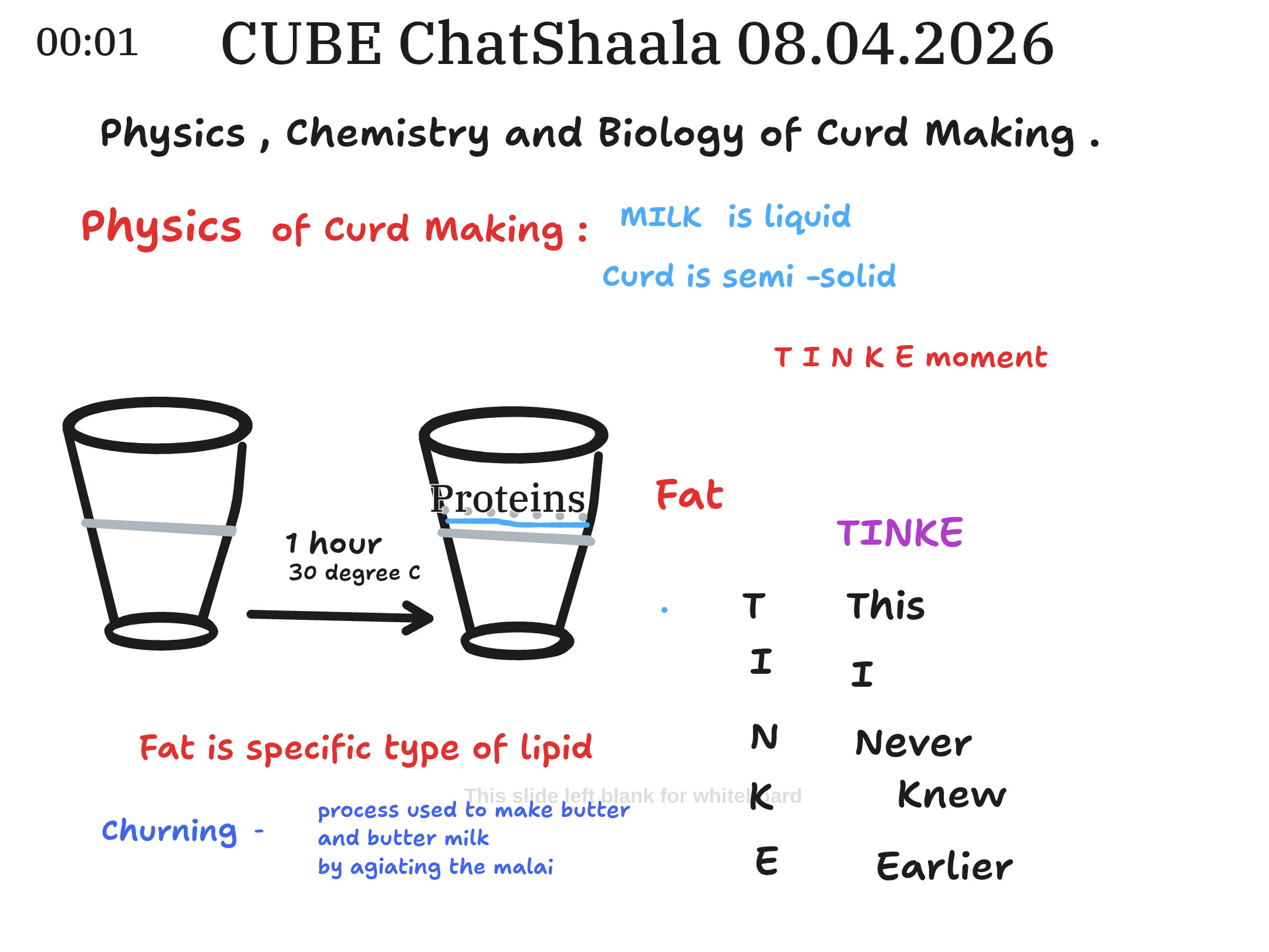
- Physics of curd-making: Milk begins as a liquid and transforms into semi-solid curd when incubated at around 30°C for an hour. This physical change is visible in texture and consistency.
-
Chemistry of curd-making:
- Lemon juice causes acid coagulation, curdling milk chemically but producing an uneven texture.
- Curd starter introduces lactic acid bacteria (LAB), which ferment lactose into lactic acid, lowering pH and forming smooth, uniform curd.
-
Biology of curd-making: LAB such as Lactobacillus delbrueckii and Streptococcus thermophilus are responsible for fermentation, flavor development, and probiotic benefits.
-
Cultural context: The formation of milk skin (malai) was discussed as a protein-fat film formed during heating. In India and globally, milk skin has culinary and cultural significance, from sweets like “Sarpuria” in Bengal to “kaymak” in Turkey. en.wikipedia.org
-
Experiment shared: A comparative study tested lemon vs curd as starters. Results showed lemon produced grainy, patchy curd with whey separation, while curd starter yielded creamy, consistent curd. metastudio.org
-
Practical processes: Churning malai produces butter and buttermilk, linking traditional practices to biochemical principles.
 Provocative Questions
-
Why does lemon juice fail to produce probiotic curd, while microbial starters succeed?
-
Could combining lemon and curd starters create novel textures or flavors?
-
How do different milk types (cow, buffalo, plant-based) influence curd formation?
-
What role does ambient temperature play in determining curd quality?
-
How might milk skin (malai) affect fermentation or butter-making processes?
-
Can traditional starters like green chili stems or tamarind be scientifically validated for curd-making?
 What I Have Learned
-
Starter choice is crucial: Lemon curdles milk chemically, but curd starter ensures fermentation and probiotic benefits.
-
Microbes are central: LAB not only thickens milk but also enhances flavor, texture, and health value.
-
Cultural practices matter: Milk skin, often dismissed, is nutritionally valuable and culturally celebrated.
-
Curd-making is interdisciplinary: Physics (state change), chemistry (acid vs fermentation), and biology (microbial activity) converge in this everyday process.
 TINKE Moments (This I Never Knew Earlier)
-
“Fat is a specific type of lipid” – clarified a common misconception about fat’s chemical identity.
-
Milk skin as malai – many participants realized its scientific basis in protein denaturation, not just culinary tradition.
-
Lemon vs curd starter – the experiment revealed that lemon only curdles milk, while curd starter truly ferments it, a distinction not widely known.
-
Churning malai – connecting traditional butter-making to scientific agitation processes was eye-opening.
 Gaps and Misconceptions
-
Confusion between curdling and fermentation: Many assume lemon makes “curd,” but it only causes coagulation, not microbial fermentation.
-
Overlooking milk skin’s value: Some participants considered malai undesirable, unaware of its nutritional and cultural importance.
-
Starter proportions and incubation conditions: The role of temperature and starter amount in curd quality needs deeper exploration.
-
Terminology mix-ups: “Curd” in Indian usage differs from “yogurt” in global contexts, which may cause conceptual confusion.
 Photographs during ChatShaala


 Reference