 CUBE ChatShaala—Discussion Summary (16/03/2026)
Today’s ChatShaala centered on the Methylene Blue Reduction Test (MBRT) as a practical method to assess milk quality. Manali Devanand Bhujade, a first-year BSc biotechnology student at Elphinstone College in Mumbai, Maharashtra, led the discussion. It began with the test’s principle: microorganisms in milk consume oxygen, lowering the oxidation-reduction potential, causing methylene blue dye to lose its color when reduced. Cubists investigated the relationship between bacterial load and decolorization speed, concluding that rapid dye fading indicates poor milk quality due to high microbial activity.

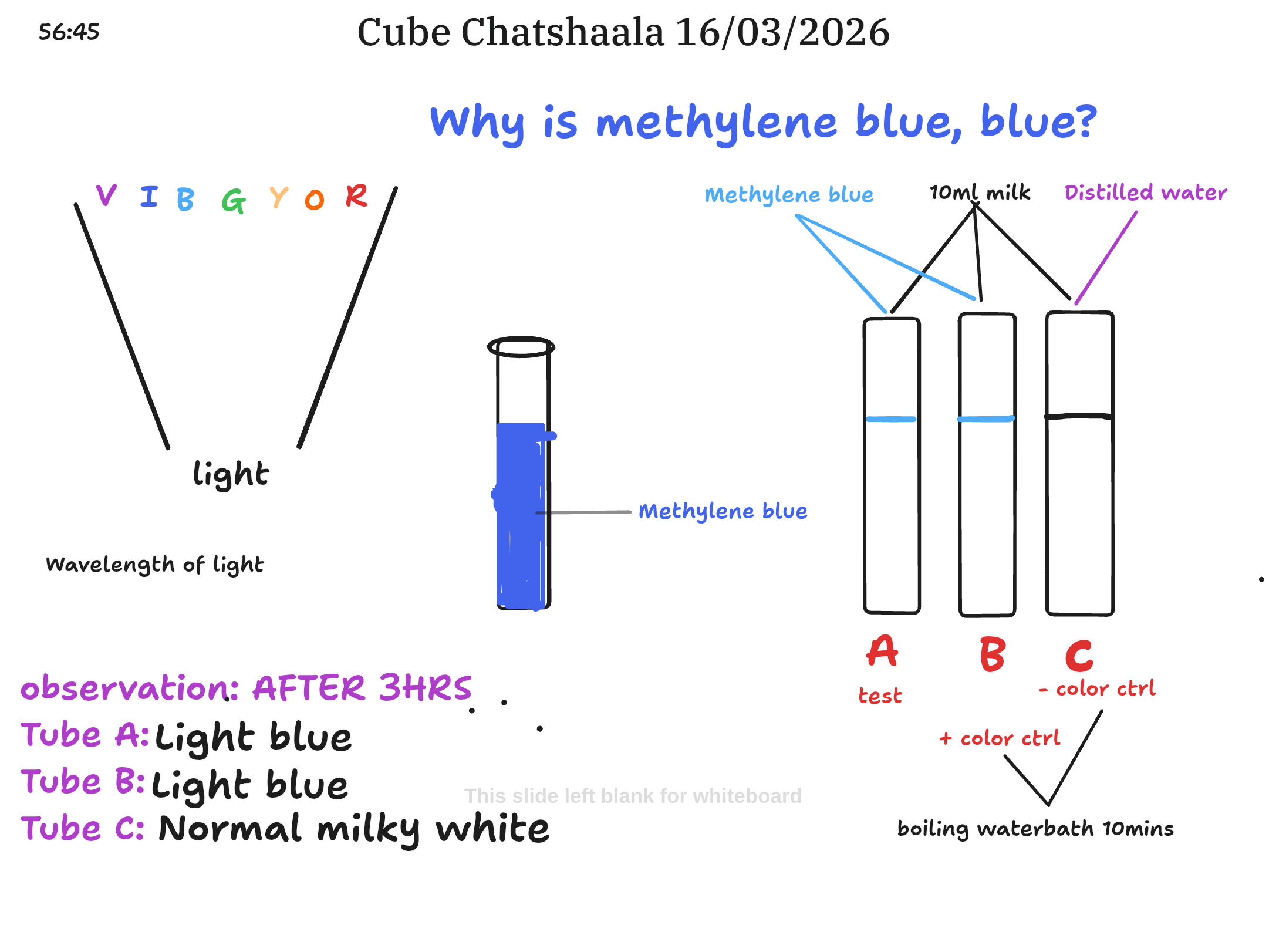
The procedure was clearly defined: 10 mL of milk was mixed with 1 mL of methylene blue solution, incubated at 37°C, and monitored over time. Decolorization time was used to classify milk quality.
- Good quality: >6 hours
- Fair quality: 2–6 hours
- Poor quality: 30 minutes–2 hours
- Very poor quality: < 30 minutes
The effect of boiling milk was emphasized. Sneha Maurya proposed that boiling kills bacteria, so no reduction would occur, and the methylene blue would remain blue. This prompted consideration of how heat treatment alters microbial activity and thus influences test results.
The cubists also investigated why methylene blue appears blue, determining that it is caused by the absorption of specific visible wavelengths. Diagrams of test tubes (A, B, and C) and controls aid in visualizing the experimental setup, emphasizing the importance of controls in scientific testing.
Finally, the limitations of MBRT were acknowledged: it measures metabolic activity rather than precise bacterial counts, and different species may reduce methylene blue at different rates. Despite these limitations, MBRT remains a quick, cost-effective, and efficient tool for evaluating hygiene standards in dairy production.
 Provocative Questions
-
If boiling milk prevents methylene blue reduction, does this mean MBRT cannot be applied to pasteurized milk?
-
Could different bacterial species produce misleading results in MBRT, and how might we design experiments to account for this?
-
What does the persistence of methylene blue color tell us about oxygen availability in milk?
-
How might MBRT results differ between raw milk collected under hygienic versus unhygienic conditions?
-
Can MBRT be adapted to test other food products where microbial activity plays a role in spoilage?
-
What are the broader implications of MBRT for public health and consumer trust in dairy products?
 What I Have Learned
From today’s discussion, I learned that milk quality is directly linked to microbial activity, and MBRT provides a simple yet powerful way to measure this. The test is not just about color change—it reflects the invisible metabolic processes of bacteria consuming oxygen. I also realized the importance of controls in experiments, as they help distinguish between genuine microbial activity and other factors. The conversation highlighted how boiling alters test outcomes, reminding me that experimental conditions must always be carefully considered.
 TINKE Moments (This I Never Knew Earlier)
-
Boiling and MBRT: I had not considered that boiling milk could completely prevent methylene blue reduction, essentially halting the test.
-
Color and Chemistry: Understanding why methylene blue is blue—because of its absorption of certain wavelengths—was a fresh insight into the link between chemistry and perception.
-
Metabolic Activity vs. Cell Count: Realizing that MBRT measures bacterial metabolism rather than exact numbers was eye-opening, as it explains why results can vary between species.
 Gaps and Misconceptions
-
Misconception: Some participants assumed MBRT directly measures bacterial count. In reality, it measures metabolic activity, which can differ across species.
-
Gap: Limited discussion on how MBRT applies to pasteurized or boiled milk. More exploration is needed on whether the test remains valid after heat treatment.
-
Gap: The role of oxygen diffusion in milk was touched upon but not fully explored. This could be an important factor influencing reduction rates.
 Photographs during ChatShaala



 Reference