 CUBE Chatshaala - Discussion Summary
Date : 09th September 2026
The session focused on the physical, chemical, and biological mechanisms that govern curd formation, comparing traditional fermentation with chemical acidification. Participants analyzed how milk changes when it is treated with a starter culture or alternative bio-sources, such as red chilli stems containing non-dairy lactic acid bacteria (LAB), versus direct chemical shock using acetic acid (white vinegar) or citric acid (lemon juice). Key inquiries focused on the exact chemical nature of white vinegar, the structural changes milk proteins undergo under varying acid concentrations, and the underlying reasons for the differences in texture, flavor, and coagulation across these methods.
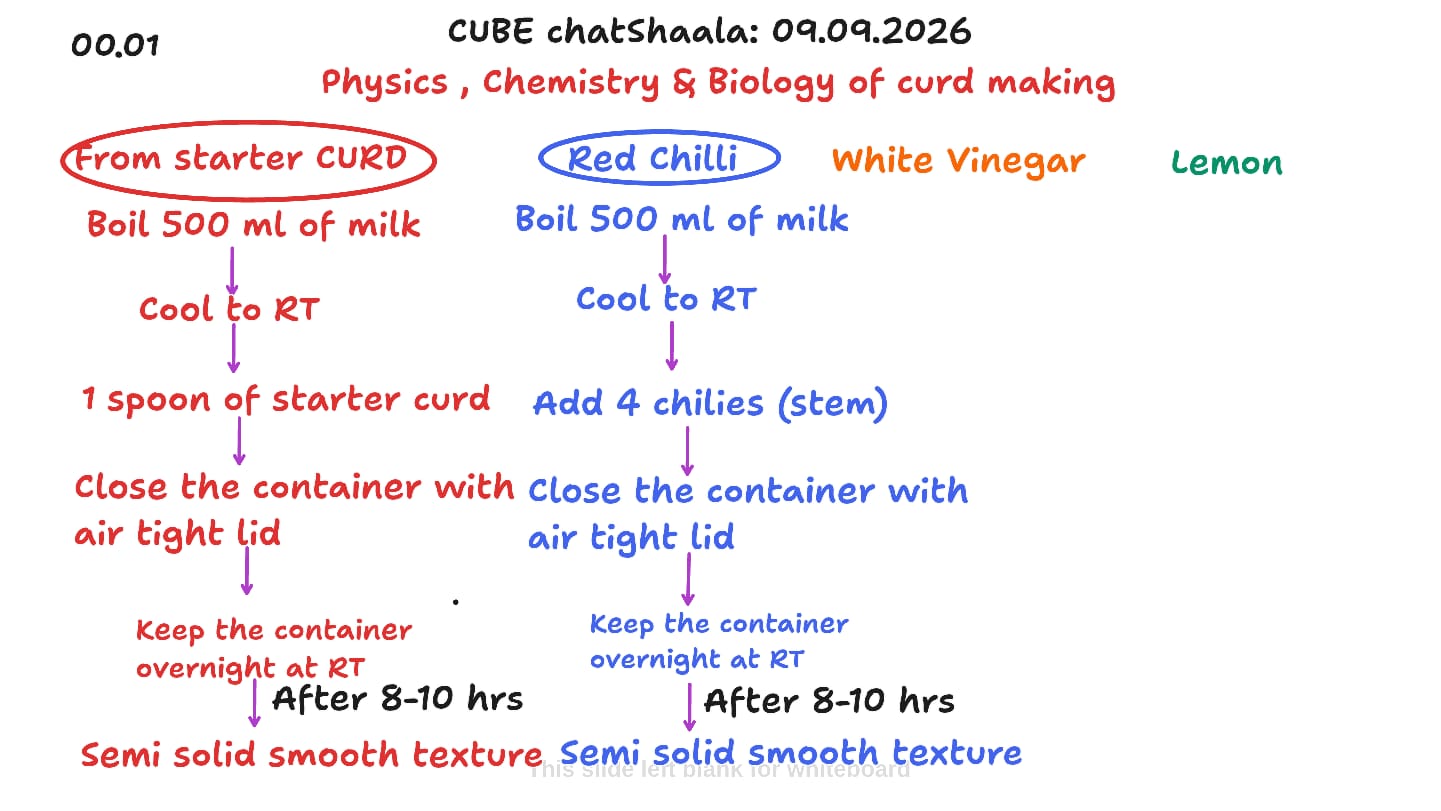
The discussion detailed the primary bacterial genera driving milk fermentation, including Lactobacillus, Lactococcus, Streptococcus, Leuconostoc, Enterococcus, and Pediococcus. When incubated over an 8-to-10-hour period, these organisms convert lactose into lactic acid, gradually lowering the pH to yield a uniform, semi-solid gel structure. In contrast, direct chemical addition rapidly precipitates casein proteins, resulting in the curd separation typical of paneer or chenna rather than a smooth fermented curd.
The second part of the session transitioned to scientific methodology, focusing on the definition and application of peer review. Participants discussed what constitutes a “peer” within research contexts. While initial ideas centered on age or academic standing, the consensus shifted toward defining peers as subject-matter experts who independently evaluate a study’s methodology, data, and conclusions before publication. A critical question arose regarding whether senior academic mentors reviewing a student’s paper act as “peers” or evaluators, highlighting the nuance of academic hierarchy within scientific validation.
 Provocative Questions
-
Given that red chilli stems carry non-dairy Lactic Acid Bacteria capable of setting curd, what evolutionary advantages allow these bacteria to thrive on plant tissue, and how do their metabolic profiles compare to dairy-native strains?
-
How does the rate of pH reduction in direct acid shock differ from gradual bacterial lactic acid production, and how does this kinetic variation influence casein micelle destabilization and gel network formation?
-
If a peer reviewer is defined by domain expertise rather than institutional status or age, how can early-career researchers actively participate in formal peer review without structural hierarchies introducing bias?
-
Why does incubating milk in a sealed, airtight container at room temperature favor anaerobic lactic acid fermentation while suppressing spoilage microflora?
 What I Have Learned
-
Biological vs. Chemical Acidification: Bacterial fermentation relies on live Lactic Acid Bacteria to metabolize lactose into lactic acid slowly, creating a cohesive protein network. Chemical shock via acetic or citric acid causes rapid denaturation, leading to immediate protein clumping.
-
Role of LAB Diversity: Specific bacterial groups impart distinct physical and sensory qualities to fermented products; Lactobacillus and Streptococcus drive primary acidification, whereas genera like Leuconostoc produce volatile flavor and aroma compounds.
-
Core Principles of Peer Review: Scientific peer review is grounded in relevant domain expertise rather than age or position. It functions as an essential quality control mechanism to ensure experimental rigor and valid data interpretation.
 TINKE Moments &
 Gaps, and Misconceptions
-
TINKE Moments (Thinking In New Knowledge Environments): Investigating chilli stems as a non-dairy inoculum provided a compelling example of re-evaluating household traditions through a biological framework. Connecting everyday culinary practices with plant-associated microbiomes opened a practical path for exploring functional microbes outside standard dairy environments.
-
Gaps: The discussion lacked precise quantitative data comparing how milk proteins behave under different acid treatments. While the visual and tactile differences between curd (biological) and paneer (chemical) were established, the exact molecular kinetics—such as the rate of calcium phosphate solubilization across different acid types—require further investigation.
-
Misconceptions: A primary point of ambiguity involved defining a “peer” in the review process. The initial assumption that peers must share the same age or student status caused confusion regarding whether faculty mentors qualify as peers. Clarifying that “peer” refers to equivalent domain competence helped resolve this misconception.
 Photographs during ChatShaala




 Reference
-
🍋 Culture Clash: Lemon vs Curd – The Ultimate Fermentation Face‑off!
-
What Happens When You Chemically Shock Milk?,, Using Vinegar, Lemon and LACTIC ACID
-
https://www.sciencedirect.com/topics/agricultural-and-biological-sciences/lactic-acid-bacterium
-
Lactic Acid Fermentation in Food | Overview, Bacteria & Products - Lesson | Study.com
-
Dairy Lactic Acid Bacteria and Their Potential Function in Dietetics: The Food–Gut-Health Axis - PMC
-
https://pmc.ncbi.nlm.nih.gov/articles/PMC7566098https://ijarbs.com/pdfcopy/aug2016/ijarbs8.pdf