 CUBE ChatShaala – Meeting Summary (15 January 2026)
The session explored an everyday biological feature—the human nail—as a model system to understand growth, measurement, hypothesis building, and comparative reasoning. Using the voter’s nail mark as a natural time stamp, participants demonstrated how biological data can be reconstructed retrospectively through careful observation and proportional reasoning.
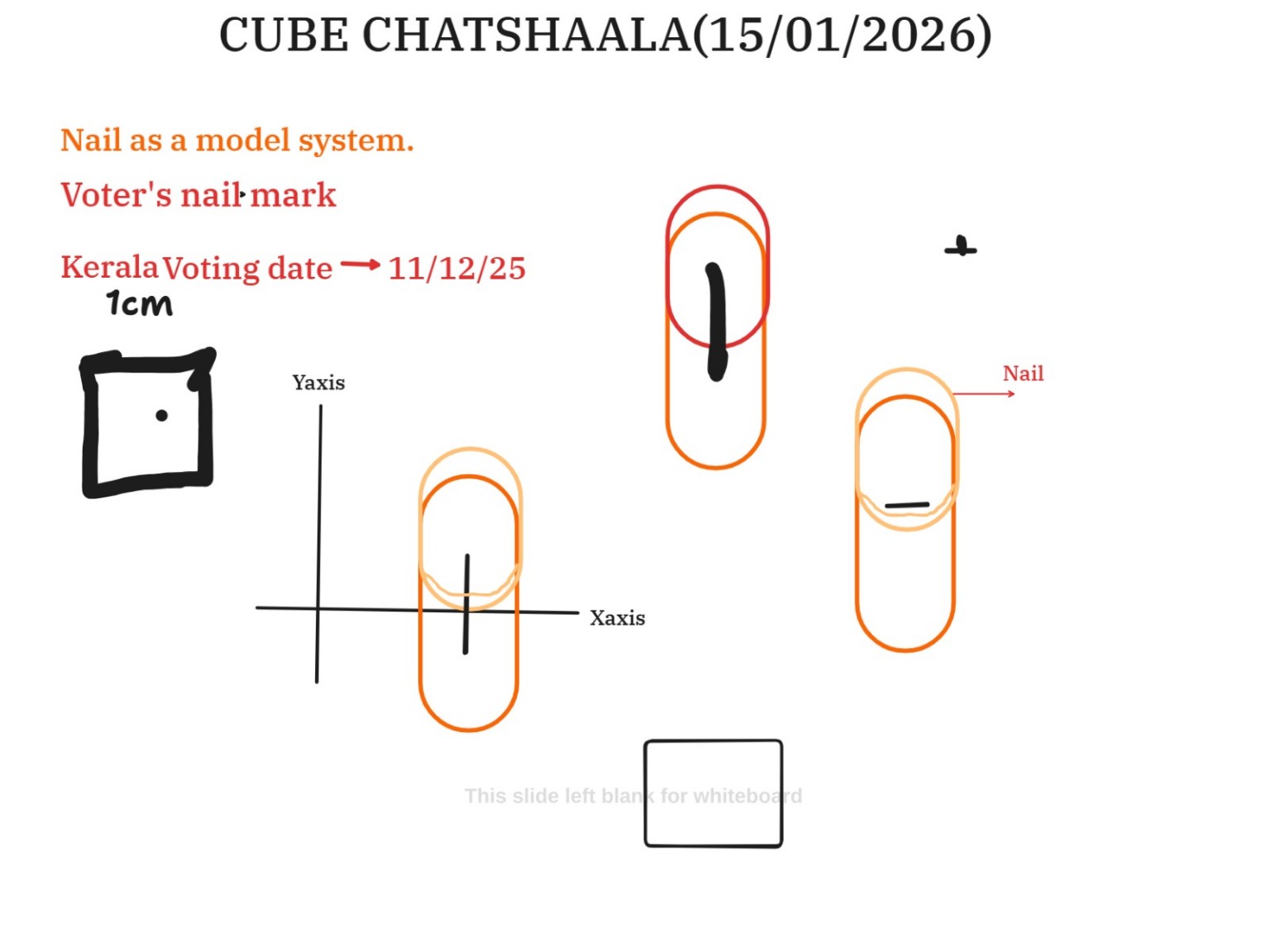
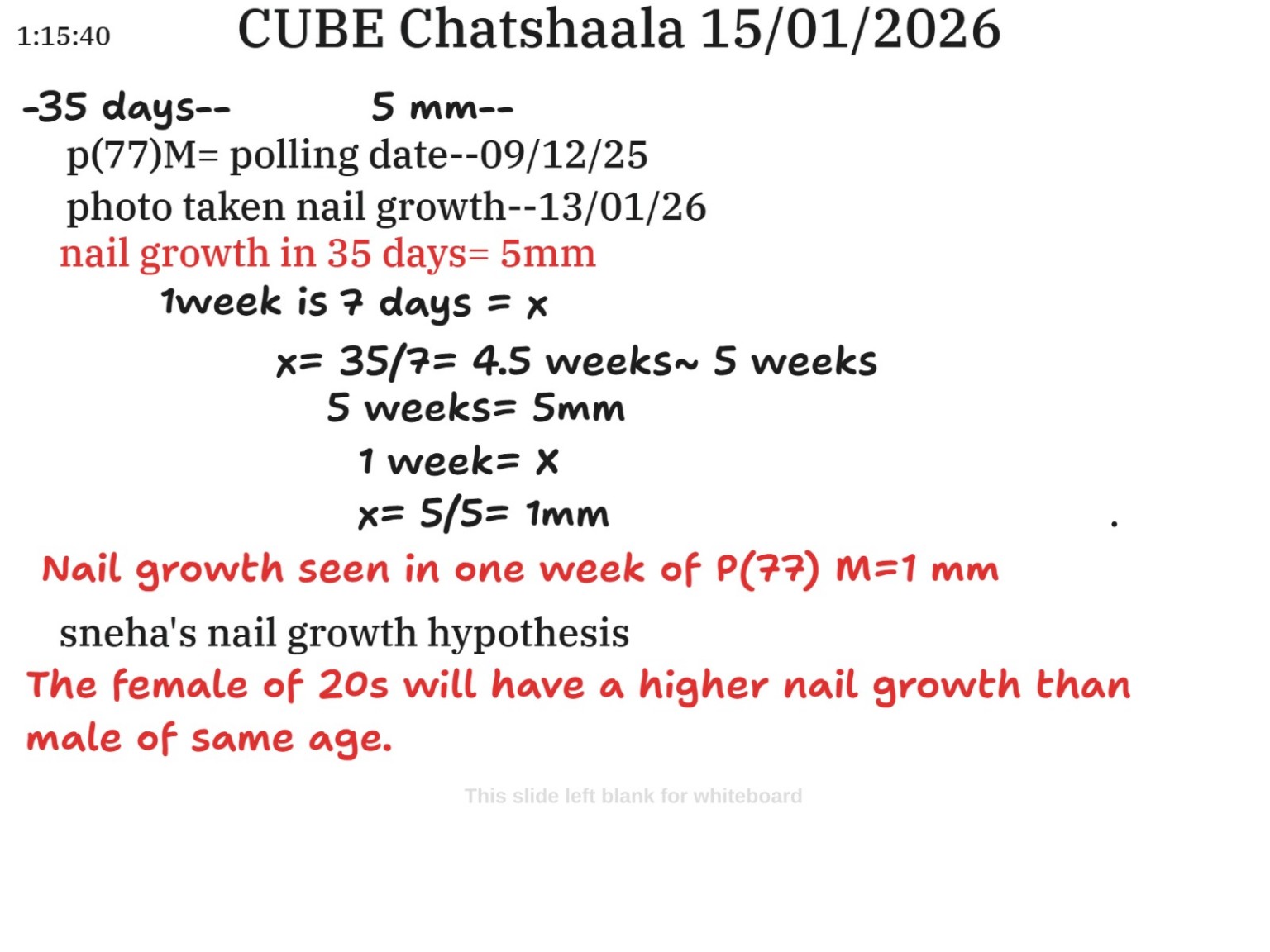
The discussion began with the Kerala voting date and the visible indelible ink mark on the nail. By measuring the displacement of the mark over time, nail growth over a 35-day period was estimated to be approximately 5 mm. This simple observation was translated into a weekly growth rate, arriving at an approximate value of 1 mm per week. The exercise highlighted how biological rates can be inferred using basic arithmetic, timelines, and spatial reference points (axes, scale, and direction).
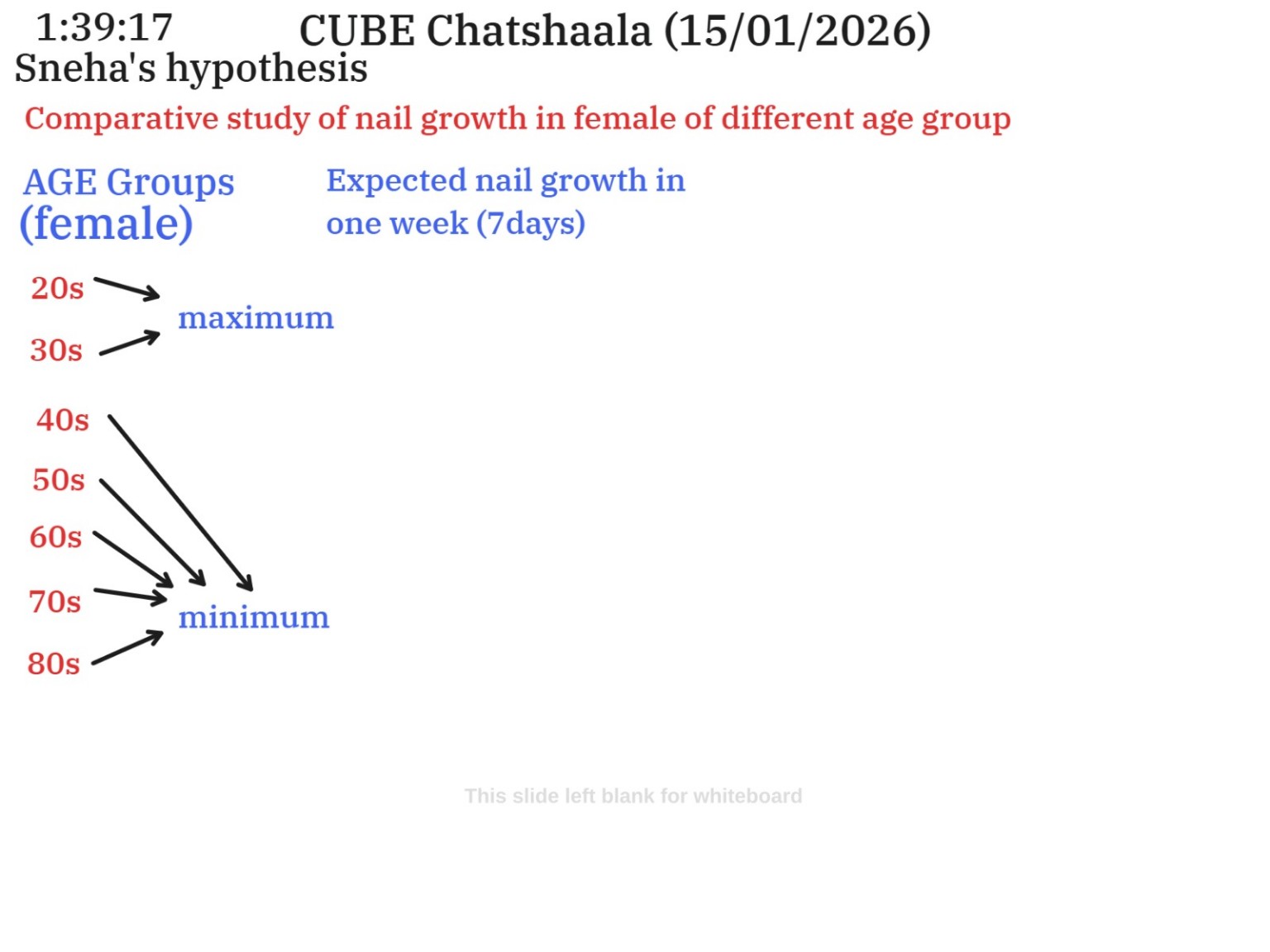
Building on this, the group examined hypothesis formulation. A central hypothesis proposed that females in their 20s exhibit higher nail growth rates than males of the same age. This idea was extended into a comparative framework focusing on nail growth across different female age groups. The expected trend discussed was maximum growth during the 20s–30s, followed by a gradual decline with advancing age, reaching a minimum in the 70s–80s. The session emphasized that these were expected patterns requiring systematic data collection for validation.
Overall, the meeting demonstrated how simple, observable phenomena can serve as entry points into scientific thinking—connecting biology, mathematics, time, and human context.
 Whiteboard-Inspired Provocative Questions
-
If your body keeps records, are we trained enough to read them?
-
Can observation and reasoning sometimes be more powerful than machines?
-
What other everyday actions leave invisible data trails on our bodies?
-
If growth slows with age, what does that say about vitality and adaptation?
-
Is science limited by tools—or by imagination?
 What I Learned Today
-
Scientific models do not always need laboratories; the human body itself can act as a living dataset.
-
Time, when paired with a visible marker, becomes measurable biology.
-
Hypotheses emerge naturally from curiosity but demand structured comparison to gain
meaning. -
Age-related biological changes can be reasoned conceptually even before numerical validation.
-
Simplicity in observation does not reduce scientific value; it often increases accessibility.
 TINKE Moments (This I Never Knew Earlier)
-
A voter’s nail mark can function as a reliable temporal reference for growth studies.
-
Nail growth can be approximated accurately using basic proportional logic.
-
Growth rates are not constant across life stages and may peak in early adulthood.
-
Everyday marks and traces can be repurposed as scientific indicators.
-
Biology quietly records time, even when we are not paying attention.
 Gaps and Misconceptions
-
Overgeneralization risk: Assuming uniform nail growth across individuals without accounting for health, nutrition, or genetics.
-
Sample limitation: Conclusions were discussed conceptually, not supported by diverse
- datasets.
-
Gender assumption: The hypothesis comparing males and females needs empirical grounding to avoid bias.
-
Precision vs approximation: The difference between rough estimation and statistically rigorous measurement was not always explicit.
-
Causation vs. correlation: Age-related decline was discussed descriptively, but underlying mechanisms were not explored.
 Photographs during Chatshaala




Closing Reflection:
Today’s ChatShaala reminded us that science begins not with answers, but with noticing. When curiosity meets careful thinking, even a fingernail can become a gateway to understanding life, time, and change.