 CUBE ChatShaala—Meeting Summary (16 December 2025)
The ChatShaala session focused on connecting core biological concepts with everyday observations, using simple curves, media compositions, and microbial examples to build conceptual clarity. The discussion moved fluidly between enzyme kinetics, bacterial growth dynamics, and milk fermentation, showing how similar principles govern different biological systems.
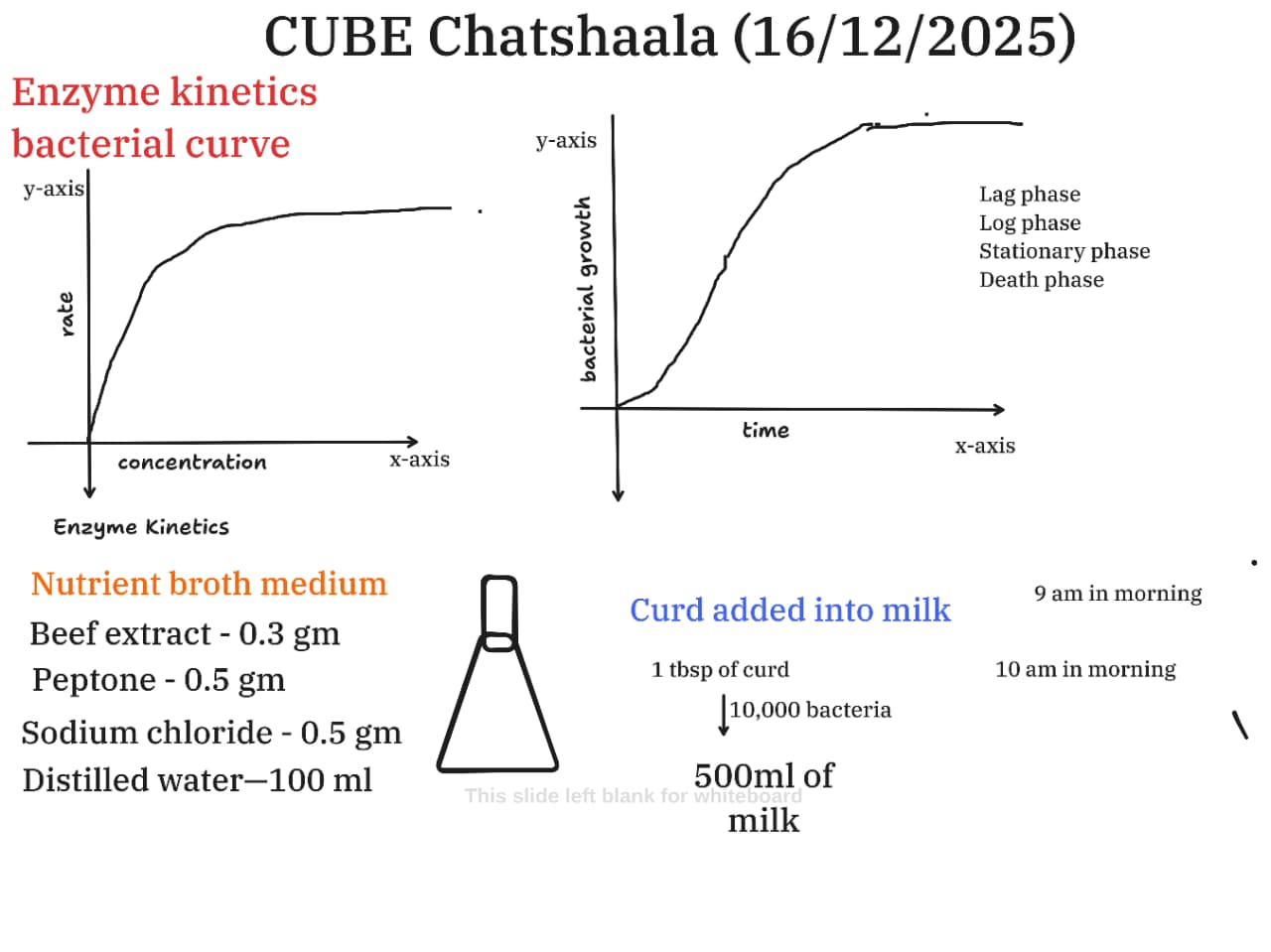
The session began with enzyme kinetics, emphasizing how reaction rate increases with substrate concentration until enzyme saturation is reached. This was visually reinforced through a saturation curve, helping participants relate abstract kinetic principles to real biological limits.
This idea naturally transitioned into the bacterial growth curve, highlighting the four classical phases—lag, log, stationary, and death. Rather than treating these as textbook labels, the discussion emphasized why each phase exists and how environmental conditions, nutrients, and metabolic stress shape microbial behavior over time.
A practical example followed through the nutrient broth medium, where each component (beef extract, peptone, sodium chloride, water) was discussed in terms of its biological role, reinforcing the idea that growth is never accidental—it is chemically supported.
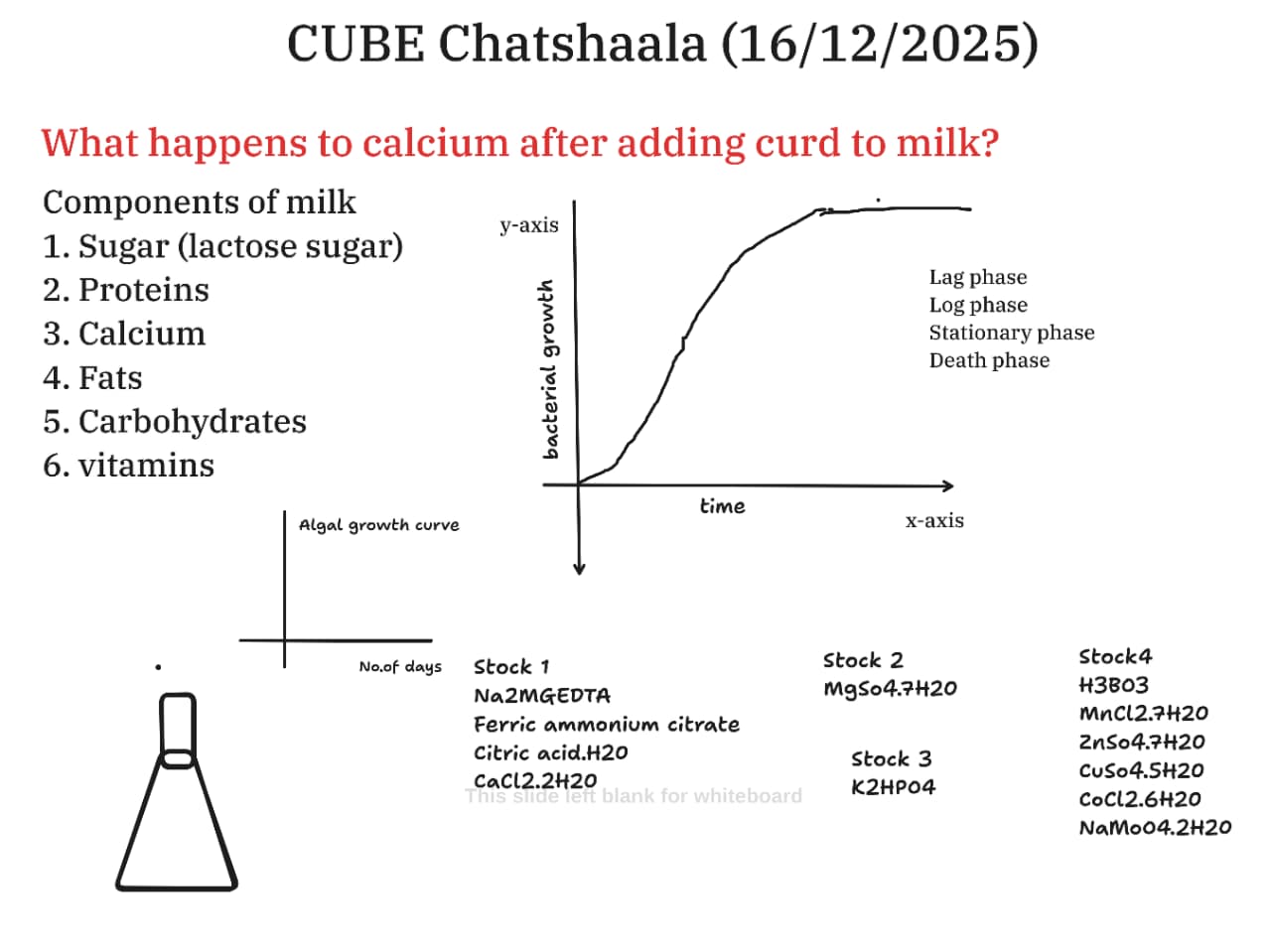
The most engaging part of the session centered on curd formation in milk. By tracing what happens when curd is added to milk, the group explored microbial multiplication, lactose fermentation, acid production, and the resulting calcium–casein interactions. This linked microbial metabolism to protein chemistry and mineral availability, demonstrating how invisible biochemical changes produce visible outcomes like milk coagulation.
The session also briefly touched on algal growth media and stock solutions, underscoring the importance of micronutrients and chelators in regulating ion availability—again circling back to calcium dynamics and growth control.
Overall, the ChatShaala successfully blurred the boundaries between microbiology, biochemistry, and daily life, encouraging participants to see biology as a set of connected processes rather than isolated topics.
 What I Learned Today
-
Enzyme and bacterial growth curves follow similar logic: initial acceleration, optimal performance, and eventual limitation.
-
Nutrient composition directly controls microbial behavior; growth media are designed.
systems*, not neutral backgrounds. -
In curd formation, calcium does not disappear—it redistributes, binding more tightly to casein as pH drops.
-
Everyday foods like milk can serve as powerful models to understand microbial ecology and biochemical regulation.
-
Growth is always conditional—controlled by availability, balance, and environmental context.
 TINKE Moments (Thoughts I Never Knew Earlier)
-
The same curve shape can explain both enzyme activity and bacterial population growth.
-
Calcium is not just a nutrient—it acts as a structural switch in milk proteins.
-
“Stationary phase” is not inactivity; it is metabolic negotiation under stress.
-
Fermentation is not spoilage—it is controlled biochemical transformation.
-
Limitation is as biologically important as abundance.
 Gaps and Misconceptions That Emerged
-
Assuming higher substrate concentration always increases enzyme activity indefinitely.
-
Believing bacteria stop metabolizing during the stationary phase.
-
Thinking calcium is removed from milk during curd formation rather than reorganized.
-
Viewing growth curves as static diagrams instead of dynamic biological stories.
-
Underestimating the role of trace ions and chelators in growth media.
 Post-ChatShaala Queries for Reflection
-
What does enzyme saturation teach us about limits in biological systems and even in human productivity?
-
What exactly happens inside a cell during the lag phase, and why is it essential?
-
How does a spoonful of curd reorganize proteins, minerals, and microbes so dramatically?
-
Can we rethink minerals as structural regulators rather than just dietary components?
-
What biological struggles are masked behind smooth textbook graphs?
 Reference