 CUBE ChatShaala – Meeting Summary
Date: 30 December 2025
Theme: Research Methodology through Field Observation – Mango Flowering and Latitude
The session focused on strengthening research methodology by grounding hypothesis formation and testing in real, location-specific observations. Cubist used mango flowering as a biological indicator to investigate how latitude, local climate, and sampling design affect phenological patterns across India. The whiteboard discussion visualized India’s flowering timelines using reference latitudes ranging from Trivandrum (~8°N) to Mumbai (~19°N).
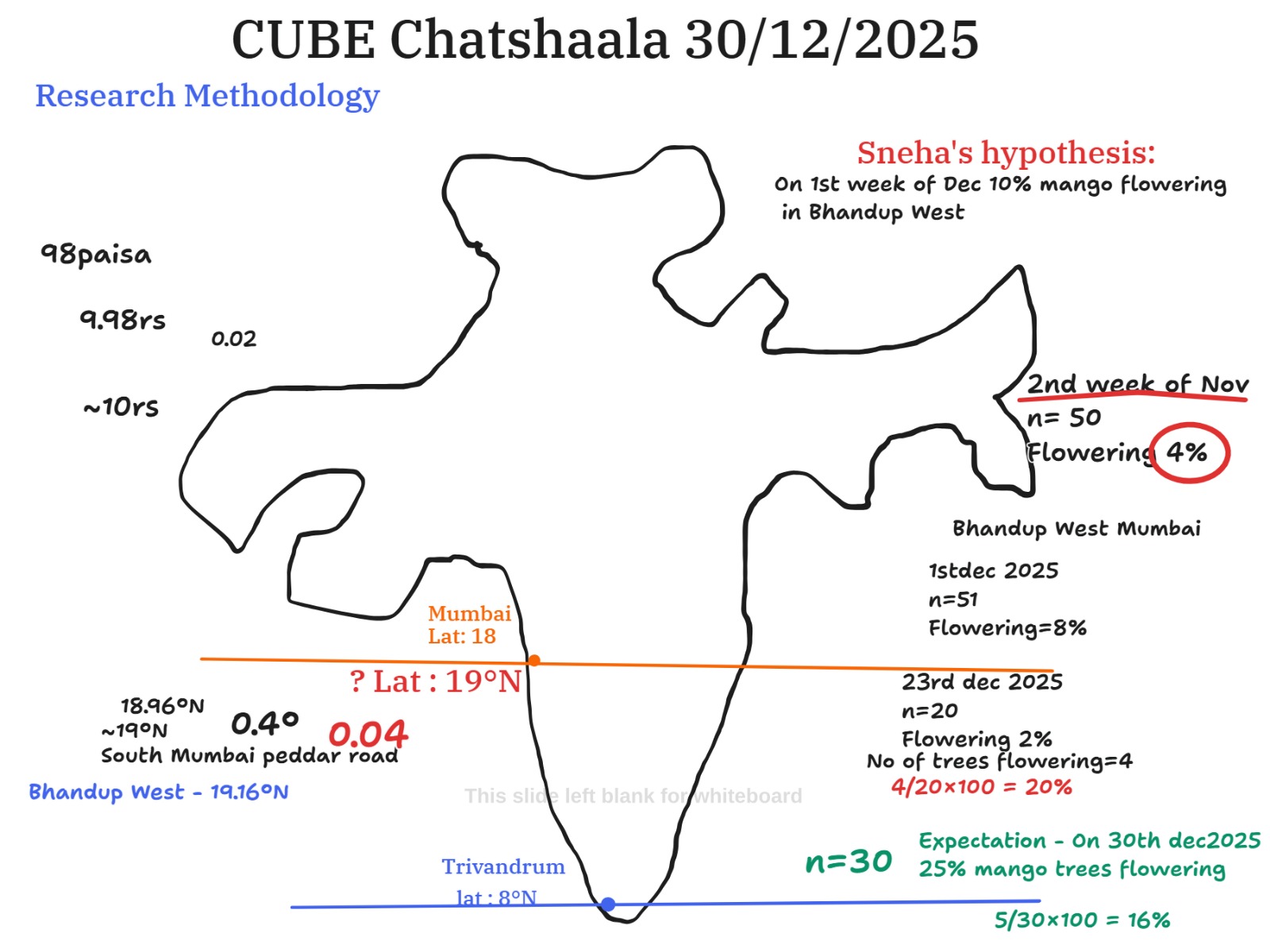
A central hypothesis proposed by Sneha is that mango flowering begins earlier and progresses more rapidly at lower latitudes. Observations from Bhandup West (Mumbai) were used as a case study. Data points included flowering percentages recorded in the second week of November, early December, and late December, with varying sample sizes (n = 20–51). The cubist critically evaluated discrepancies between expected and observed flowering percentages, highlighting the importance of consistent sampling, clear definitions (flowering vs. panicle initiation), and temporal resolution.
The conversation shifted from numbers to methodology, including how minor mistakes in latitude estimation, uneven sample sizes, or percentage computations can skew results. Cubist thought of hypothesis testing as an iterative process that is improved through repeated observation, correction, and contextual understanding rather than as a final decision. The session concluded with an emphasis on scientific humility—allowing data to challenge assumptions.
 Provocative Questions to Inspire the Audience
-
If two places differ by just one degree of latitude, can nature already sense the difference?
-
When observed data does not match predictions, should the hypothesis bend or the method break?
-
At what point does a sample become representative rather than anecdotal?
-
Are changing flowering times signals of climate variability or observer bias?
 What I Learned Today
-
Hypotheses gain strength only when tied to precise, verifiable variables such as latitude and time.
-
Percentages without clarity on sample size can mislead interpretation.
-
Small numerical inaccuracies (latitude, ratios, dates) can cascade into large conceptual errors.
-
Scientific discussion thrives when disagreement is treated as data, not failure.
 TINKE Moments (This I Never Knew Earlier)
-
A shift of less than one degree in latitude can correspond to noticeable phenological differences.
-
“Flowering” itself needs an operational definition before it can be quantified.
-
Expectations can unconsciously influence how observations are recorded in the field.
-
Revisiting raw counts often reveals errors hidden behind neat percentages.
 Gaps and Misconceptions Identified
-
Misconception: Flowering percentage alone reflects biological reality.
Gap: Lack of clarity on stages of flowering and uniform criteria. -
Misconception: A single observation date is sufficient for hypothesis testing.
Gap: Need for longitudinal data across multiple weeks. -
Misconception: Approximate latitude values are acceptable.
Gap: Precision matters when correlating geography with biology.
 Reference