 CUBE ChatShaala – Discussion Summary
Date: 24 January 2026
Focus Areas: Plant model systems, experimental design, biological variability, and observation-based science
Objective of the Session
The session aimed to strengthen conceptual understanding of model organisms in plant biology, experimental controls, and biological variability across environments and age groups, using real examples rather than textbook abstractions. Emphasis was placed on how observations become data, and how data must be interpreted cautiously.

 Key Discussion
a) Cardamine as a Model System
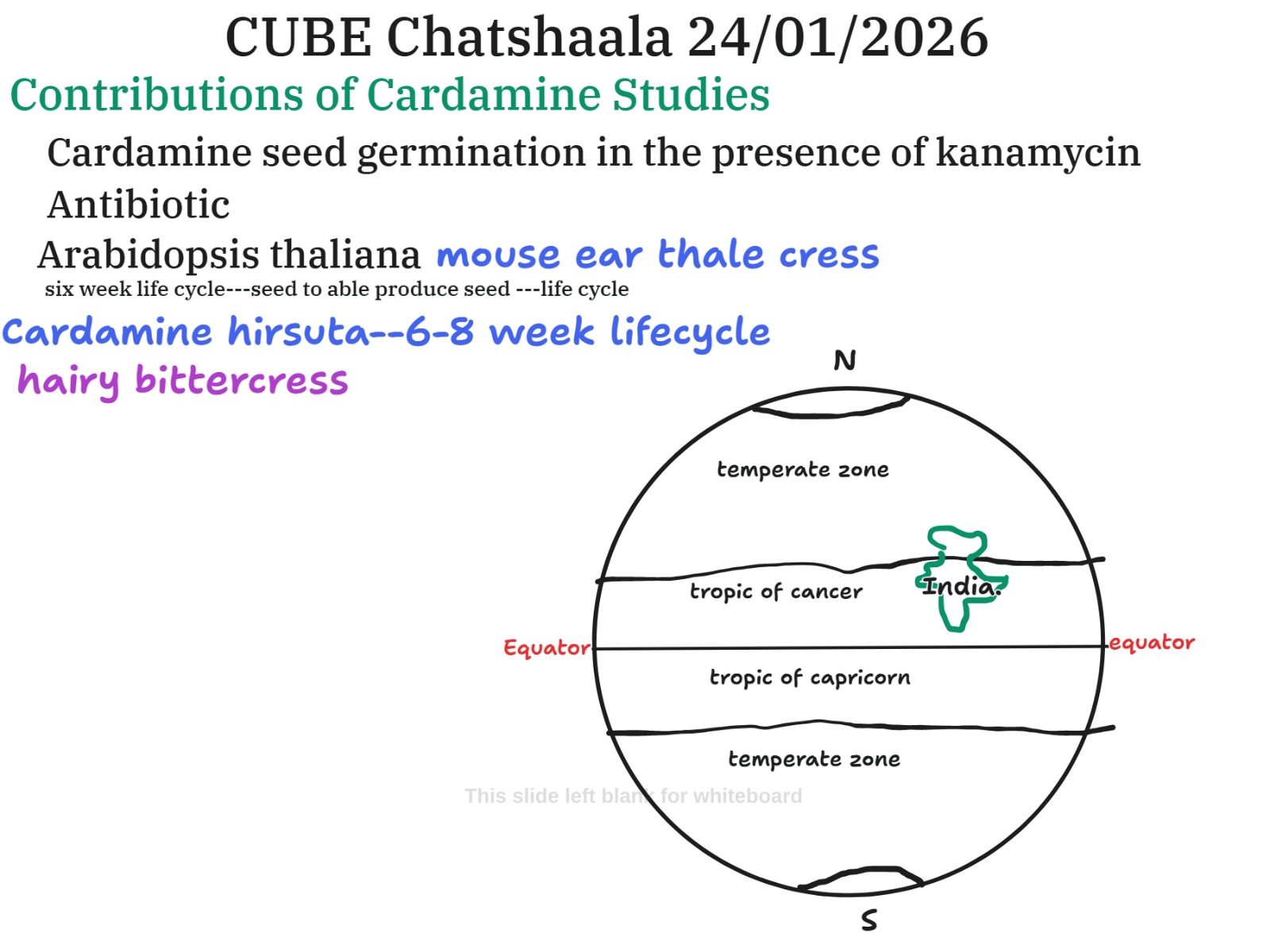
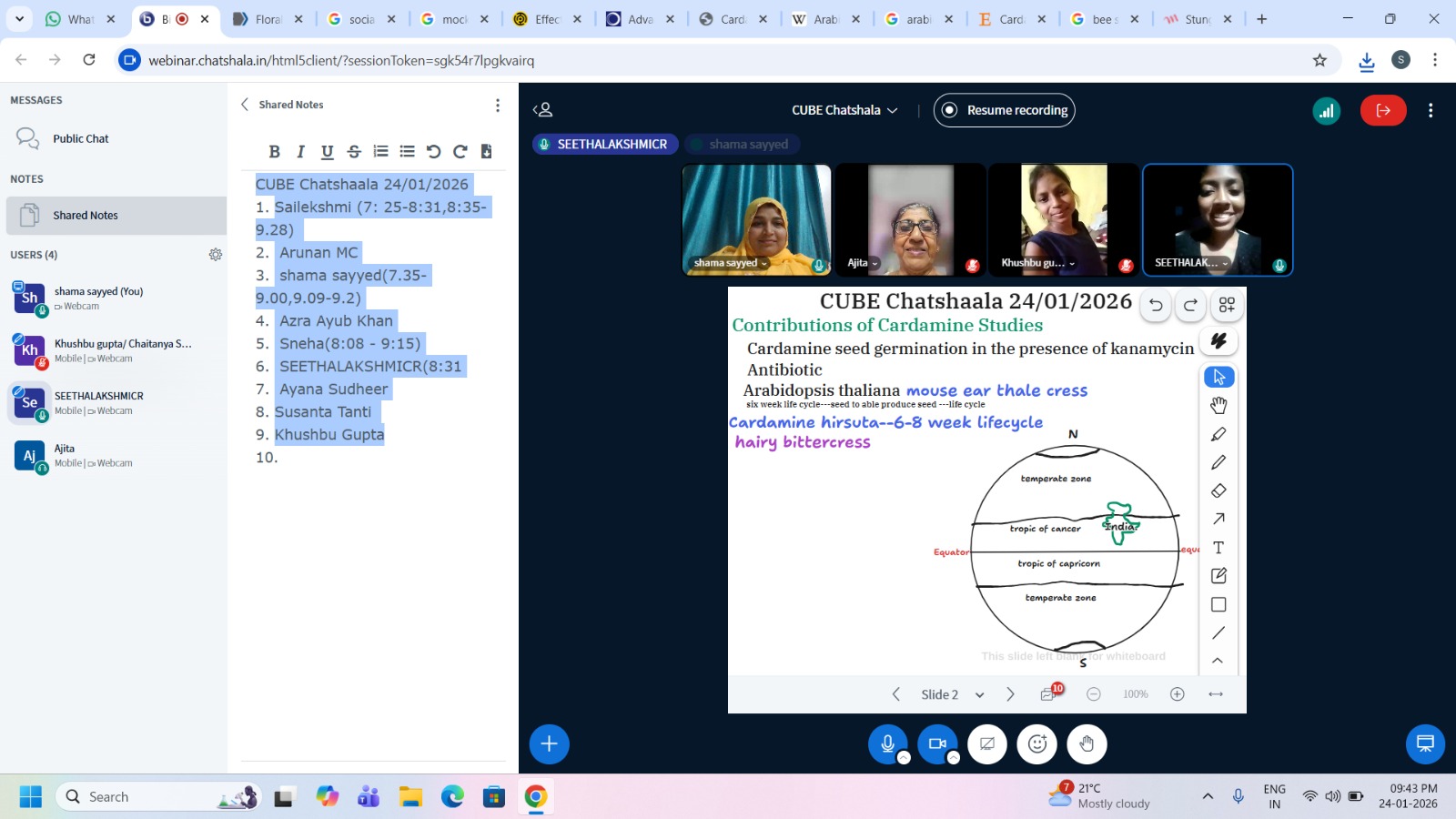
The discussion highlighted Cardamine hirsuta (hairy bittercress) as a comparative model organism alongside Arabidopsis thaliana (mouse-ear cress).
Key points:
- Short life cycle (6–8 weeks) makes Cardamine suitable for rapid experimental studies.
- Comparable developmental stages to Arabidopsis allow meaningful genetic and physiological comparisons.
- Cardamine seed germination experiments under kanamycin (antibiotic) exposure were referenced to demonstrate selection markers and resistance screening in plant research.
This reinforced the idea that model organisms are chosen for practicality, not importance.
b) Arabidopsis thaliana – Why It Matters
Arabidopsis was revisited not as a “famous plant,” but as a tool:
- Complete life cycle in ~6 weeks.
- Easy seed-to-seed propagation.
- Widely used for genetic, developmental, and molecular studies.
The group emphasized that ease of manipulation, not natural dominance, is what makes a species a model.
c) Geography, Climate, and Biological Context
Using a simplified Earth diagram:
- Tropical, temperate, and equatorial zones were discussed.
- India’s position relative to the Tropic of Cancer was used to explain climatic influence on biological processes, including plant growth and experimental reproducibility.
This connected laboratory biology to real environmental constraints, often ignored in controlled experiments.
d) Observation-Based Human Biology: Nail Growth Study
A practical, low-tech data table was introduced to study nail growth rates across:
- Age groups (18–78 years)
- Gender
- Weekly growth measurements (mm)
This activity reinforced:
- Biological variation across age and sex.
- The importance of consistent marking dates.
- That even simple observations require standardization to become valid data.
3. Key Decisions and Insights
- Model organisms must always be evaluated in context.
- Data without controls or comparisons is meaningless.
- Simple observations (like nail growth) can teach core scientific principles if designed properly.
- Environmental and physiological variables cannot be ignored.
 What I Learned
-
Not all plants are studied because they are special—many are studied because they are convenient.
-
Antibiotics like kanamycin are not just medical tools; they are experimental selectors.
-
Climate and geography silently influence biological outcomes.
-
Data collection is not about numbers—it is about discipline and consistency.
-
Even everyday biology (nails, growth) follows measurable scientific rules.
 TINKE Moments (This I Never Knew Earlier)
-
Cardamine hirsuta has research value comparable to Arabidopsis.
-
A plant’s life cycle length directly impacts experimental feasibility.
-
Antibiotic resistance concepts apply to plants as well as microbes.
-
Age significantly alters growth rates, even in tissues like nails.
-
Simple classroom observations can mirror real research methodologies.
 Gaps and Misconceptions
-
Misconception: Model organisms are “more evolved.”
Correction: They are simply easier to study. -
Misconception: Climate does not matter in controlled experiments.
Correction: Environmental background always influences results. -
Gap: Poor understanding of why antibiotics are used in plant studies.
Action: Reinforce the concept of selectable markers. -
Gap: Treating observation as casual rather than systematic.
Action: Emphasize protocol even in simple experiments.
 Whiteboard-Based Engagement Questions
-
What makes a tiny bittercress more valuable than a massive banyan?
-
What does kanamycin really do in a plant lab?
-
Would the same plant experiment work in Europe and India?
-
Is your body quietly running experiments every day?
 Provocative Questions to Inspire Thinking
-
If model organisms are chosen for convenience, what important biology are we missing?
-
Are we over-trusting lab results that ignore environmental context?
-
How many scientific truths begin as simple observations we overlook?
-
Is complexity always better than simplicity in research?
 Photographs during Chatshaala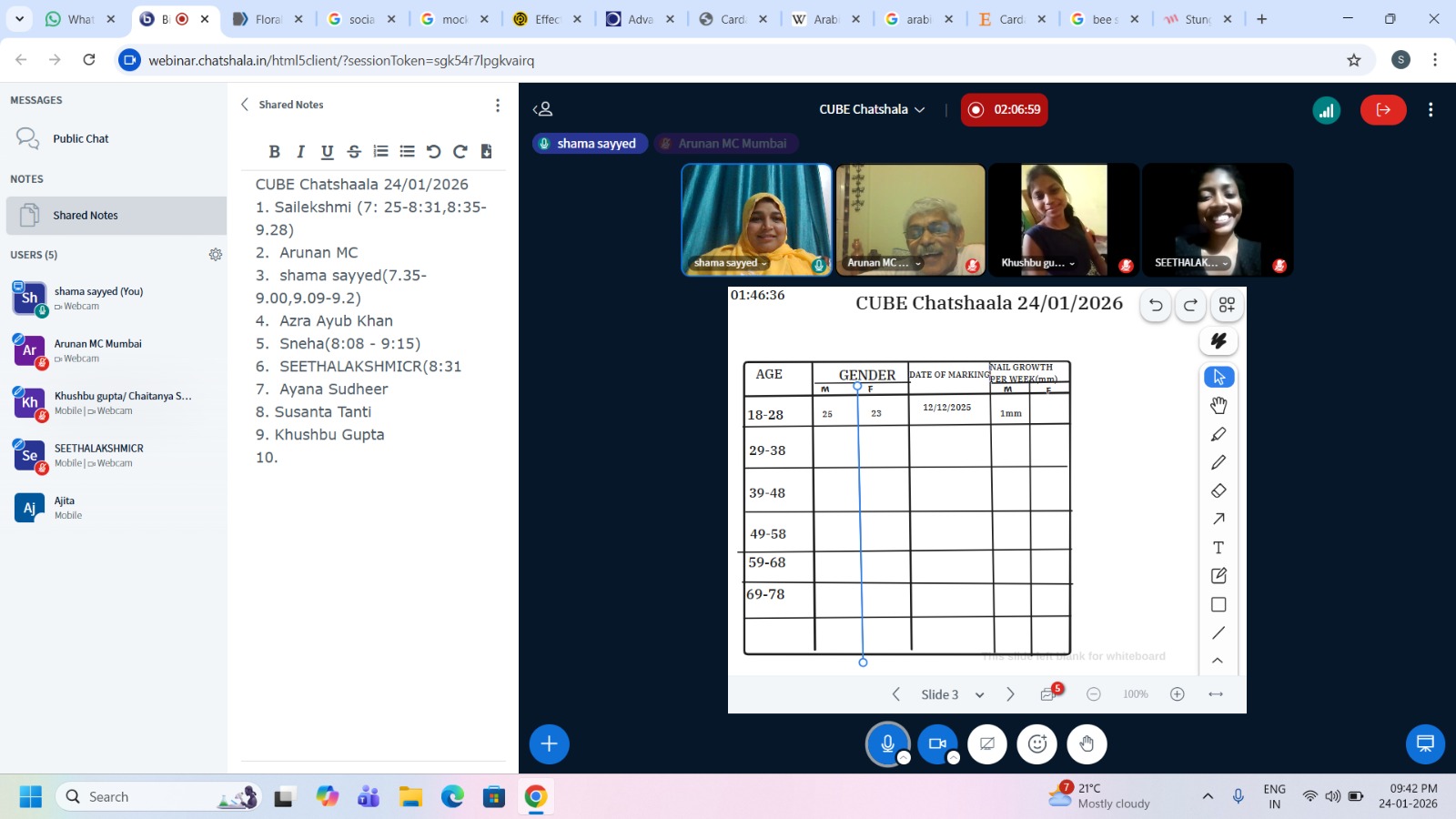
 Reference