 CUBE ChatShaala - Discussion Summary
Date: 27 July 2026
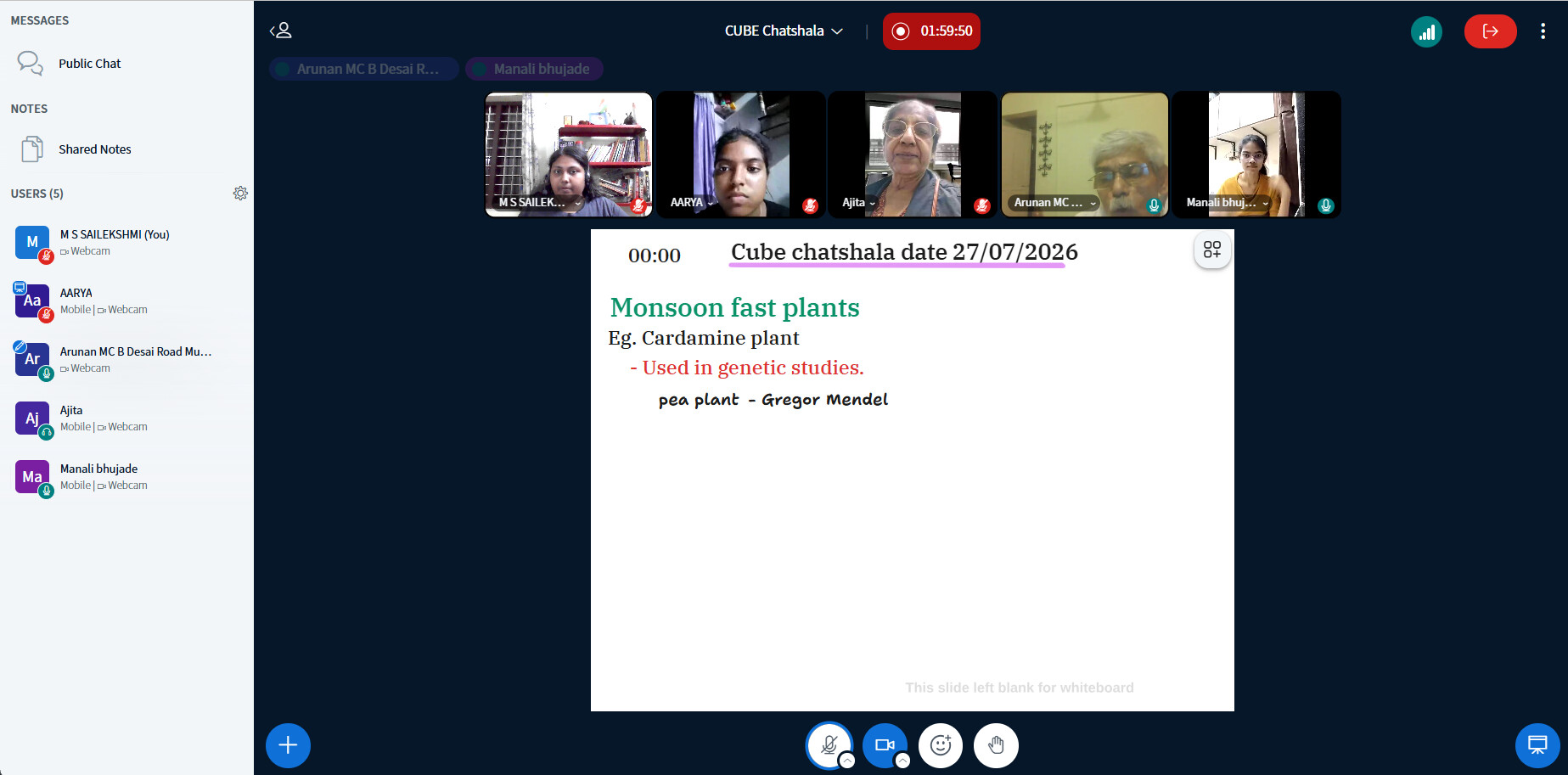
Today’s ChatShaala session returned the community to a theme that has run through CUBE’s monsoon observations for the past couple of years: monsoon fast plants, especially the genus Cardamine as a model organism for studying rapid life cycles. The session opened with participants including M S Sailekshmi, Aarya, Ajita, Arunan MC, Kiran, Kavitha and Manali Bhujade, and the discussion centred on why certain plants seem built for speed during the rains, sprouting, flowering, and setting seed within a matter of weeks.
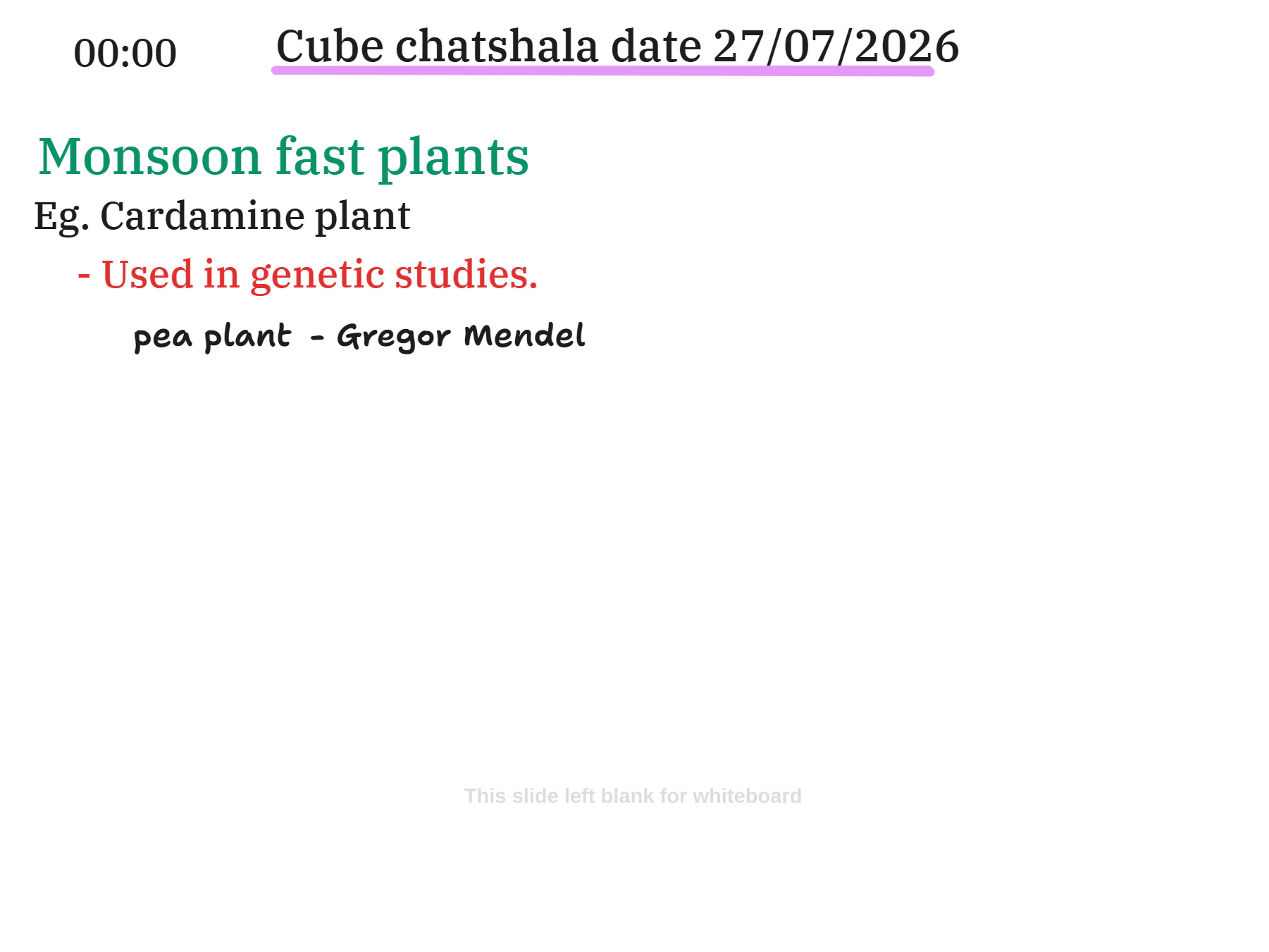
Cardamine was highlighted as the anchor example. What makes it particularly interesting to the group is its dual identity — it behaves as a genuine monsoon ephemeral in the field, completing germination to seed dispersal in roughly three to four weeks, while also being a workhorse plant in genetics laboratories. The conversation drew a direct line to Gregor Mendel’s pea plant experiments, noting that the same qualities that make a plant convenient for classical genetics studies (short generation time, easily observable traits, manageable size) are what make it thrive as a monsoon fast plant in the first place.
This connects naturally to CUBE’s broader ongoing observation project, where members across different cities — Mumbai, Goa, Palakkad, Kozhikode — have been photographing and logging monsoon-triggered plant growth for a while now, drawing inspiration from the Wisconsin Fast Plants program. Earlier CUBE documentation has captured a striking comparative case: Cardamine grown at one participant’s home in Bhandup West completed its full life cycle in about 23 days, while the same species sown around the same time at a college site in Mulund East took slightly longer, flowering roughly a week later. Curiously, a third nearby location showed no fast plant growth at all, which raised useful questions about how uneven urban monsoon ecology can be even across short distances.
The idea of ephemerality itself came up as a scientific concept worth unpacking. Plants like Cardamine fall into a category ecologists call weedy or ruderal ephemerals — species whose entire life cycle is compressed into a short favourable window, in this case the monsoon rains, and which then rely on seed dormancy to survive until the next opportunity arises. This is a different survival strategy from spring ephemerals in temperate forests or desert ephemerals that wait out long dry spells, but the underlying logic is the same: grow fast, reproduce fast, and let the seeds do the waiting.
 Provocative Questions
-
If Cardamine can complete its life cycle in three weeks, what evolutionary pressure favoured speed over size or resilience in these plants?
-
Mendel chose pea plants somewhat by chance for his experiments — what other overlooked monsoon fast plants around us might be equally suited for genetics teaching, and how would we even know?
-
Why do two sites in the same monsoon-fed city, sometimes even within walking distance of each other, show such different fast-plant activity? Is it soil, shade, drainage, or something we haven’t thought to measure yet?
-
Could the presence or absence of Cardamine and similar species be used as a simple, low-cost indicator of urban soil or ecosystem health?
-
Since ephemeral plants time their entire life cycle around a narrow window of good conditions, what happens to them as monsoon patterns shift with climate change? Do they simply vanish from a site, or adapt their timing?
 What I Have Learned
This session reinforced how much a single small plant can teach if we’re willing to look closely. Cardamine’s usefulness isn’t accidental; the very traits that let it survive as a monsoon opportunist- fast germination, quick flowering, and rapid seed set are exactly the traits Mendel needed for tractable genetic experiments. That overlap between ecological strategy and scientific convenience felt like a genuinely useful insight to sit with. I was also struck again by how CUBE’s citizen-science observations, gathered informally by members photographing weeds on walls and pavements, have quietly built up a comparative dataset that a formal ecology lab might envy. The gap in fast-plant sightings at one otherwise similar location is a good reminder that “monsoon-fed region” is a much coarser category than the actual, lived experience of a plant trying to germinate in a specific patch of soil.
 TINKE Moments (This I Never Knew Earlier)
-
The same biological traits that suit a plant to rapid monsoon opportunism (short generation time, simple observable traits) are precisely what made Cardamine and pea plants valuable for classical genetics; ecology and experimental convenience were never really separate questions.
-
Ephemeral plants aren’t a single strategy; spring ephemerals, desert ephemerals, and monsoon/weedy ephemerals all solve the same problem (a short window of good conditions) in climate-specific ways, and Cardamine sits squarely in the weedy/ruderal category.
-
Absence of a monsoon fast plant at a site is not a null result but a data point in itself, worth investigating with the same rigour as a successful germination.
-
A humble whiteboard sketch or a phone photo of a weed on a wall, taken consistently by community members over time, can build into a genuinely comparative ecological record.
 Gaps and Misconceptions
-
The session’s whiteboard notes were brief, listing only the Cardamine example and its link to Mendel, without capturing the specific comparative timelines, site names, or measurements that gave the discussion its depth; a more detailed live log would help future write-ups stand on their own.
-
There’s a lingering assumption worth challenging: that “monsoon fast plant” growth is primarily rainfall-driven. As earlier CUBE data already suggests, local soil, shade, drainage, and human disturbance appear to matter just as much, and this session did not fully resolve which factor dominates.
-
The precise identity and count of monsoon fast plant species being tracked by CUBE across different cities remains loosely defined; a consolidated species list would sharpen future comparative work.
-
It would help to distinguish, going forward, between true ephemerals completing a full seed-to-seed cycle and longer-lived weeds that merely appear seasonally more visible during the monsoon.
 Photographs during Chatshaala
 Referance