 CUBE ChatShaala Summary – 15.08.2025
Topic: Budding vs. Fragmentation in Chlorohydra & Plant Tissue Culture Physiology
 Summary of Discussion
Today’s ChatShaala delved into two interconnected research themes—
- Budding vs. Fragmentation in Chlorohydra
-
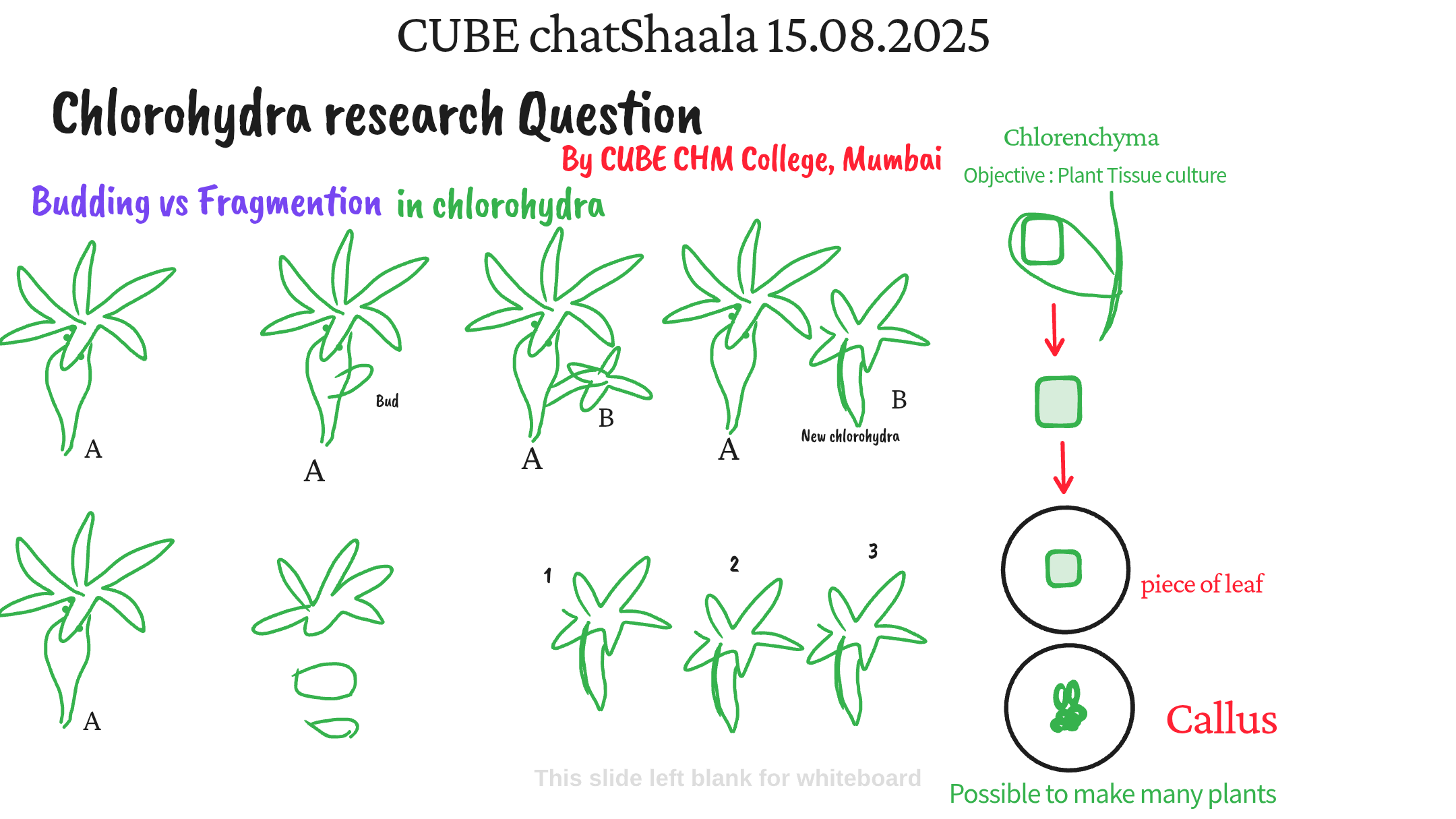
Participants discussed morphological sequences in Chlorohydra reproduction.
-
Budding was illustrated with stages where a bud gradually develops on the parent (A), elongates (B), and eventually detaches to form a new individual.
-
Fragmentation was shown through instances where the organism splits into multiple pieces, each capable of regenerating into a complete individual.
-
Comparative observations were highlighted to identify environmental and physiological triggers that may favour one mode over the other.
- Plant Tissue Culture & Physiology
-
The focus shifted to chlorenchyma tissue isolation for plant tissue culture.
-
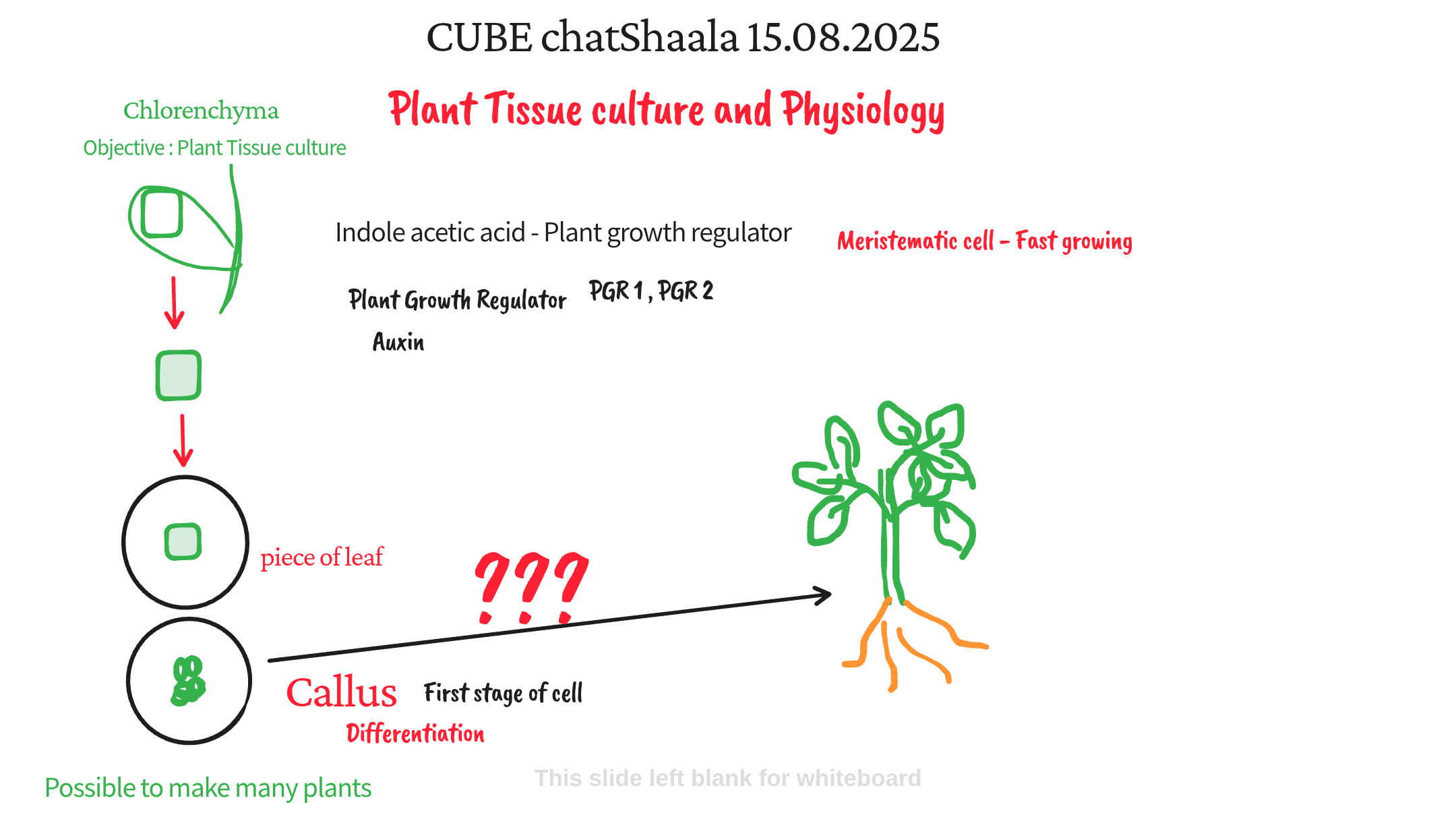
Process flow: Leaf cell extraction → callus formation → plant regeneration.
-
Callus was discussed as an undifferentiated mass of meristematic cells, capable of producing multiple plants under controlled conditions.
-
The role of plant growth regulators (PGRs) such as Indole-3-acetic acid (IAA) and specific PGR combinations (PGR 1, PGR 2) in controlling cell differentiation and organ formation was reviewed.
-
Physiological emphasis: Fast-growing meristematic cells, auxin-mediated growth, and the mystery gap between callus formation and full plant development (root-shoot differentiation stage).
 TINKE Moments (Things I Never Knew Earlier)
-
Hydra-like organisms such as Chlorohydra can switch between budding and fragmentation—indicating adaptive reproductive strategies.
-
In plant tissue culture, callus is not the end product; precise hormonal control decides whether roots or shoots emerge.
-
Meristematic cells are essentially biological “blank slates” that can be guided into becoming any plant tissue.
-
The balance between auxin and cytokinin concentrations is crucial for directing callus into either root or shoot development.
 Provocative questions for the inspiration
 If a single cell from a plant leaf can produce an entire plant, could one cell from Chlorohydra regenerate the whole organism?
 Why might Chlorohydra “choose” fragmentation over budding in certain conditions?
What exactly happens inside the callus before roots and shoots appear—and can we see it in real-time ?
 Is the principle of totipotency in plants somehow mirrored in animal regeneration like in hydra?
 What I Learned
Today’s discussion revealed that both Chlorohydra regeneration and plant tissue culture share a core principle: totipotent cells + environmental cues = complete organism regeneration. Whether in aquatic animals or terrestrial plants, the process hinges on the ability of cells to reprogram and form complex structures from scratch. Understanding the precise control factors—be they environmental signals in Chlorohydra or hormonal balances in plant cultures—can unlock efficient regeneration methods in both fields.
 References
-
Google Search (Indole-3-acetic acid)
-
Morphogenetic movements during budding in Hydra - ScienceDirect
@KiranKalakotiR @Arunan @SN1261 @Hinaiqbal_Mudgal @Chitralekha @2020ugchsncnseethala @sakshiconsultant2002 and others.