 CUBE Chatshala Summary
 From Cardamine to Leguminous Plants & New Scientific Learnings
⸻
 2180th Day of CUBE Chatshala
- On 19 May 2026, we discussed that CUBE Chatshala completed its 2180th day
 .
. - By calculating 2180 ÷ 365, we found that the journey has continued for approximately 5.9 years.
- This showed the long and continuous journey of scientific learning and collaboration
 .
.
⸻
 Renowned Institutes & Scientific Inspiration
- We discussed Indian Agricultural Research Institute (IARI), where Arunnima Ma’am pursued her studies.
- We also discussed Elphinstone College, where Manali Ma’am studied Biotechnology
 .
. - We learned about Bhabha Atomic Research Centre, one of India’s major scientific research centres .
- We discussed Govind Ballabh Pant University of Agriculture and Technology, which is the first agricultural university of India .
- These discussions helped us understand the importance of research institutes in scientific discoveries and innovation.
⸻
From Cardamine to Leguminous Plants
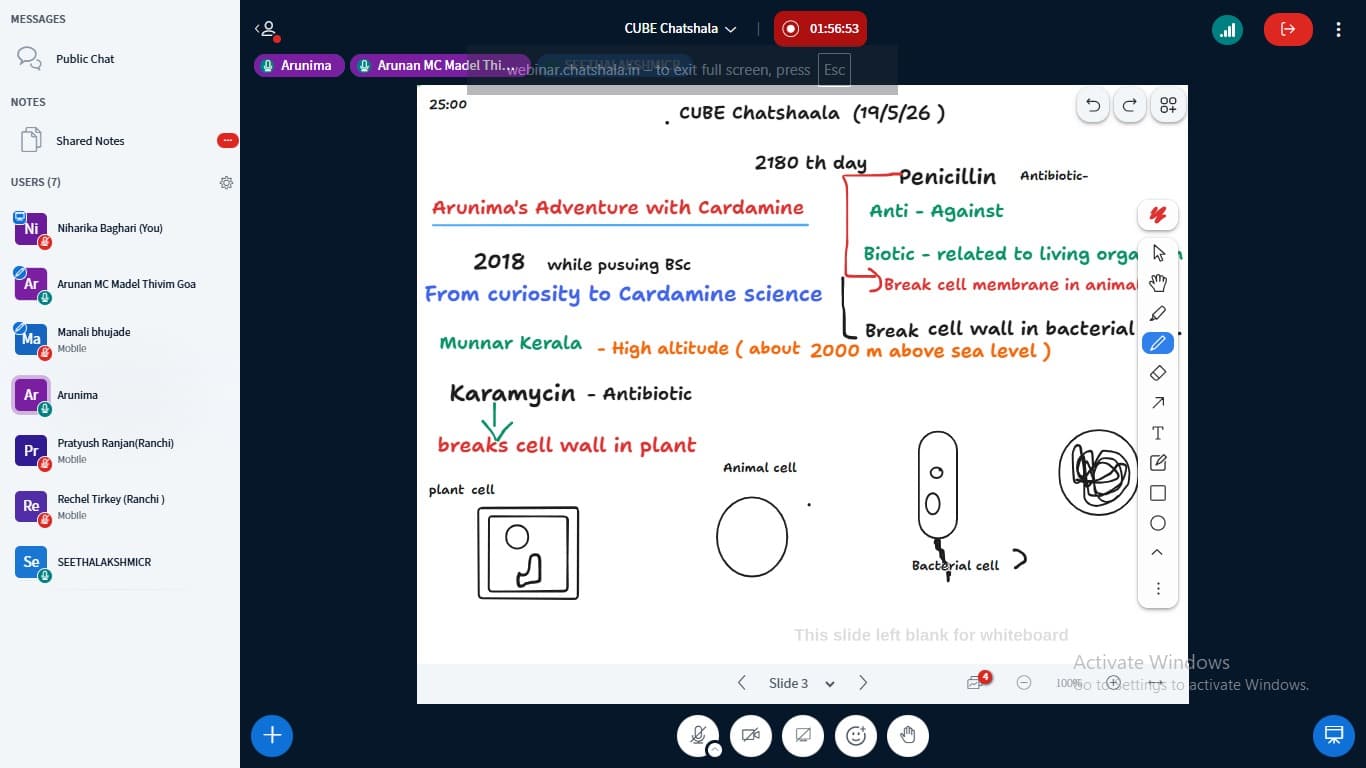
- We discussed Arunima Ma’am’s adventure with Cardamine
 .
. - In 2018, while pursuing her BSc degree, she first learned about Cardamine through her professor.
- We learned about Arabidopsis thaliana, which is commonly used as a model plant in foreign laboratories.
- Later, it was discovered that Cardamine, belonging to the mustard family, is also available in India
 .
. - We connected this discussion with leguminous and non-leguminous plants
 .
. - We learned that Cardamine is used as a model plant because it grows quickly, produces many seeds, needs very little space, and is easy to grow in laboratories .
- We also learned that model plants help scientists study inheritance, variation, genetics, and chromosomal theories .
- This discussion showed how small plants can help scientists understand major biological concepts.
⸻
 Discovery from Munnar, Kerala
- We learned that the first Cardamine observed by Arunnima Ma’am was found in Munnar
 .
. - Munnar is located about 2000 meters above sea level.
- This discussion helped us understand how altitude and environmental conditions affect plant growth and biodiversity .
⸻
 Antibiotics & Cell Wall Concepts
- We discussed antibiotics such as Penicillin and Karamycin
 .
. - We learned that Penicillin breaks the bacterial cell wall
 .
. - We also learned that Karamycin affects the plant cell wall .
- This discussion cleared misconceptions about how different antibiotics work on different organisms.
⸻
Plant Cell, Animal Cell & Bacterial Cell
- We compared plant cells, animal cells, and bacterial cells
 .
. - We learned that plant cells and bacterial cells have cell walls
 .
. - We also learned that animal cells do not have cell walls
 .
. - This comparison helped us understand structural differences among different types of cells.
⸻
Binary Fission & Cell Enlargement
- We studied bacterial reproduction through binary fission
 .
. - We learned that bacterial cells first enlarge because of cell synthesis .
- After enlargement, the bacterial cell divides through binary fission to form new cells.
- This was a TINKE moment — “This I Never Knew Earlier” .
- This discussion helped us understand how bacteria grow and reproduce rapidly.
Leguminous Plants, Root Nodules & Nitrogen Fixation
-
We also discussed the difference between leguminous and non-leguminous plants
. -
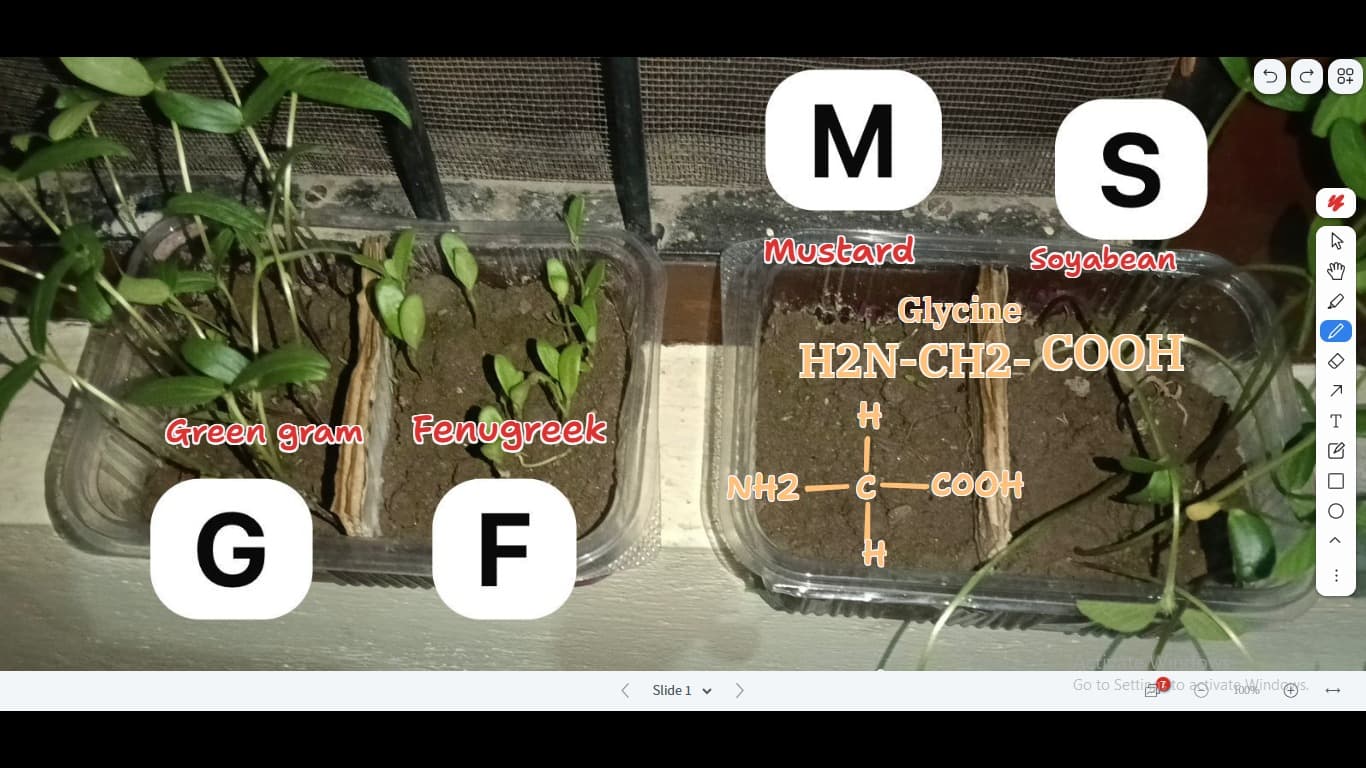
In the experimental setup:
- G represented Green Gram
- F represented Fenugreek
- S represented Soybean
- M represented Mustard
-
Green Gram, Fenugreek, and Soybean are leguminous plants, while Mustard is a non-leguminous plant and was used as the control plant in the observation
. -
We carefully observed the growth of root nodules in the leguminous plants
. -
During the discussion, we learned about the mutualistic relationship between Rhizobium bacteria and the roots of leguminous plants
. -
Rhizobium bacteria live inside the root nodules and help in nitrogen fixation by converting atmospheric nitrogen into ammonia, which can be used by plants.
7… In return, the plant provides food and shelter to the bacteria. Since both the bacteria and the plant benefit from each other, this relationship is called a mutualistic relationship .
- We also discussed the importance of nitrogen in plants. Nitrogen is essential for the formation of proteins, amino acids, and other important biological compounds .
9… During this discussion, we learned about the amino acid Glycine. Glycine contains both an amino group (NH₂) and a carboxyl group (COOH).
10… The structural formula of Glycine is:
NH₂ — CH₂ — COOH
11… The IUPAC name of Glycine is Aminoethanoic Acid .
12… This discussion helped us understand the connection between leguminous plants, root nodules, nitrogen fixation, amino acids, and plant growth in a more scientific and practical way .
 Questions Raised During the Session
- Why are model plants important in laboratories?
- Why do bacterial and plant cells have cell walls while animal cells do not?
- How do antibiotics target specific cells?
- Why is Cardamine useful for studying genetics and inheritance?
 Overall Learning
- This session connected plant science, microbiology, antibiotics, biodiversity, and scientific discoveries together .
- From Cardamine to leguminous plants, every discussion increased our scientific curiosity.
- The session helped us understand new biological concepts in a more interesting and practical way.
@Arunan sir , @manali mam , @KiranKalakotiR