 CUBE Chatshaala – Discussion Summary
Today’s session focused on the integration of internships within the four-year undergraduate degree program under NEP 2020. The discussion highlighted how institutions such as the University of Kerala and S.N. College, Chempazhanthy (M.S. Sailekshmi), are structuring their semesters, with internships planned at research institutes like the Haffkine Institute.
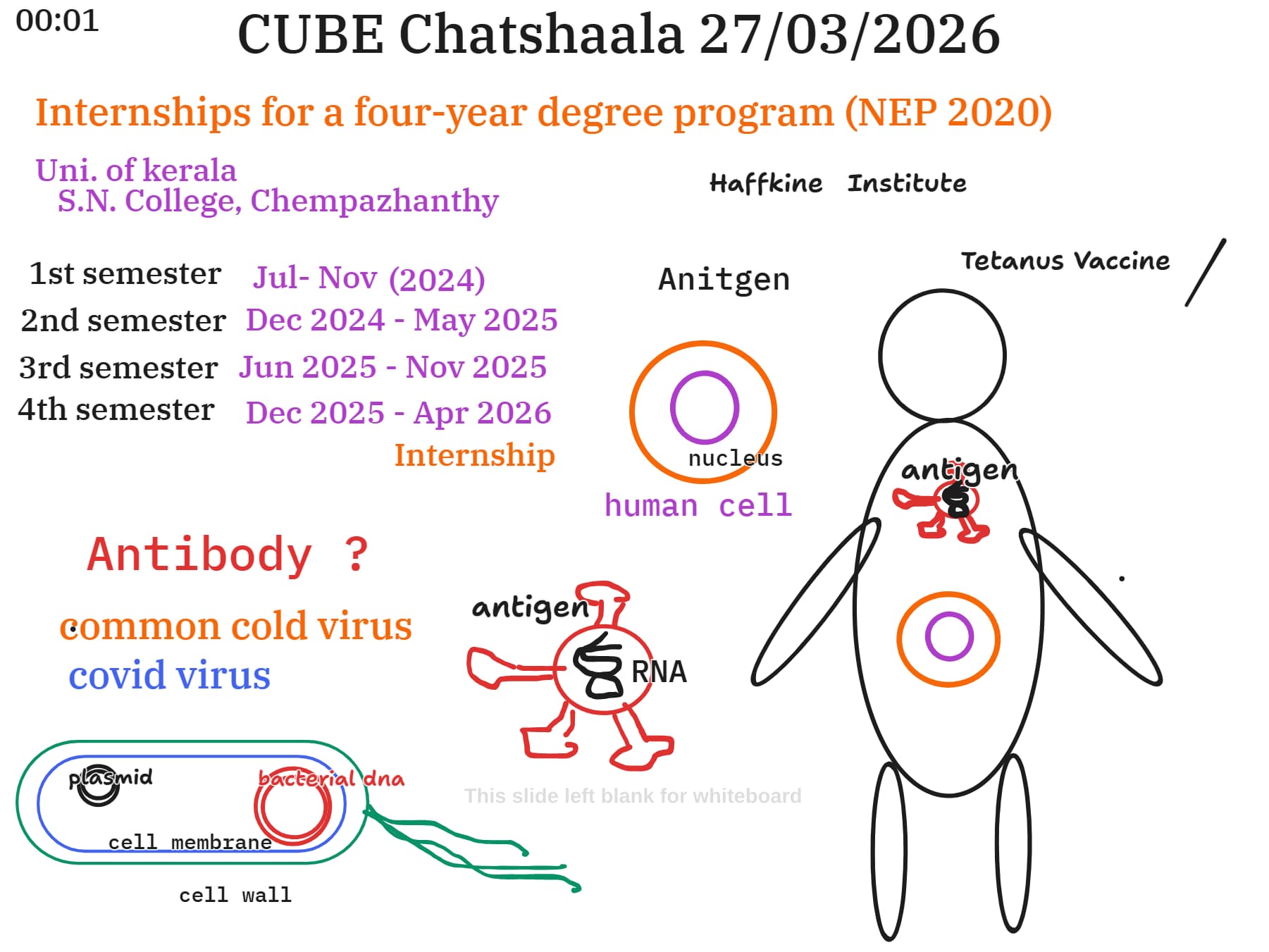
The conversation then shifted toward immunology and virology. Cubists explored the concepts of antigens, antibodies, and vaccines, using examples such as the tetanus vaccine and COVID-19. Aishanee Sinha Roy explained how antibodies are specialized proteins produced by the immune system to recognize and neutralize viruses. Sneha Maurya raised an important point about viral RNA injection, noting uncertainty about whether viruses directly inject RNA into the nucleus or simply into the cell cytoplasm. This sparked a valuable clarification moment, underscoring the need to distinguish between viral entry mechanisms and replication processes.
Kiran Kalakoti ’s query about Preety Salian’s involvement with BRSV (Bovine Respiratory Syncytial Virus) at Haffkine added a practical dimension, linking the theoretical discussion to real-world research. Arunan contributed by sharing the Haffkine Institute’s website, encouraging participants to explore its resources further.
Overall, the session blended academic timelines, institutional references, and scientific inquiry, creating a rich dialogue that connected education policy with frontline biomedical science.
 Provocative Questions
-
How can internships under NEP 2020 be designed to balance academic coursework with hands-on research exposure?
-
What are the differences between how bacterial cells and human cells respond to antigens?
-
Do all viruses inject their RNA into the nucleus, or do some replicate entirely in the cytoplasm?
-
How does the immune system distinguish between antigens from harmless microbes and those from dangerous pathogens?
-
Could citizen science projects play a role in bridging the gap between classroom learning and real-world immunology research?
-
What lessons can be drawn from the development of the tetanus vaccine when designing vaccines for rapidly mutating viruses like COVID-19?
 What I Have Learned
The most important takeaway from today’s Chatshaala is the recognition that internships are not just add-ons but integral to the NEP 2020 vision of holistic education. They provide opportunities for students to engage with real-world research, such as vaccine development and virology studies at institutes like Haffkine.
On the scientific side, I learned that while antibodies are central to our defense against viruses, there is still confusion among learners about the exact mechanisms of viral entry and replication. This highlights the importance of clarifying foundational concepts in immunology.
Another key insight is the value of linking policy discussions (like NEP 2020) with scientific content (like antigens and RNA viruses). This interdisciplinary approach makes learning more relevant and engaging.
 TINKE Moments (This I Never Knew Earlier)
-
Uncertainty about viral RNA entry: Sneha’s question revealed a gap in understanding whether viruses inject RNA into the nucleus or cytoplasm. This moment highlighted the need for deeper exploration of viral replication strategies (e.g., retroviruses vs. coronaviruses).
-
Connection between internships and immunology research: The realization that students could directly engage with cutting-edge biomedical research during their degree programs was eye-opening. It reframed internships as gateways to scientific discovery rather than mere academic requirements.
-
Citizen science potential: The idea that non-specialists could meaningfully contribute to immunology discussions and even research projects broadened the scope of what science education can achieve.
 Gaps and Misconceptions
-
Virus replication site confusion: Some participants assumed all viruses inject RNA into the nucleus, which is not accurate. For example, coronaviruses replicate in the cytoplasm, while retroviruses like HIV involve the nucleus.
-
Terminology slip (“Anitgen” vs. “Antigen”): Small errors in spelling or labeling can lead to misunderstandings in scientific communication.
-
Antibody function oversimplification: While antibodies do attack and neutralize viruses, their role is more nuanced, involving signaling other immune cells and preventing viral entry rather than directly “destroying” viruses.
 Photographs during Chatshaala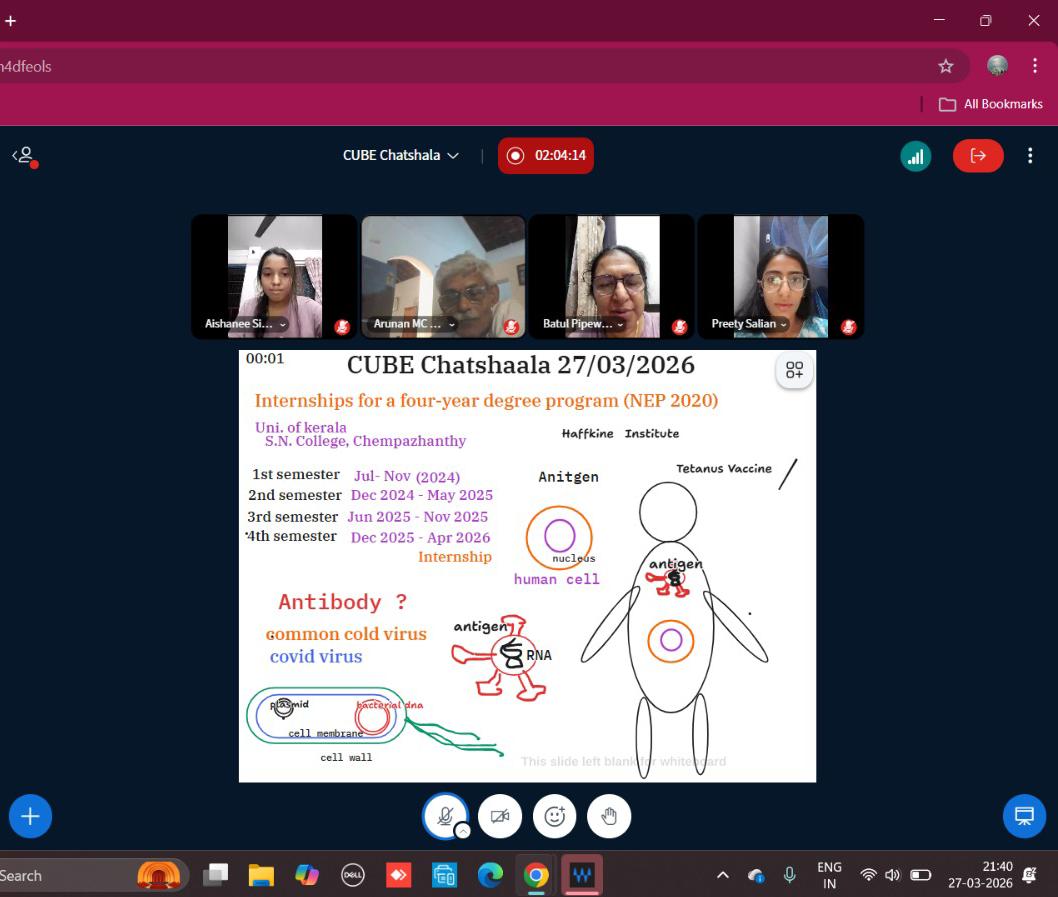
 Reference