 CUBE ChatShaala: Session Summary - December 7, 2025
The CUBE ChatShaala session focused on a fascinating blend of cancer research and fundamental natural processes, bridging advanced scientific concepts with everyday biological and chemical phenomena. Key discussions centered around the distinction between ‘Cancer research’ and ‘Cancer studies’, advanced techniques like Immunohistochemistry (IHC), and the surprisingly complex science behind curd making. The meeting also initiated a critical look at the role of surveys in the context of scientific research.
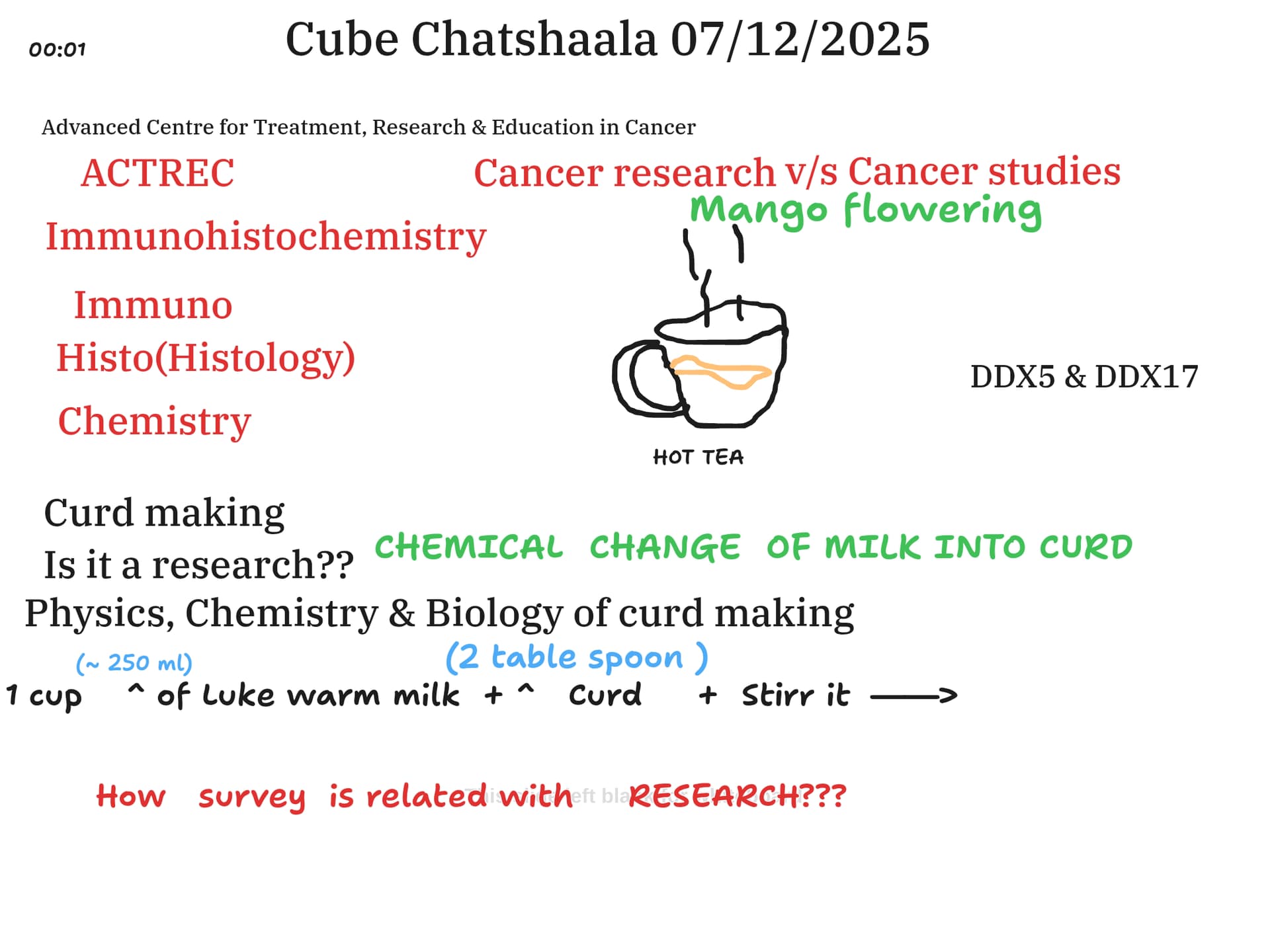
 Advanced Cancer & Molecular Biology Focus
-
ACTREC & IHC: The session began with an acknowledgment of the Advanced Centre for Treatment, Research & Education in Cancer (ACTREC), setting a high bar for the discussion. This led into a detailed examination of Immunohistochemistry (IHC), breaking down the term into its constituent parts: Immuno (related to immune system/antibodies), Histo (related to tissue/histology), and Chemistry (the underlying reaction). This technique is crucial for diagnosing and understanding cancer by localizing specific antigens in tissue sections.
-
Molecular Players (DDX5 & DDX17): The mention of DDX5 & DDX17 signals a discussion on specific molecular targets, likely RNA helicases involved in gene expression, which are often implicated in cancer progression and regulation.
-
Research vs. Studies: A key conceptual clarification was initiated to delineate the difference between Cancer research (implying the generation of new knowledge or novel interventions) and Cancer studies (which might involve observational work, literature review, or specific diagnostic testing).
 The Science of Curd Making: A Multidisciplinary Investigation
The simple act of making curd was elevated into a profound example of interdisciplinary science:
-
Chemical Change: Curd making was fundamentally defined as a CHEMICAL CHANGE OF MILK INTO CURD.
-
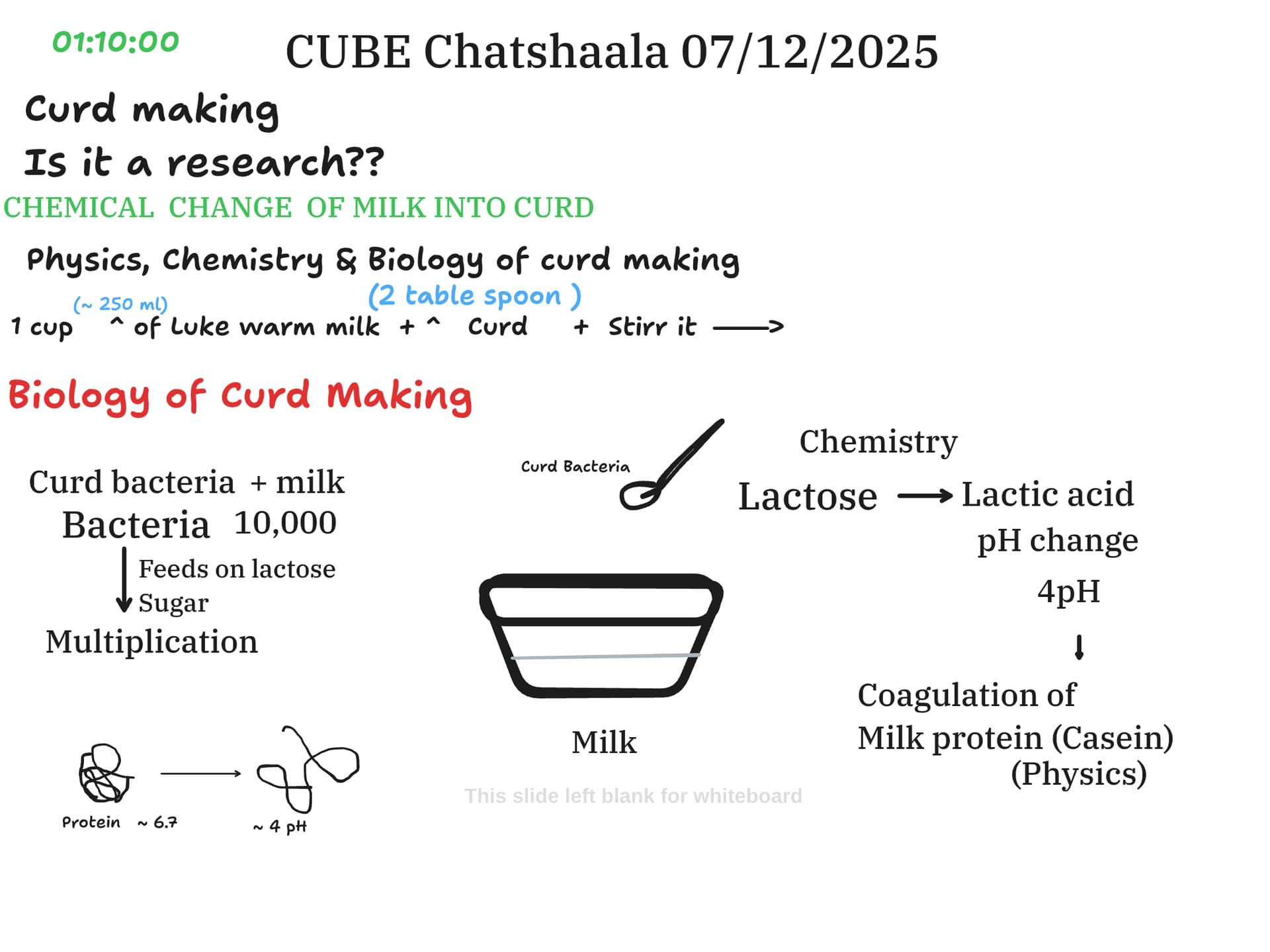
Biology: This process is driven by Curd bacteria (like Lactobacillus species), with an estimated 10,000 bacteria per sample. These bacteria feed on lactose sugar in the milk and multiply.
-
Chemistry: The bacteria metabolize Lactose (milk sugar) into Lactic acid, which causes a rapid pH change from the milk’s initial value (around pH 6.7) to the acidic environment of curd (around pH 4).
-
Physics: The drop in pH causes the coagulation of Milk protein (Casein), which is the physical change observed as the liquid milk solidifies into curd. This coagulation is a macroscopic physical manifestation of the molecular chemical change.
-
Methodology: A practical recipe was noted: 1 cup ( 250 ml) of Luke warm milk + 2 table spoon of curd + Stir it.
 The Research Question & Survey
The session posed two important meta-questions:
-
“Is Curd making a research??” This encourages participants to define the boundary between an experiment (following a protocol) and research (seeking to answer an unknown question).
-
“How survey is related with RESEARCH???” This prompted a discussion on how systematic data collection (surveys) forms the foundational data layer for many types of research, especially in epidemiology or understanding population-level biological trends.
 What I Have Learned
During this ChatShaala, my understanding shifted from viewing topics in isolation to appreciating their interconnectedness.
-
The Interdisciplinary Nature of Curd: I learned that making curd is not just a cooking process, but a perfect, real-world demonstration of Biology (bacterial action), Chemistry (lactose to lactic acid transformation and pH shift), and Physics (protein coagulation). It’s a microcosm of the scientific method.
-
Precision in Scientific Terminology: The necessity to strictly define terms like ‘Cancer research’ vs. ‘Cancer studies’ reinforced the importance of precise language in scientific discourse to avoid ambiguity in objectives and outcomes.
-
IHC’s Foundational Role: I gained a deeper appreciation for Immunohistochemistry as a cornerstone diagnostic technique that links molecular phenomena (antigen-antibody binding) directly to observable tissue morphology.
 TINKE Moments (This I Never Knew Earlier )
| Aspect | Insight/Observation |
|---|---|
| Gap in Understanding | The specific function and mechanism of DDX5 & DDX17 were introduced but require a focused follow-up to fully grasp their regulatory roles in a cancer context. |
| Misconception Addressed | The common view of curd making as merely a change in state was corrected: it is a chemical change (lactic acid production) that leads to a subsequent physical change (casein coagulation). |
| Surprising Revelation | The quantitative aspect of the process—that an estimated 10,000 bacteria initiate the change in 250ml of milk—highlights the immense power of microscopic biological agents. |
| Gaps and Misconceptions (Curd Making) | The discussion on pH and protein denaturation/coagulation might need further visual or experimental proof to solidify the link between the acidic environment pH 4 and the physical change of the Casein protein. The mechanism by which the Casein structure changes at the isoelectric point requires a more detailed explanation. |
 Engaging Follow-Up Questions for the Community
1. DDX Unlocked: The Cellular Controllers
Question: If DDX5 and DDX17 are RNA helicases involved in gene regulation, how might their dysfunction or overexpression specifically drive the progression of a cancer type? What experimental approaches (beyond IHC) could be used to precisely target their activity in a lab setting?
2.  The 10,000 Initiative: Bacterial Tipping Point
Question: The recipe calls for ‘2 tablespoon of curd’ as an inoculum. If we were to start with a drastically lower number of bacteria (e.g., only 100), what would be the impact on the reaction kinetics? Could we model the minimum viable bacterial count needed to ensure successful curd production within a standard timeframe?
3.  Research vs. Study: Where is the Novelty?
Question: Consider an observational project tracking the mango flowering cycle (Mango flowering was noted in the discussion) across different altitudes in Kerala for five years. Does this constitute research or study? What single factor would need to be added to transform it definitively into novel research?
4.  The Survey Catalyst: Transforming Data to Discovery
Question: A general ‘survey’ is often criticized for lacking depth. How can the design of a scientific survey—particularly one related to cancer awareness or dietary habits impacting health—be structured to not just collect data, but to test a falsifiable hypothesis, thereby establishing its validity as a core research tool?
 Gaps and Misconceptions
🔴 Gaps in Current Understanding
- Molecular Mechanism of DDX Proteins: The precise upstream and downstream signaling pathways regulated by DDX5 and DDX17 in a cellular context (especially in cancer) remain a key area for detailed exploration.
-
Kinetics of Curd Formation: While the recipe was noted, the session lacked a detailed exploration of reaction kinetics—specifically, how changes in temperature (Luke warm), inoculum size (2 table spoon), or milk composition affect the rate of Lactic acid production and subsequent coagulation time.
-
Mango Flowering Research Methodology: The exact research question or hypothesis linking “Mango flowering” to cancer studies or research was not clearly articulated, leaving a conceptual gap between the two topics.
❌ Common Misconceptions Addressed
- Curd Making is Just Physical: The common misconception that curd formation is simply a change in the state of matter (liquid to semi-solid) was corrected. It is primarily a chemical change (Lactose - - - > Lactic acid) that triggers the subsequent physical change (Casein protein coagulation).
-
The pH Effect is Simple: The idea that the pHchange is merely incidental was refuted. The pH drop from 6.7 to 4 is the critical trigger that causes the Casein protein to reach its isoelectric point and denature/coagulate, making it a pivotal aspect of the physics and chemistry involved.
-
All Data Collection is Research: The distinction between a general “survey” (data collection) and “research” (investigation of a hypothesis) was initiated, challenging the idea that simply compiling information equates to a formal research endeavor.
 Reference