 CUBE Chatshaala - Discussion Summary
The CUBE ChatShaala session on 24 February 2026 focused on the biology and industrial significance of vitamins, DNA composition, and the role of fermentation in commercial production, in preparation for Sneha’s presentation tomorrow. The discussion began with the fundamentals: vitamins are essential organic compounds that must be consumed in small quantities for metabolic processes, growth, and disease prevention. Their importance in vision, immunity, and energy production was emphasized, alongside industrial applications in food fortification, pharmaceuticals, nutraceuticals, animal feed, and cosmetics.
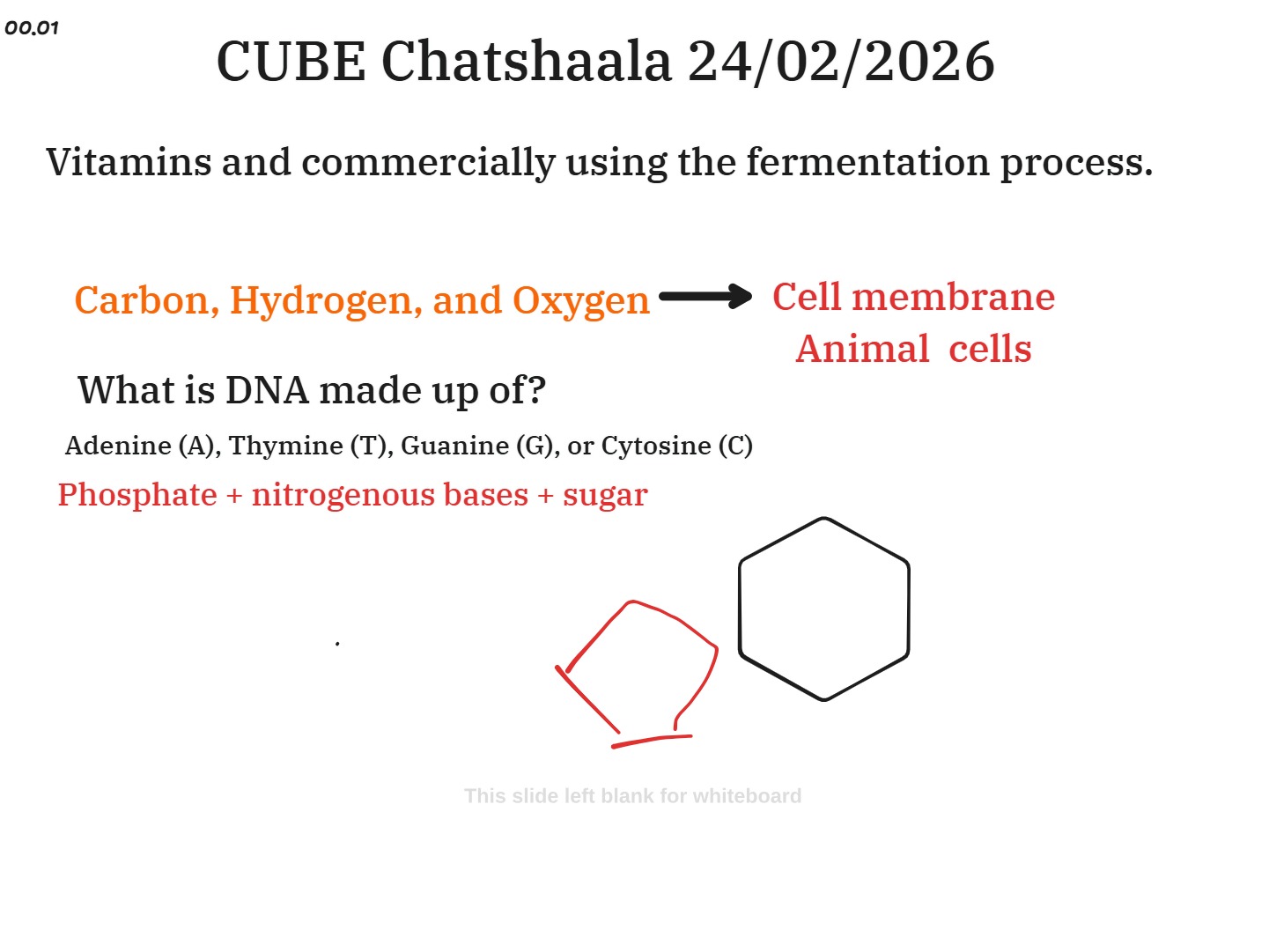
The group explored DNA structure, noting its composition of nitrogenous bases (adenine, thymine, guanine, and cytosine), phosphate groups, and sugars. This reinforced the molecular foundation of life and connected to broader themes of cellular function.
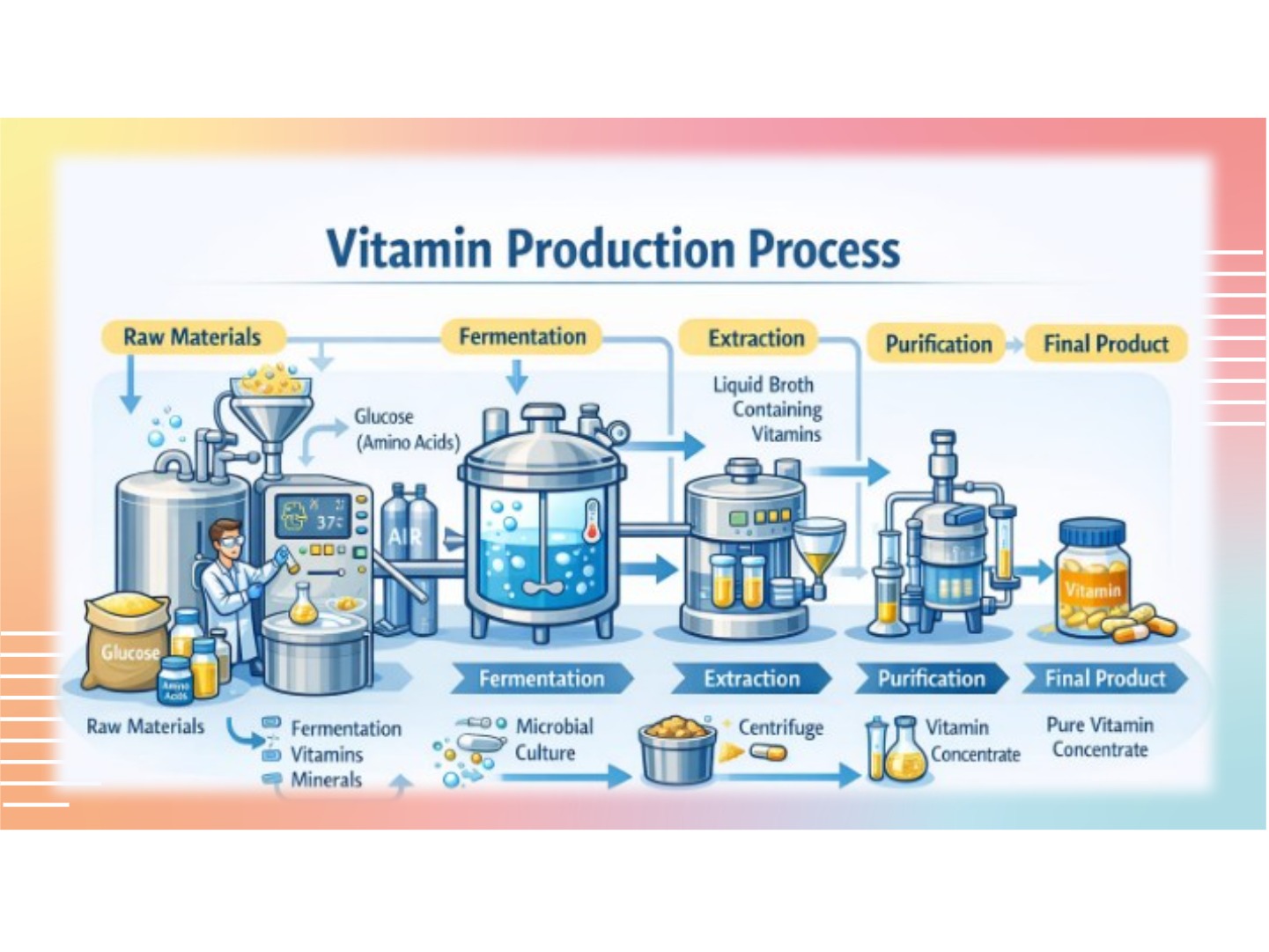
A major focus was on fermentation technology in vitamin production. The process was illustrated step by step: raw materials (glucose, amino acids), microbial fermentation, extraction, purification, and packaging into final products. The conversation highlighted how microbial cell factories, metabolic engineering, and CRISPR can enhance yields—particularly for vitamin B12. Future technologies such as synthetic biology, biofilm reactors, precision fermentation, and nanotechnology in purification were discussed as sustainable alternatives to chemical synthesis.
The session also touched on applications and future aspects, including nutraceuticals, supplements, and sustainable bio-refineries that could replace up to 70% of synthetic methods.
 Provocative Questions
-
If vitamins are required only in small amounts, why do industrial processes aim for such high yields?
-
How does the structure of DNA (bases, phosphate, sugar) influence its ability to store genetic information?
-
Could microbial fermentation eventually replace all synthetic vitamin production, or will chemical synthesis remain necessary for certain compounds?
-
What ethical considerations arise when using CRISPR and synthetic biology to engineer microbial strains for vitamin production?
-
How might nanotechnology in purification change the economics of vitamin manufacturing?
-
In what ways does food fortification with vitamins alter public health outcomes compared to natural dietary intake?
 What I Have Learned
-
Vitamins are not just dietary essentials but also industrially significant compounds with wide-ranging applications.
-
DNA’s molecular composition provides a clear example of how structure underpins biological function.
-
Fermentation is a powerful, sustainable method for producing vitamins, especially when enhanced by modern biotechnologies.
-
Future technologies—synthetic biology, precision fermentation, and nanotechnology—promise greener, more efficient production systems.
-
The intersection of biology and industry highlights how fundamental science translates into real-world applications.
 TINKE Moments (This I Never Knew Earlier)
-
CRISPR-enhanced microbial strains can increase vitamin yields by 10–50 times, a scale far beyond traditional fermentation.
-
Precision fermentation has the potential to replace 70% of synthetic vitamin production, marking a major shift toward sustainability.
-
Nanotechnology in purification offers not just efficiency but also enhanced selectivity, which could revolutionize downstream processing.
-
The idea of biofilm reactors and cell factories as future vitamin production systems was a surprising and innovative concept.
 Gaps and Misconceptions
-
Some participants assumed vitamins are only dietary supplements, overlooking their industrial and pharmaceutical roles.
-
There was limited discussion on the economic feasibility of scaling precision fermentation compared to established synthetic methods.
-
The complexity of DNA was simplified to its basic components, but the functional implications (replication, transcription) were not fully explored.
-
The environmental impact of current synthetic vitamin production methods was mentioned but not deeply analyzed.
 Reference