CUBE ChatShaala — Discussion Summary | 27 May 2026
Today’s CUBE ChatShaala session, held on 27 May 2026, opened with an introduction by Samiksha and presented the ongoing Nail Growth Study by Sailekshmi, a simple yet deeply instructive citizen science experiment she has been conducting at home. What made this presentation stand out was not just the data but the careful methodology behind it, which sparked a rich group discussion.
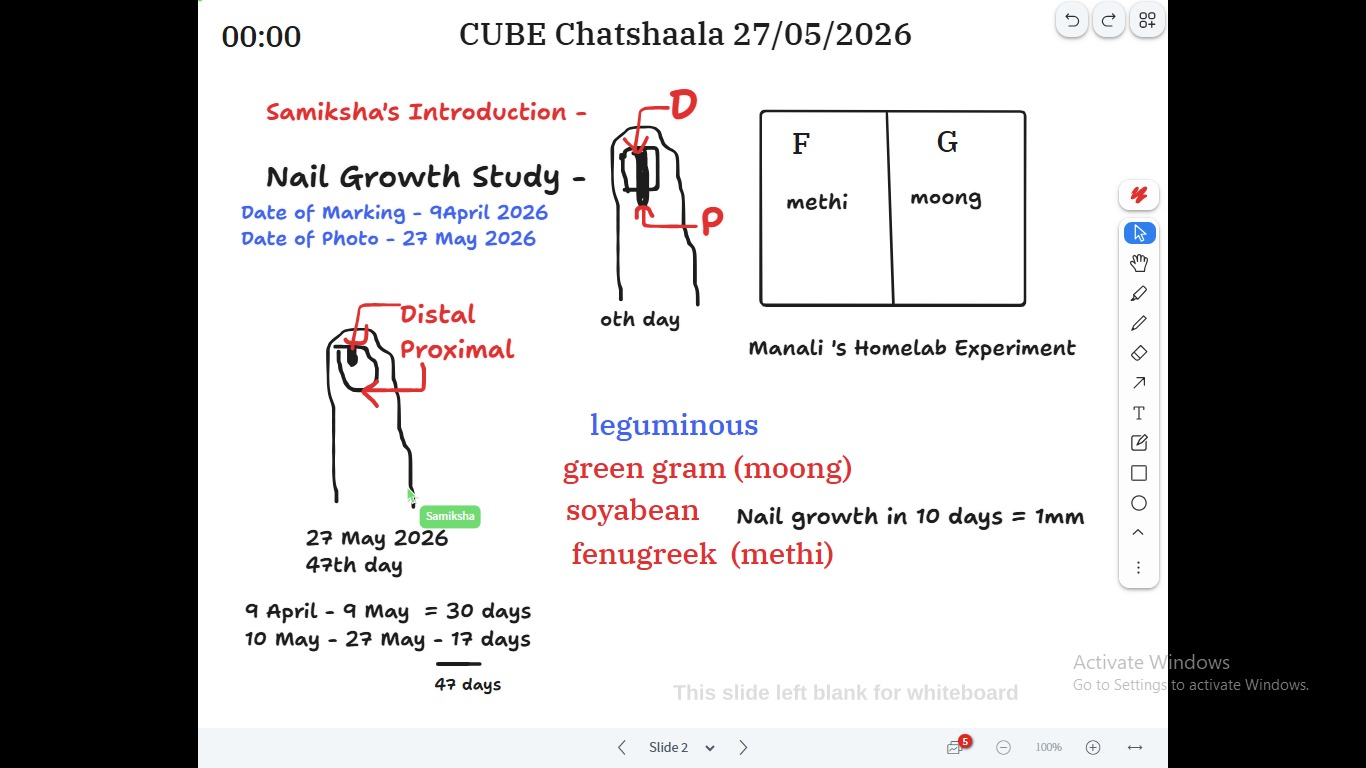
Sailekshmi had marked her nail on 9 April 2026 (Day 0) and photographed it again on 27 May 2026, which the group collectively worked out to be the 47th day. The day count was calculated step by step on the whiteboard: 9 April to 9 May equals 30 days, and 10 May to 27 May adds another 17 days, giving a total of 47 days. This seemingly small arithmetic exercise turned out to be a good teaching moment; participants had to think carefully about whether to count the start date, how to handle month boundaries, and why precision in day-counting matters for any longitudinal study.
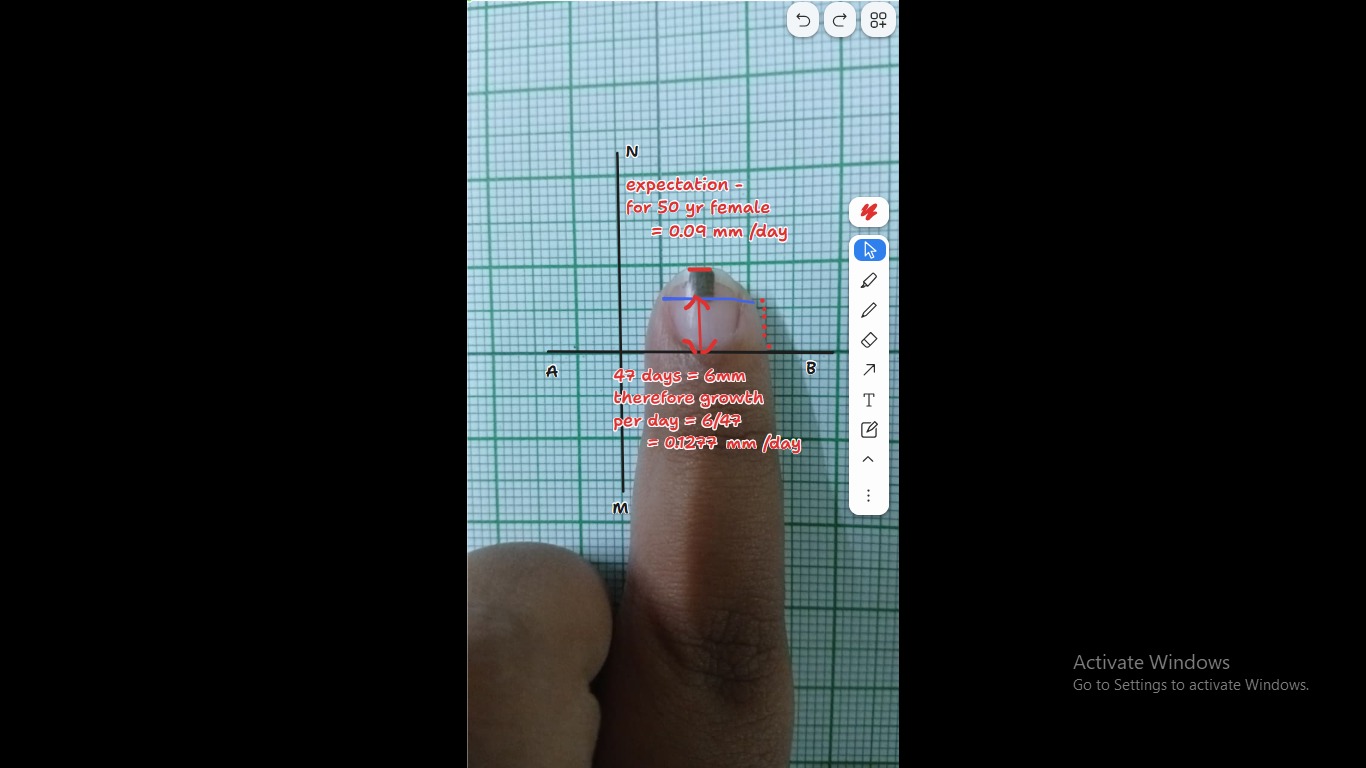
The measurement photograph (Image 2) showed Sailekshmi’s left hand index finger placed against graph paper with coordinate axes marked N–M (vertical) and A–B (horizontal). The graph paper was used as a scale reference, with one small square serving as the unit of measurement. The distance between the original ink mark (shown as a blue line) and the current position of the nail’s proximal edge (shown by red arrows) was measured to be 6 mm over 47 days. From this, the group calculated the rate of nail growth:
6 mm ÷ 47 days = 0.1277 mm per day
The whiteboard also clarified anatomical terminology. Participants discussed the distal end of the nail (the free-growing tip, marked “D”) and the proximal end (the root end near the skin, marked “P”). Understanding which end to measure from, and why, was an important conceptual point that came up organically during the discussion.
Interestingly, the whiteboard noted that “nail growth in 10 days = 1 mm” as a reference figure, likely from literature or a prior session, which, when compared with Sailekshmi’s result (0.1277 mm/day × 10 = approximately 1.277 mm/10 days), shows a reasonable agreement with general estimates, though slightly higher. This invited reflection on variation between individuals, fingers, and conditions.
The second major thread of the session centred on Manali’s Homelab Experiment, which compared the germination and early growth of two leguminous plants:
- F — Methi (Fenugreek)
- G — Moong (Green Gram)
The whiteboard listed the broader category these belong to, leguminous plants, and also referenced soyabean as another example. While detailed results from Manali’s experiment were not fully captured in today’s whiteboard notes, the experimental setup was noted and is presumably ongoing. The distinction between different legume species and why they might be chosen for comparison (e.g., seed size, germination speed, nitrogen fixation) was touched upon.
 Provocative Questions
-
Niharika measured growth from the proximal mark, but does nail growth actually occur at the proximal end, the distal end, or somewhere in between? What does the biology of the nail matrix tell us about where growth originates?
-
The reference figure on the whiteboard states “nail growth in 10 days = 1 mm,” which gives 0.1 mm/day. Sailekshmi’s data gives 0.1277 mm/day. Is this difference biologically significant, or is it within normal variation? What factors, such as age, nutrition, dominant hand, and finger used, might explain this difference?
-
Sailekshmi used graph paper as a measurement scale. How reliable is this method? What are the sources of error: parallax, photograph angle, and lighting, and how could the measurement be made more precise without expensive instruments?
-
Why were fenugreek (methi) and moong (green gram) chosen for Manali’s comparison experiment specifically? Is it because they are both legumes, both commonly available kitchen seeds, or both fast-germinating? What hypothesis is being tested?
-
All three plants mentioned, green gram, soyabean, and fenugreek, are leguminous. What common trait makes legumes particularly interesting for home lab germination studies? Does their nitrogen-fixing ability affect early seedling growth, and can that be observed without lab equipment?
-
The nail was marked on Day 0 (9 April). How do we know the mark itself did not shift due to nail trimming, damage, or pen fade over 47 days? How does Samiksha verify that the reference mark is still reliable at Day 47?
-
If we wanted to test whether nail growth rate changes over time (faster in summer, slower in illness, etc.), what would a better experimental design look like: weekly photographs, multiple fingers, or a controlled diary of diet and activity?
-
The coordinate axis system (N–M and A–B) is drawn on the graph paper in Image 2. Is this just a visual alignment aid, or does it serve a specific measurement function? Could it help correct for finger tilt or camera angle?
 What I Have Learned
The first is how much everyday biology lives in our own hands literally. Nail growth is something we all notice when nails get long and need cutting, but we rarely think of it as a measurable, trackable biological process. Sailekshmi’s work reframes something mundane into a rigorous question: how fast does the human nail grow, and how do we actually know? The answer turns out to require careful marking, consistent photography, accurate day-counting, and a measurement reference, none of which is trivial when you sit down to do it properly.
Second, I came to appreciate the value of a graph paper background as a low-cost but remarkably effective calibration tool. You do not need a microscope or a digital calliper to do meaningful science. A grid, a mark, a photograph, and patience are enough to produce a result (0.1277 mm/day) that is comparable to published estimates. That is a powerful message for anyone who thinks good science requires expensive equipment.
Third, the day-count calculation, though simple, reminded me that in longitudinal experiments, counting errors compound. Being off by even one day changes the rate slightly, and over longer experiments, such errors become significant. It is a good scientific habit to explicitly write down both the start and end dates, calculate the interval carefully, and state assumptions (do we count Day 0 or Day 1?).
Fourth, the connection drawn between Manali’s legume experiment and broader biology classifying moong and methi as leguminous plants alongside soyabean helped situate a kitchen-counter experiment within a real taxonomic and ecological framework. These are not just sprouting seeds; they are nitrogen-fixing organisms with a fascinating relationship with soil bacteria. Even if that layer of biology was not the focus today, naming the category correctly matters.
Finally, the distal vs. proximal terminology discussion was a reminder that precision in language is as important as precision in measurement. Using the correct anatomical terms, even in a home-science context, builds the habit of thinking clearly about what exactly is being described.
TINKE Moments (This I Never Knew Earlier)
TINKE 1 — Nails grow from the proximal end, not the tip
Many people intuitively assume nails “grow out” from the tip. The discussion of distal vs. proximal anatomy and the placement of the mark near the proximal fold prompted the realisation that growth occurs at the nail matrix (under the skin at the base), pushing the existing nail distally. The mark moves away from the cuticle as the nail grows — that is how the measurement works. This is not obvious until someone points it out.
TINKE 2 — 47 days is not “about a month and a half” — it is precisely countable
There was a moment in the session where the group paused to actually count the days rather than estimate. Breaking it into 9 April → 9 May (30 days) and 10 May → 27 May (17 days) and adding them carefully was a small but important discipline. The TINKE here is that in science, approximation and precision are not the same thing, and the difference between “roughly 45 days” and “exactly 47 days” changes the calculated rate.
TINKE 3 — Graph paper is a valid scientific instrument
The use of graph paper as a measurement reference in the photograph (Image 2) was initially surprising. However, it is actually a well-established technique in biology and ecology for scale reference in field photographs. The TINKE moment here is recognising that the quality of a tool is determined by how carefully it is used, not by how sophisticated it looks.
TINKE 4 — Leguminous plants share more than we think
The mention of fenugreek (methi), moong (green gram), and soyabean together under “leguminous” prompted a moment of recognition that these three very different-looking kitchen plants — one a leafy herb, one a bean sprout, one an oil cro belong to the same family with shared ecological properties. Manali’s experiment becomes far more interesting once you know what connects F and G beyond the fact that they are both seeds.
 Gaps and Misconceptions
Gap 1 — Results from Manali’s experiment not yet discussed
The whiteboard clearly set up a two-condition comparison (F = methi, G = moong), but today’s session did not present any germination data, measurements, or observations from that experiment. It is unclear whether the experiment is still in progress, whether data collection has begun, or what specific parameter (germination time, shoot length, root length, leaf count) is being measured. This is a significant gap that needs to be filled in a follow-up session.
Gap 2 — No mention of which finger was measured
Nail growth rates differ across fingers; the middle finger typically grows fastest, and the thumbnail grows slowest. Sailekshmi’s photograph shows what appears to be a thumb, but this was not explicitly stated or discussed. The finger used should be documented as part of the experimental record.
Gap 3 — No comparison with published data or peer discussion
While the reference “nail growth in 10 days = 1 mm” appeared on the whiteboard, the group did not explore where this figure came from (literature, a previous session, a different participant’s data). Comparing Samiksha’s result with other participants’ data or with published human nail growth rates (typically cited as 2–3 mm/month) would strengthen the scientific discussion considerably.
Misconception to address — “Nail growth = 1 mm in 10 days” as a universal constant
There is a risk that participants may walk away treating “1 mm per 10 days” as a fixed biological constant rather than an average or estimate. Nail growth varies with age, nutrition, health status, season, dominant hand, and even individual fingers. Sailekshmi’s result (approximately 1.277 mm per 10 days) is already slightly different, and that difference should be celebrated as data, not dismissed as error.
Misconception to address — The distal mark moves because the nail tip grows
As noted in the TINKE section, some participants may still be visualising nail growth incorrectly, imagining new material being added at the tip. Reinforcing the correct model (growth at the matrix, proximal movement of the mark relative to the cuticle) should be a priority in the next session.
 Photographs during Chatshaala