 CUBE Chatshaala - Discussion Summary
The CUBE Chatshaala session on September 17, 2026, brought together participants including Sailekshmi, Kiran, Diya, Raina Sayyed, Riya Sakat, Vatshla Singh, Yukti Manral, Prof. Arunan MC (B Desai Road, Mumbai), Himanshu Joshi, Divya, Chitralekha, and Anamika Soni from Chaitanya Sciences and Art College, Pamghar. The session centered on collaborative biological inquiry, data collection, and physical measurements recorded on the interactive whiteboard.
The group addressed several interconnected scientific topics:
-
Model Organisms & Life Cycles: The discussion revisited the life cycle of Drosophila melanogaster (fruit fly), emphasizing the importance of standardizing references.
-
Pathology and Medical Definitions: Participants examined pathology reports, including a case involving a 59-year-old male. The session also touched upon defining cardiac arrest using authoritative sources, specifically citing WHO standards.
-
Biological Growth Measurement (Nails): A major practical demonstration tracked human nail growth using a Henna/Mehndi stain as a baseline reference mark. Observations recorded for a 20-year-old female subject showed significant distal movement of the mark between April 9th and May 9th, demonstrating a simple, non-invasive method for measuring keratin growth rate.
-
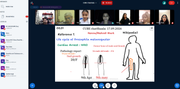
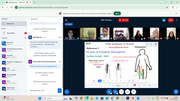
Anatomical Scale & Skeletal Proportion: The team discussed human skeletal dimensions, examining data for a 16-year-old male (height 5’4") with specific attention to the femur bone’s proportions in relation to the whole bodyThe whiteboard illustration highlighted the femur’s anatomical position.
 Provocative Questions
-
How can citizen science techniques—such as tracking Henna stain movement on nails—be standardized across diverse demographics to yield scientifically rigorous physiological growth data?
-
When evaluating skeletal measurements (such as the femur length relative to total height in a growing 16-year-old male), what biological variables account for variations in proportion across sex and age groups?
-
Why is relying on open, crowdsourced platforms like Wikipedia insufficient for precise medical or epidemiological definitions (such as WHO’s clinical definition of cardiac arrest), and how should researchers evaluate source credibility?
 What I Have Learned
-
Simple Markers for Growth Tracking: I learned that temporary epidermal or keratin stains, such as Henna/Mehndi, serve as efficient, low-cost baseline indicators to measure longitudinal tissue growth over time without specialized laboratory equipment.
-
Cross-Scale Biological Inquiry: The session demonstrated how small-scale observations (nail growth rates) can be integrated alongside macro-scale anatomy (femur proportions) and organismal life cycles (Drosophila melanogaster) within the same analytical framework.
-
Critical Reference Selection: Validating definitions from recognized organizations like the WHO rather than unverified online sources is vital for maintaining rigor in pathology and medical discussions.
 TINKE Moments (This I Never Knew Earlier)
-
TINKE 1 — The Henna Nail Growth Assay: Discovering that an everyday cultural application like a Henna/Mehndi mark can double as a quantitative tool to track human fingernail movement over a 30-day period (April 9 to May 9) was an eye-opening example of frugal, accessible science.
-
TINKE 2 — Visualizing Skeletal Proportions: Mapping the femur bone directly onto a full-body silhouette provided an intuitive realization of how single long-bone measurements correlate with total body stature in growing adolescents.
 Gaps and Misconceptions
-
Gap — Lack of Precise Quantitative Metrics on Nail Growth: While the whiteboard illustrates the progression of the Henna mark from April 9th to May 9th, it lacks a precise linear measurement scale (such as millimeters per day) alongside the visual diagram. Adding a physical ruler to future photodocumentation will improve data quality.
-
Misconception — Source Ambiguity for Medical Definitions: Using general internet sources or Wikipedia for clinical concepts like cardiac arrest can lead to imprecision. The session emphasized that clinical definitions must strictly align with validated medical criteria (e.g., WHO guidelines).
 Photographs during Chatshaala
 Referance