 CUBE ChatShaala Summary – Journeys, Rhythms, and Reflections
Date: 10th September 2025
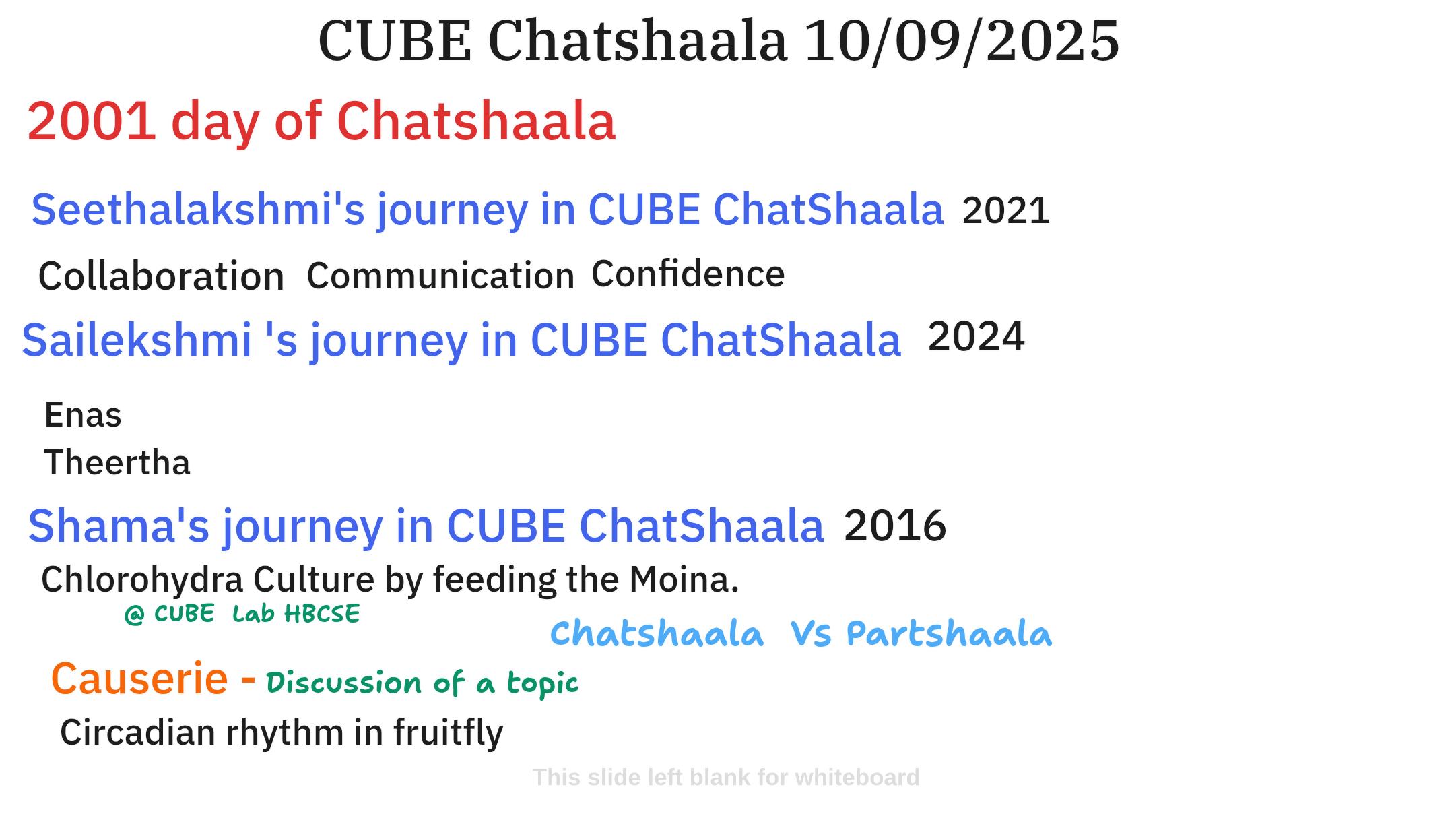
Event: 2001st Day of ChatShaala
 Highlights of the Session
- Journeys in CUBE ChatShaala
-
Seethalakshmi (2021): Reflected on how CUBE enhanced collaboration, communication, and confidence.
-
Sailekshmi (2024): Shared her evolving journey, mentioning peers like Enas and Theertha, showing how learning happens in community spaces.
-
Shama (2016): Presented her pioneering work on Chlorohydra culture using Moina as feed at CUBE Lab, HBCSE.
- Causerie (Discussion of a Topic):
- Circadian rhythm in fruit flies became the central point of exploration.
- Fruitfly Experiments (2017 onwards):
-
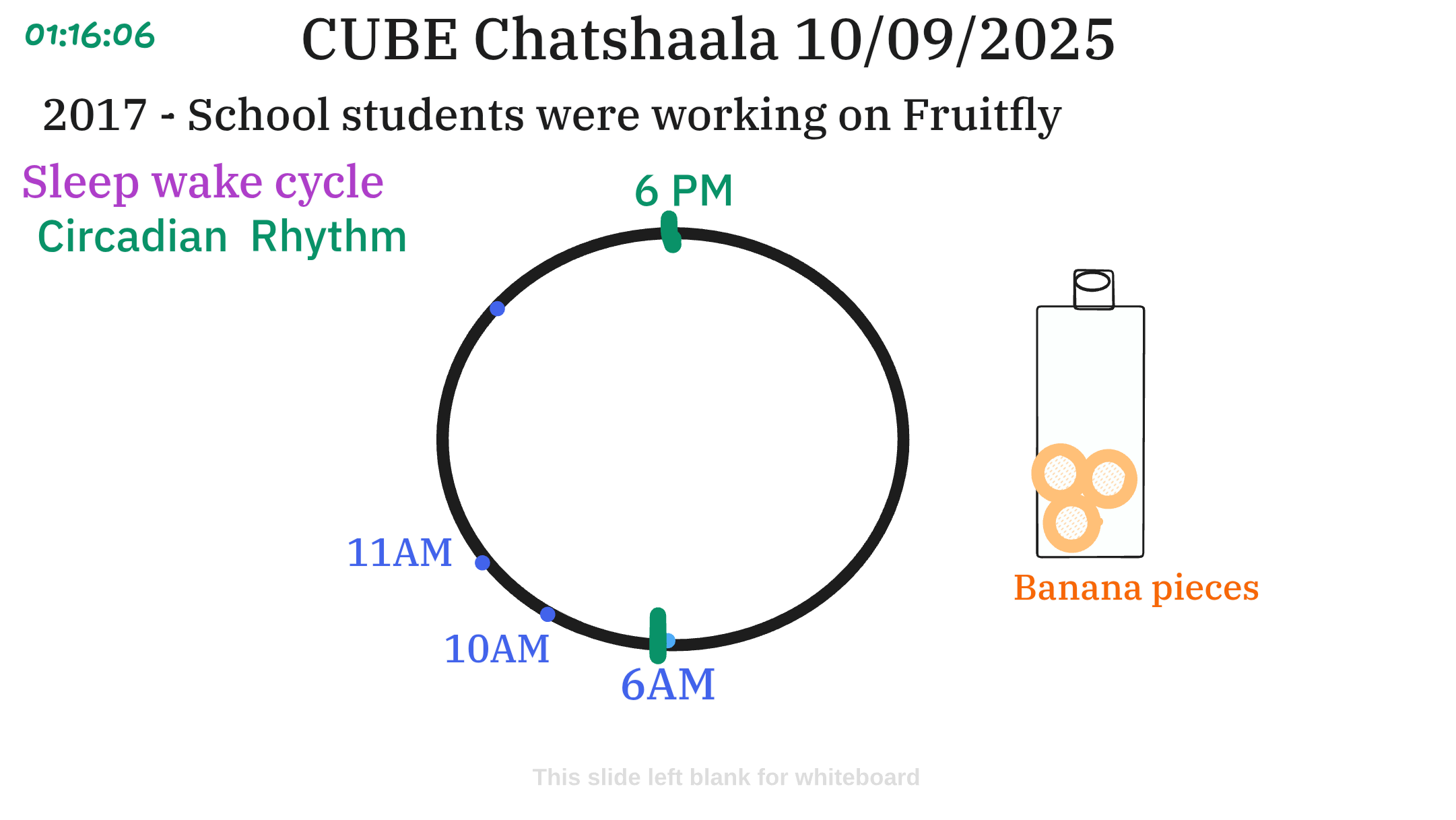
School students studied the sleep–wake cycle of fruit flies using simple setups like banana pieces in bottles.
-
The diagram highlighted specific time points (6 AM, 10 AM, 11 AM, 6 PM) showing how fruit fly activity peaks follow a daily rhythm.
- Meta-reflection:
- The difference between ChatShaala and PartShaala was discussed, reinforcing how informal conversations (ChatShaala) spark deeper structured studies (PartShaala).
 What I Learned Today
- Learning is not just about experiments but also about the journeys of individuals—how communication, collaboration, and persistence build scientific temper.
- Fruit flies, though simple organisms, mirror complex biological rhythms, making them excellent models for studying circadian cycles.
- Science in CUBE is deeply democratic and participatory—students, teachers, and mentors together contribute knowledge.
 TINKE Moments (This I Never Knew Earlier)
-
Fruit flies show daily activity peaks that can be linked with human sleep–wake cycles.
-
Banana pieces are not just food but an accessible tool to culture flies, making high-end labs unnecessary.
-
Journeys of members are as valuable as data—they sustain motivation and community growth.
 Gaps and Misconceptions Identified
-
Many still confuse ChatShaala with PartShaala, not realizing the importance of informal exploratory conversations before formal research.
-
There is limited clarity about how exactly to record circadian rhythm data—whether observation times are sufficient or whether more systematic quantification is needed.
-
Misconception that fruit fly studies are too complex for school students—when in reality, CUBE’s history shows otherwise.
 Provocative Questions for the Community
-
If tiny fruit flies follow a daily rhythm, do humans and other organisms share a universal “biological clock”?
-
How can simple models like fruit flies and banana pieces challenge the notion that science requires sophisticated labs?
-
What sustains a scientific community more—data from experiments or personal journeys of learners?
-
Should we view ChatShaala as the “soil” and PartShaala as the “plant” that grows from it?
 Reference
@Arunan @2020ugchsncnseethala @magpie @dhanraj7 @GN @SN1261 and others.