CUBE ChatShaala – Discussion Summary (02.04.2026)
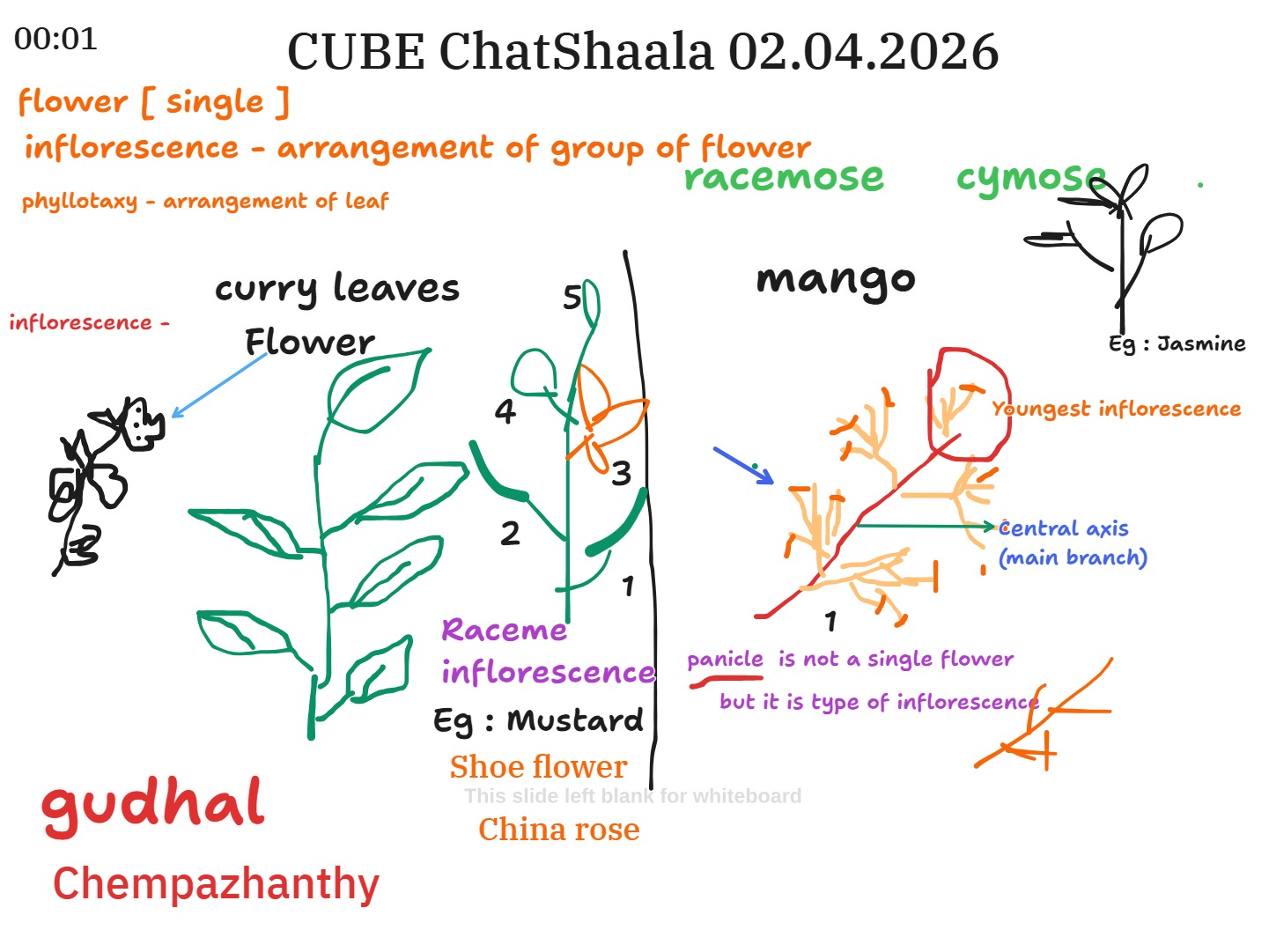
Today’s ChatShaala session focused on the fascinating topic of flowers and inflorescence types. The group began by distinguishing between a single flower and an inflorescence, emphasizing that inflorescence refers to the arrangement of a group of flowers on a plant. This naturally led to a comparison with phyllotaxy, which describes the arrangement of leaves.
Two major categories of inflorescence were highlighted:
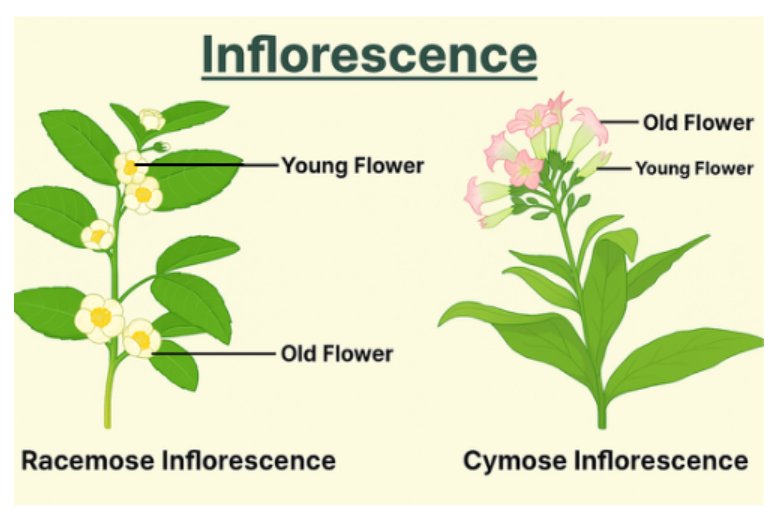
- Racemose inflorescence – where the main axis continues to grow, and younger flowers are found towards the tip. Examples discussed included mustard and curry leaves.
- Cymose inflorescence – where the main axis ends in a flower, and growth continues from lateral branches. Examples included jasmine and China rose (also known as shoe flower).
Participants examined specific plants such as mango, which displays a panicle inflorescence. It was clarified that a panicle is not a single flower but a branching type of inflorescence. The diagrams illustrated how the central axis and the position of the youngest flowers help in identifying the type of inflorescence.
The discussion also touched upon familiar plants like gudhal and chempazhanthy, connecting everyday observations with botanical terminology. The whiteboard notes encouraged participants to visualize and compare structures, reinforcing the importance of observation in learning plant morphology.
 Provocative Questions
-
How does the position of the youngest flower help us distinguish between racemose and cymose inflorescence?
-
Why might plants evolve different inflorescence types instead of relying on single flowers?
-
In what ways does inflorescence structure influence pollination strategies?
-
Can we connect phyllotaxy (leaf arrangement) with inflorescence patterns to see broader design principles in plants?
-
How does the branching pattern in mango panicles compare to the simpler raceme of mustard?
-
What role does human observation of common plants (like curry leaves or jasmine) play in democratizing botanical knowledge?
 What I Have Learned
-
Inflorescence is a collective arrangement of flowers, distinct from a single flower.
-
The two main types—racemose and cymose—differ in growth direction and flower positioning.
-
Everyday plants such as curry leaves, mustard, jasmine, and mango provide excellent examples to study these concepts.
-
The panicle inflorescence in mango is a branching system, not a single flower, which clears up a common misconception.
-
Observing plants around us is a powerful way to connect theory with practice, making botanical learning more accessible.
 TINKE Moments
-
Realizing that panicle is not a flower but a type of inflorescence was a striking clarification. Many participants initially assumed panicles were single flowers.
-
The distinction between racemose and cymose based on the position of the youngest flower was a subtle but crucial insight.
-
The connection between phyllotaxy (leaf arrangement) and inflorescence (flower arrangement) sparked curiosity about broader plant design principles.
-
Using common plants like curry leaves and jasmine as teaching tools highlighted the importance of citizen science—learning from what grows around us rather than relying only on textbooks.
 Gaps and Misconceptions
-
Some participants confused single flowers with inflorescence, underscoring the need for clearer visual comparisons.
-
The idea that a panicle might be a single flower revealed a gap in understanding, which was corrected during the session.
-
There was limited discussion on why plants evolve different inflorescence types, leaving room for deeper exploration of ecological and evolutionary perspectives.
-
The relationship between phyllotaxy and inflorescence was mentioned but not fully unpacked, suggesting a potential area for future sessions.
 Photograph during ChatShaala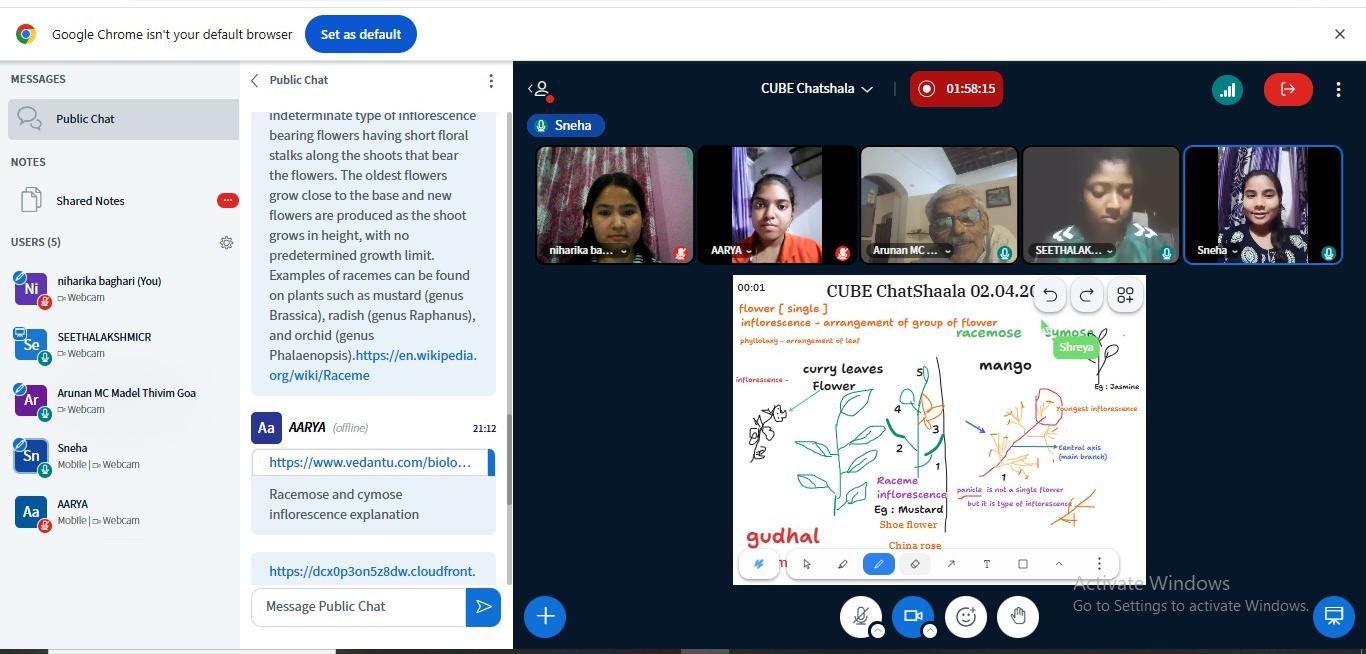
 Reference