 CUBE Chatshaala - Discussion Summary
The CUBE ChatShaala session on 28 February 2026 was dedicated to the National Science Day Celebrations, weaving together themes of Nobel Prize discoveries, genetic regulation, bacteriophage biology, and the role of women in science.
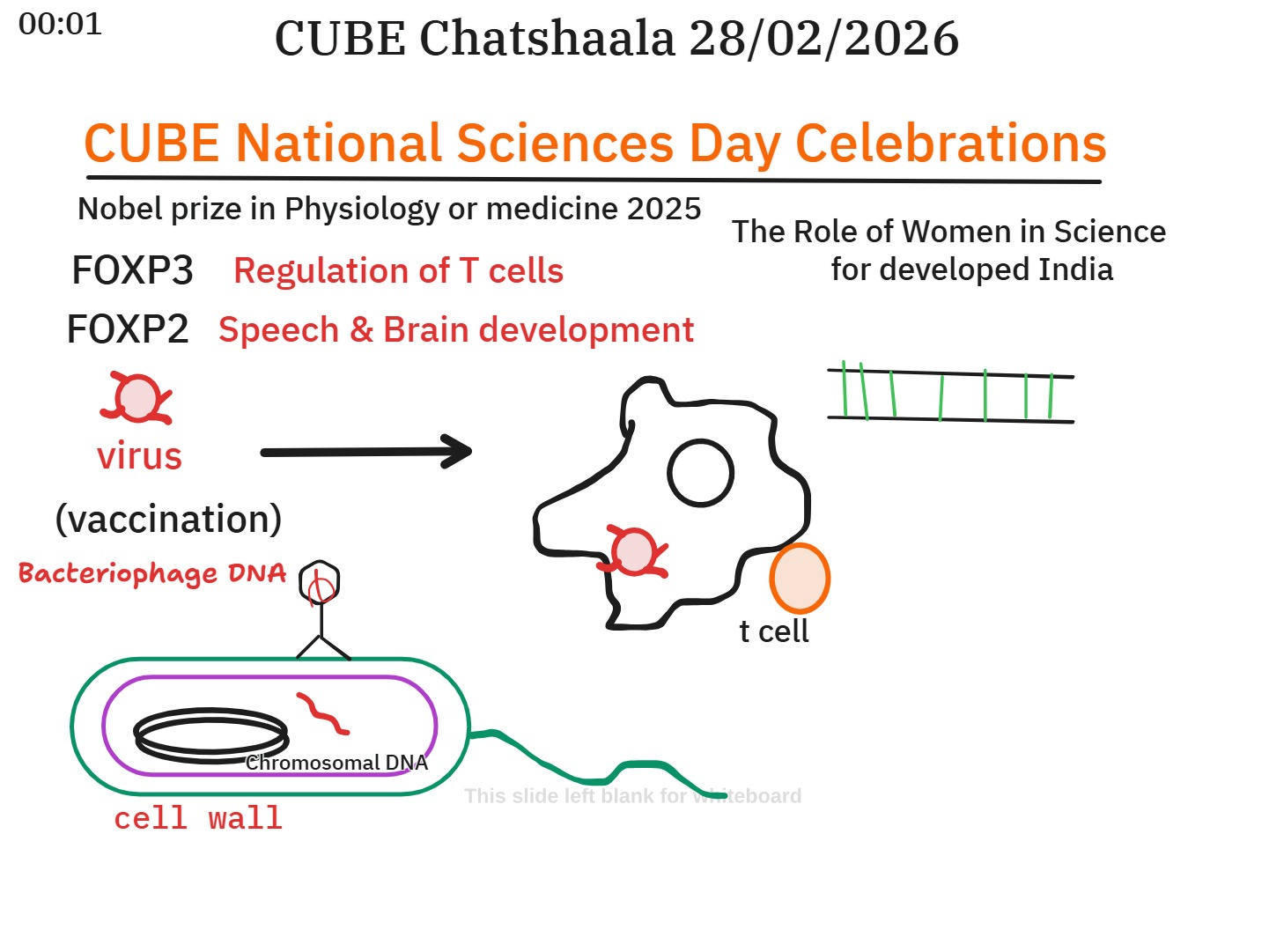
The discussion began with the 2025 Nobel Prize in Physiology or Medicine, awarded to Mary E. Brunkow, Fred Ramsdell, and Shimon Sakaguchi for their work on peripheral immune tolerance. This discovery highlighted the importance of the FOXP3 gene, which regulates T cells and prevents the immune system from attacking the body’s own organs. The Cubists investigated how this breakthrough relates to broader immunological processes, such as vaccination and viral interactions with host cells.
The FOXP2 gene, which plays a role in speech and brain development, sparked discussions about the intersection of genetics, language, and cognition. The cubists considered how two genes, FOXP3 and FOXP2, represent distinct but equally transformative aspects of human biology: immunity and communication.
The session also covered bacteriophages, viruses that infect bacteria by attaching to their cell walls and injecting DNA. This provided a vivid example of host-pathogen interactions and genetic transfer, connecting molecular biology to practical applications in biotechnology and medicine.
Finally, the conversation recognized the contributions of women in science, particularly Dr. Janaki Ammal, India’s pioneering cytogeneticist who bred high-yield sugarcane and promoted indigenous environmental approaches. Her legacy was contrasted with the fact that no Indian woman has yet received a Nobel Prize in science, emphasizing the importance of greater recognition and support for women scientists in India’s development journey.
 Provocative Questions
-
How does the regulation of T cells by FOXP3 reshape our understanding of autoimmune diseases and potential therapies?
-
Could FOXP2’s role in speech and cognition provide insights into the genetic basis of human culture and communication?
-
In what ways might bacteriophages be harnessed as alternatives to antibiotics in combating resistant bacterial infections?
-
Why has no Indian woman yet won a Nobel Prize in science, despite pioneers like Janaki Ammal, and what systemic changes are needed to address this gap?
-
How can the celebration of National Science Day be used as a platform to inspire young women to pursue careers in genetics, microbiology, and plant sciences?
 What I Have Learned
-
Immune tolerance is a delicate balance, and FOXP3 plays a central role in preventing self-destruction by the immune system.
-
Genes like FOXP2 remind us that biology is not only about survival but also about the evolution of communication and thought.
-
Bacteriophages are powerful natural tools that can be repurposed for modern medicine, offering hope against antibiotic resistance.
-
The story of Janaki Ammal illustrates both the brilliance of Indian women scientists and the structural barriers that have limited their global recognition.
-
Science is not just about discovery—it is also about equity, representation, and the societal impact of knowledge.
 TINKE Moments (This I Never Knew Earlier)
-
Learning that FOXP3 mutations can lead to severe autoimmune disorders, emphasizing its critical role in immune regulation.
-
Discovering the direct link between FOXP2 and human speech development, which bridges genetics and linguistics.
-
Realizing that bacteriophages inject DNA into bacteria, a process that has profound implications for genetic engineering and therapy.
-
Understanding that despite her groundbreaking work, Janaki Ammal never received a Nobel Prize, highlighting the historical under-recognition of women in science.
 Gaps and Misconceptions
-
Some participants initially assumed FOXP3 and FOXP2 were related genes due to their similar names, but they function in entirely different biological domains.
-
There was a misconception that bacteriophages simply “kill” bacteria; in reality, they inject DNA and hijack bacterial machinery, which is a more nuanced process.
-
The discussion revealed a gap in awareness about the systemic barriers faced by women scientists in India, particularly regarding recognition at the global level.
 Photographs during Chatshaala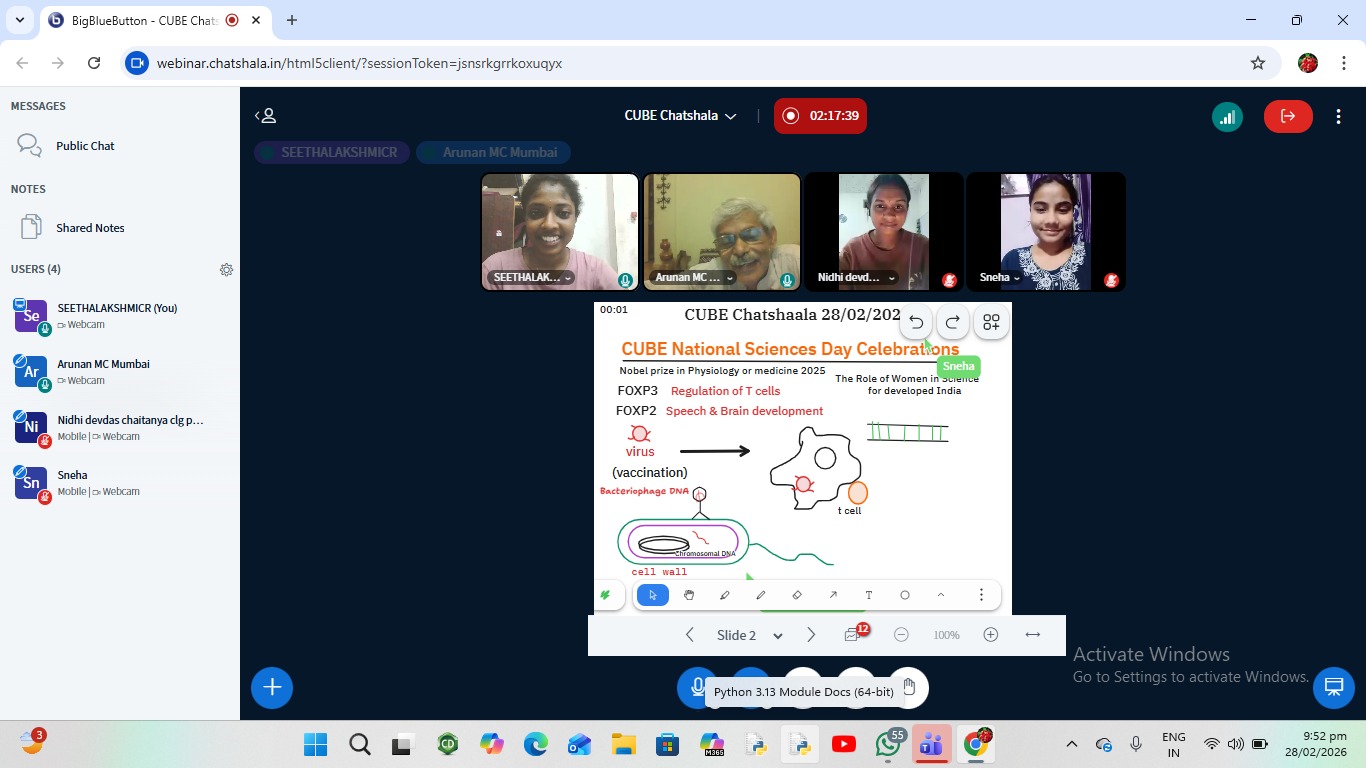
 Reference