 CUBE Chatshaala – Discussion Summary (18.03.2026)
Today’s ChatShaala centered on the seasonal flowering of mango trees in different regions of India, with a particular focus on Churchgate, Mumbai, where participants observed mango trees beginning to flower in March. This observation sparked a wider discussion about regional variations in mango cultivation and the famous varieties from the Konkan region—Hapus, Ratna, and Badami.
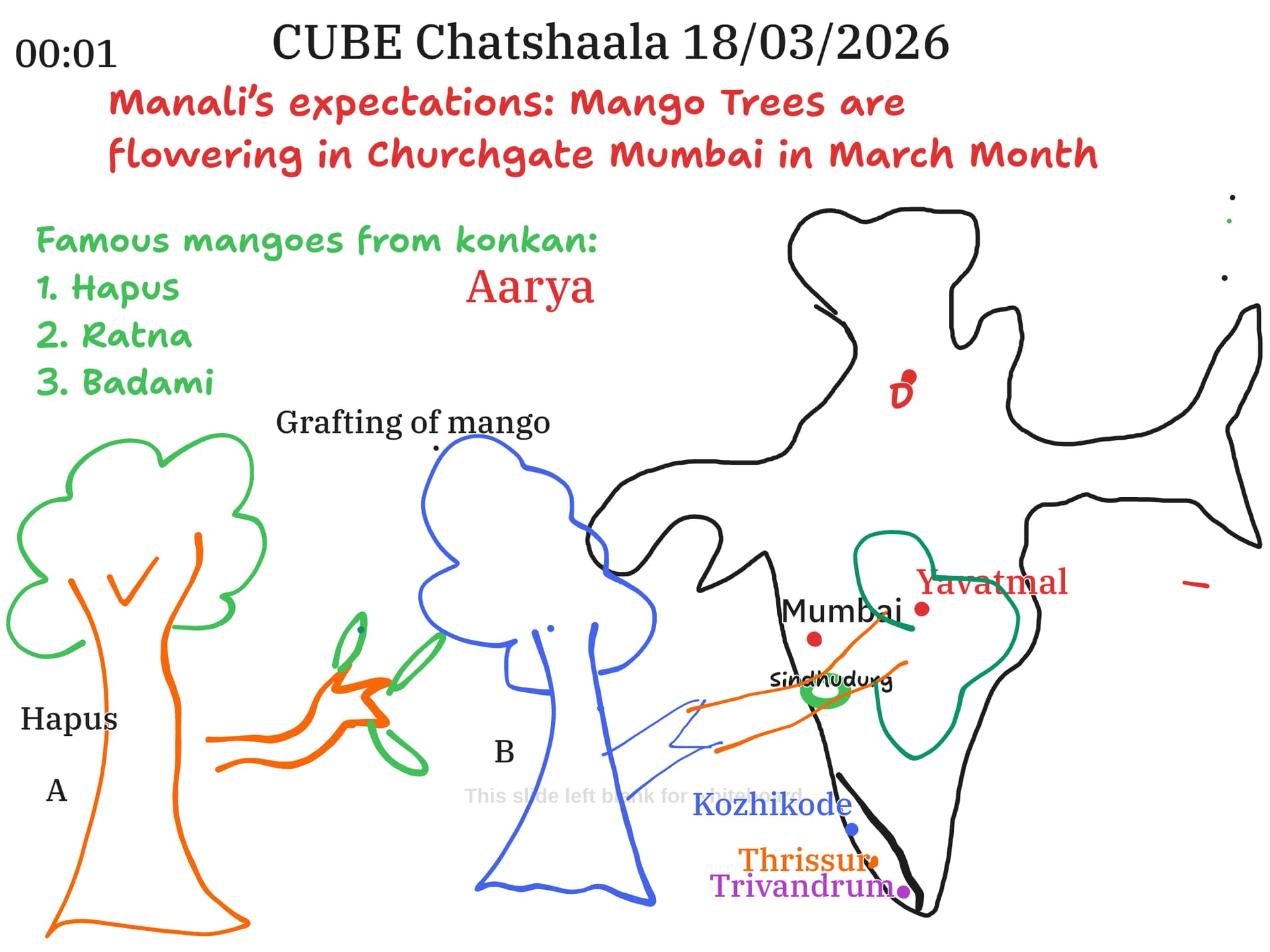
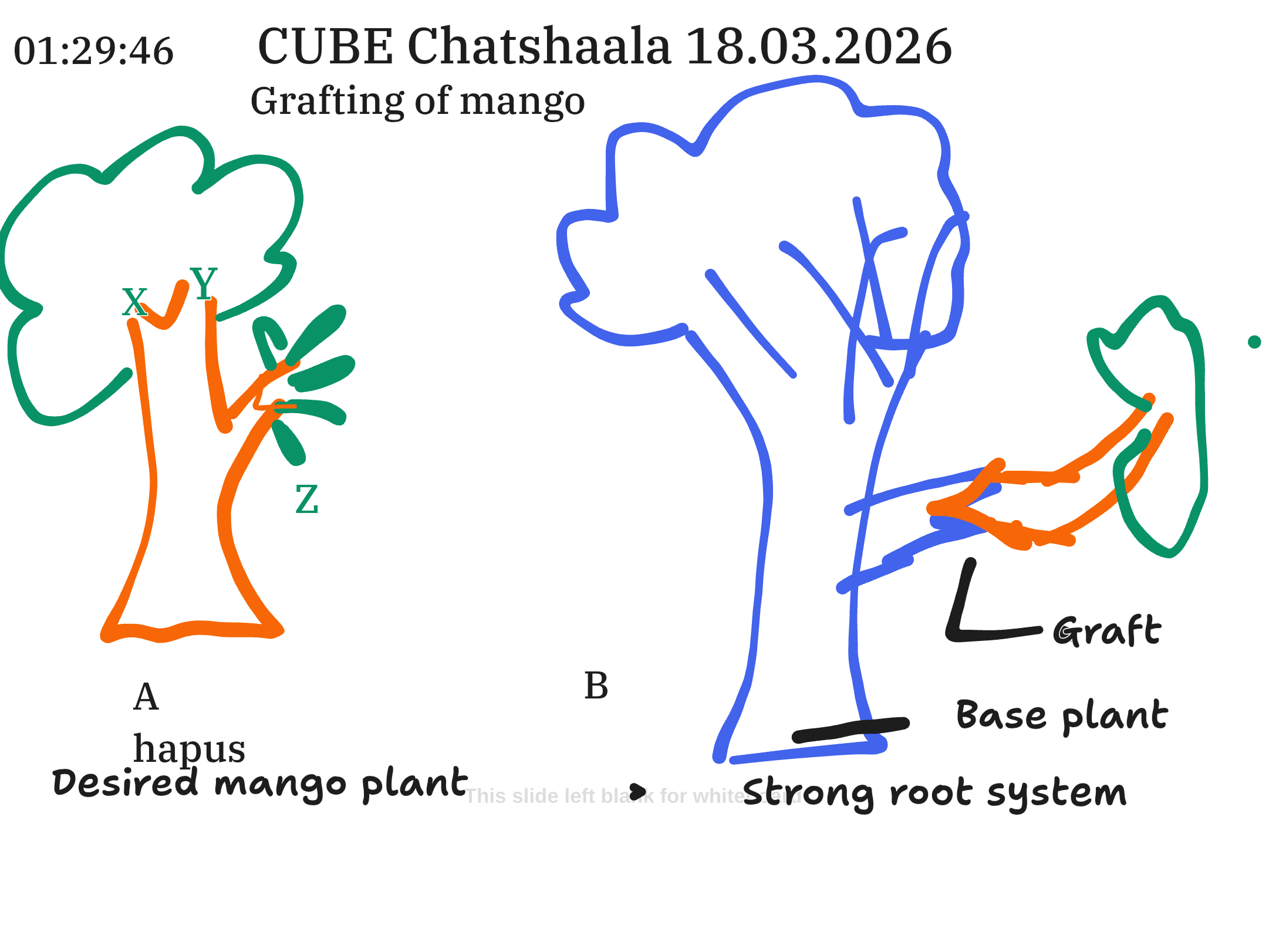
The cubists explored the horticultural practice of grafting, using diagrams to illustrate how a desirable mango variety (such as Hapus) can be grafted onto a base plant with a stronger root system. This technique allows farmers to combine the best traits of two plants: high-quality fruit from one and resilience from another.
The conversation also touched on geographical diversity, with participants mapping mango-related observations across cities such as Sindhudurg, Yavatmal, Kozhikode, Thrissur, and Trivandrum. This mapping exercise highlighted how climate and local conditions influence flowering times and fruit quality.
Additionally, the session briefly connected to cultural botany by noting the Golden Shower Tree (Cassia fistula), known locally as Kanikonna, which blooms during the Vishu festival in Kerala. This added a cultural dimension to the botanical discussion, linking plant biology with traditions and seasonal celebrations.
Provocative Questions
-
Why do mango trees in coastal regions like Mumbai flower earlier than those in inland areas such as Yavatmal?
-
How does grafting influence the long-term productivity and disease resistance of mango orchards?
-
Could mapping flowering times across India help predict climate change impacts on fruiting cycles?
-
What role do cultural festivals, like Vishu with the Kanikonna flower, play in shaping our awareness of seasonal plant biology?
-
How might citizen science initiatives expand our understanding of regional variations in mango flowering and fruiting?
-
Is there a risk that grafting for commercial varieties (like Hapus) could reduce genetic diversity in mango populations?
What I Have Learned
-
Mango flowering is highly dependent on regional climate, with coastal areas often showing earlier blooms.
-
Grafting is a powerful agricultural technique that merges desirable fruit traits with strong root systems, ensuring both quality and resilience.
-
Mapping observations across multiple cities provides valuable insights into how geography and climate shape plant behavior.
-
Cultural traditions, such as Vishu in Kerala, are deeply intertwined with plant biology, reminding us that science and culture often reinforce each other.
-
Citizen science discussions like ChatShaala can democratize research, making complex horticultural practices accessible to non-specialists.
 TINKE Moments (This I Never Knew Earlier)
-
Early flowering in Mumbai: The realization that mango trees in Churchgate flower as early as March challenged assumptions about uniform flowering times across India.
-
Grafting clarity: The diagrammatic explanation of grafting helped participants visualize how two plants are combined, making the concept more tangible than abstract descriptions.
-
Cultural-botanical link: Learning that the Vishu flower (Cassia fistula) is also known as the Golden Shower Tree, with multiple English names, expanded the group’s understanding of how plants carry both scientific and cultural identities.
 Gaps and Misconceptions
-
Some participants assumed mango flowering occurs uniformly across India, but today’s mapping exercise revealed significant regional variation.
-
There was limited discussion on the ecological risks of grafting, such as reduced genetic diversity, which could be explored further.
-
The connection between climate change and shifting flowering patterns was only briefly mentioned and deserves deeper investigation.
 Reference