 CUBE ChatShaala - Discussion Summary
During today’s special Teacher’s Day session on September 5, 2026, the CUBE ChatShaala discussion focused on Niharika defining the core distinctions between foundational biological sciences namely anatomy, physiology, and morphology while integrating interdisciplinary perspectives from Bachelor of Physiotherapy (BPT) domains, including biomechanics, sociology, and psychology. The session opened with fundamental conceptual frameworks led by Arunan MC, emphasizing that anatomy relies strictly on structural breakdown and dissection (“to cut up”) at both gross and microscopic scales. In contrast, physiology details dynamic functional mechanisms, and morphology governs external physical form.
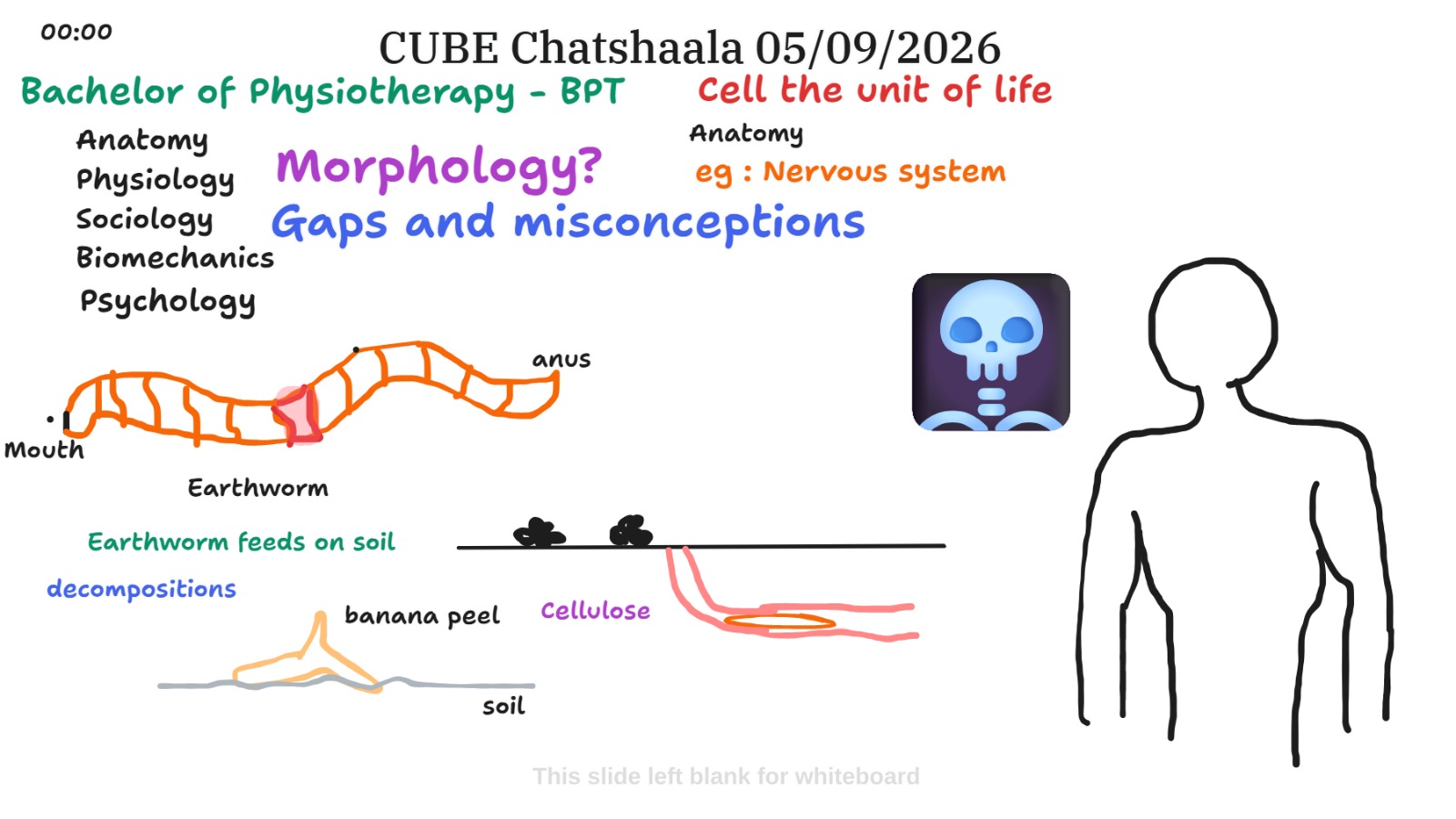
To anchor these abstract principles in empirical practice, the discussion transitioned to invertebrate neurobiology using the earthworm as a primary model organism. Participants mapped out the structural organization of the earthworm’s nervous system, highlighting its paired cerebral ganglia, circumpharyngeal connectives, sub-pharyngeal ganglion, and ventral nerve cord running along the segmented body. Expanding on this structural base, the group evaluated the organism’s ecological role in soil decomposition. This sparked a detailed examination of agricultural organic waste, specifically banana peel composition, focusing on its high concentration of dietary fiber, potassium, magnesium, and cellulose, and how soil fauna break down such complex plant polymers. Active session contributors included moderators Arunan MC and Aarya, along with presenters and participants M S Sailekshmi, Niharika Baghari, and Aarya Takke.
 Provocative Questions
-
How does the spatial arrangement of the earthworm’s ventral nerve cord relative to its alimentary canal adapt it for ground burrowing compared to the dorsal nerve cord found in vertebrates?
-
In what ways do biomechanical forces experienced by burrowing earthworms influence their cellular morphology and physiological feedback loops during soil decomposition?
-
If banana peel decomposition relies heavily on breaking down cellulose, what specific enzymatic or microbial shifts must occur within the earthworm gut to convert complex organic matter into accessible nutrients?
-
How can interdisciplinary approaches—combining biomechanics and neurophysiology—refine our understanding of movement dynamics across simple invertebrate models versus human physical therapy contexts?
 What I Have Learned
-
Structural Disconnection vs. Functional Integration: Anatomy provides the static framework through physical observation and dissection, but functional understanding requires overlaying physiological mechanisms and biomechanical motion.
-
Organismal Neurobiology: Invertebrate nervous system architecture, such as the paired cerebral ganglia and ventral nerve cord of the earthworm, demonstrates how centralized nervous control can operate efficiently without a complex vertebrate brain structure.
-
Ecological Mechanics of Decomposition: Soil dynamics depend heavily on the biochemical conversion of complex polymers (like cellulose in banana peels) through the combined digestive action of soil fauna and microbial symbionts.
 TINKE Moments (This I Never Knew Earlier)
-
Connecting Fiber Dynamics to Soil Biology: Realizing how dietary components of kitchen waste (such as potassium and cellulose in banana peels) serve as direct inputs for earthworm-mediated decomposition, linking human nutritional biochemistry directly to soil ecosystem dynamics.
-
Interdisciplinary Bridge: Recognizing that principles taught in Bachelor of Physiotherapy (BPT)—such as biomechanics and physiological responses—apply fundamentally across simple model organisms when evaluating movement and physical stress.
 Gaps and Misconceptions
-
Conflating Morphology with Anatomy: A recurring point of confusion was treating external form (morphology) and internal structural dissection (anatomy) as interchangeable terms rather than distinct levels of biological organization.
-
Oversimplifying Soil Feeding: Assuming earthworms feed solely on dirt particles, missing the necessary physiological mechanisms required to digest complex plant matter like cellulose and facilitate nutrient cycling.
-
Invertebrate vs. Vertebrate Nervous Systems: Misinterpreting the ventral position of the invertebrate nerve cord as analogous to the dorsal nerve cord of vertebrates, overlooking the distinct evolutionary and structural implications of each layout.
 Photographs during ChatShaala


 Reference